


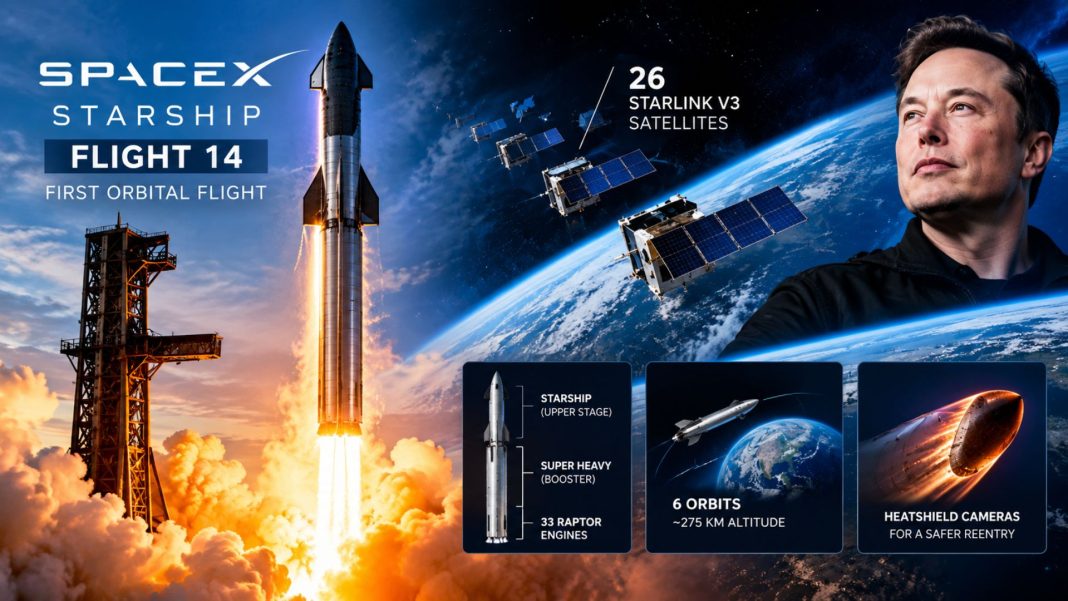

Elon Musk’s SpaceX Makes History: In a monumental leap for space exploration, Elon Musk’s SpaceX successfully launched Starship, the world’s most powerful rocket, for its 14th test flight. The mission lifted off on September 28 at 6:16 PM IST.
Unlike previous test flights that were strictly limited to sub-orbital trajectories to gather data and ensure safety, this landmark test pushed Starship into Earth’s orbit for the very first time.
What Makes This Flight a Game-Changer?
Reaching Full Orbit for the First Time
Elon Musk’s SpaceX Makes History: For all earlier flights, SpaceX kept Starship on a sub-orbital path, meaning the rocket reached the edge of space but naturally fell back to Earth without fully circling the planet.
Sub-Orbital Trajectory: Reaches space altitude but falls back without orbiting.
Orbital Trajectory: Balances speed and gravity to continually orbit the Earth.
This 14th flight broke that barrier. By reaching true orbital trajectory, Starship traveled at the exact speed and angle required to balance Earth’s gravitational pull, allowing it to orbit the planet multiple times.
A 10-Hour Journey Around the World
Target Altitude: Floating roughly 275 kilometers above the Earth.
Duration & Orbits: A 10-hour flight plan carrying the vehicle through 6 complete orbits around the globe.
Final Destination: A planned, safe splashdown landing in the Pacific Ocean near the coast of Chile.
Payload Progress: Deploying Next-Gen Starlink V3 Satellites
Elon Musk’s SpaceX Makes History: This mission marks the first operational test where Starship released 26 newly engineered Starlink V3 satellites into space.
Unprecedented Internet Capacity
Massive Bandwidth: Each Starlink V3 unit adds 1 Terabit per second (1 Tbps) of data capacity to the network.
Total Mission Boost: This single launch injects 26 Tbps into SpaceX’s constellation, nearly 10 times the capacity delivered by legacy Falcon 9 launches.
Deployment Sequence: Upon release, the satellites unfold their solar panels and antennas, establish contact via radio waves and lasers, and use onboard thrusters to reach their final orbits.
Cameras in Space: Monitoring the Heatshield
Elon Musk’s SpaceX Makes History: 3 of the 26 satellites are modified with specialized, high-tech camera gear. Instead of focusing only on ground communications, these units point back toward Starship to scan its protective thermal heatshield.
By capturing real-time images during atmospheric re-entry, ground engineers gather critical structural data needed to safely catch and re-use Starship on future launchpads.
Rocket Anatomy: The Giants of Boca Chica
Elon Musk’s SpaceX Makes History: Collectively called Starship, the full vehicle stands at an incredible 403 feet tall and consists of two main stages:
Super Heavy Booster (Lower Stage): Houses the 33 Raptor engines responsible for lifting the massive payload off the pad.
Starship Spacecraft (Upper Stage): The payload vehicle designed for deep-space transport, re-entry, and precise landings.
The Evolutionary Road: How SpaceX Reached Flight 14
Elon Musk’s SpaceX Makes History: SpaceX’s development philosophy relies on rapid prototyping, testing to failure, collecting real-world flight data, and upgrading the design. Here is a timeline showing how tests 1 through 13 paved the way for this orbital breakthrough.
The Foundation & Early Hurdles (Flights 1 to 5)
Flight 1 (April 20, 2023): The initial orbital attempt exploded 4 minutes after launch due to stage separation failure, but confirmed the pad launch dynamics.
Flight 2 (November 18, 2023): Successfully tested the new hot-staging separation technique. Both stages experienced anomalies later in flight, but all 33 Raptor engines fired cleanly off the pad.
Flight 3 (March 14, 2024): Reached space and successfully tested internal propellant transfer and payload door operations before losing signal during re-entry.
Flight 4 (June 6, 2024): Successfully survived intense re-entry heating despite damaged flaps, achieving a soft splashdown in the ocean.
Flight 5 (October 13, 2024): Made global headlines as the Mechazilla chopstick arms caught the returning Super Heavy booster live at the launchpad.
Refining Re-entry & Recovery (Flights 6 to 9)
Flight 6 (November 20, 2024): Witnessed by Donald Trump, this test verified in-space engine re-ignitions and executed a controlled ocean splashdown when catch parameters fell short of safety margins.
Flight 7 (January 17, 2025): The booster returned safely to the launchpad, though an upper-stage oxygen leak caused a loss of the spacecraft mid-flight.
Flight 8 (March 7, 2025): Booster caught at the pad; upper stage suffered engine dropouts, triggering an automated abort over air corridors.
Flight 9 (May 28, 2025): Booster performed a hard sea landing; spacecraft lost control 30 minutes into flight during atmospheric re-entry.
Scaling Up & Deploying Payloads (Flights 10 to 13)
Static Fire Anomaly (June 29, 2025): A ground test explosion temporarily paused testing, destroying a prototype upper stage on the pad.
Flight 10 (August 27, 2025): A complete 66-minute success, deploying dummy Starlink simulator payloads and relighting engines in space.
Flight 11 (October 14, 2025): Successfully tested water landings for both the booster (Gulf of Mexico) and Starship (Indian Ocean) alongside dummy payload deployments.
Flight 12 (May 23, 2026): Debuted the larger Starship V3 model. Despite an early engine malfunction, the ship survived re-entry and completed its target splashdown in the Indian Ocean.
Flight 13 (July 25, 2026): Executed a perfect vertical splashdown in the Indian Ocean. The upper stage righted itself from its signature “belly-flop” maneuver before settling gently onto the water.
Looking Forward: What Happens Next?
Elon Musk’s SpaceX Makes History: With Flight 14, SpaceX transitions Starship from an experimental rocket prototype into an operational orbital workhorse.
The successful deployment of high-capacity Starlink V3 satellites, coupled with orbital camera monitoring, brings SpaceX one step closer to its ultimate goals: fully reusable space transport, rapid satellite constellation scaling, and future human missions to the Moon and Mars.