


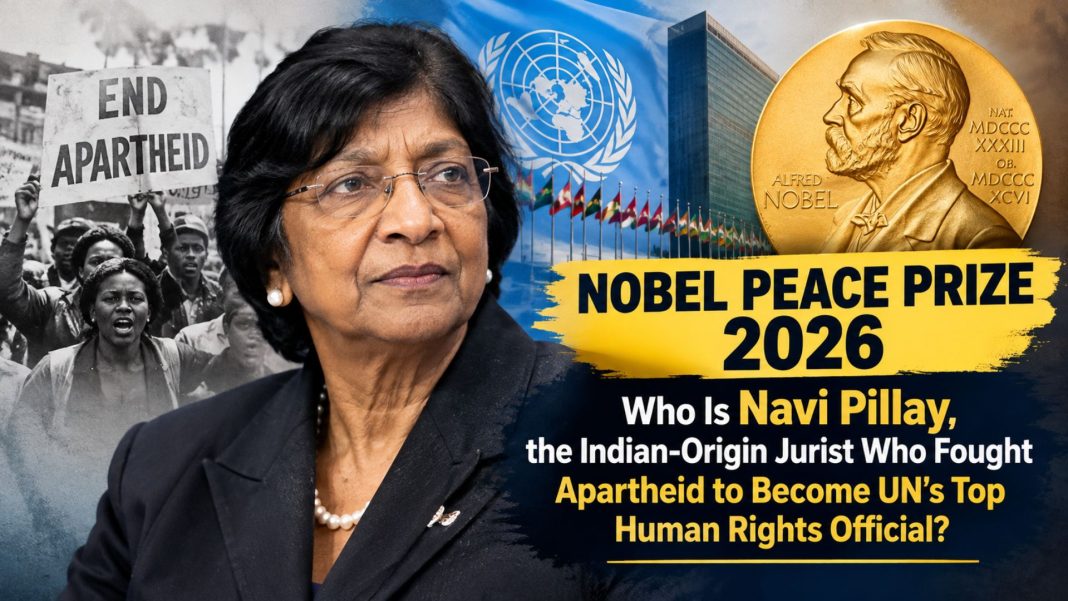

Nobel Peace Prize 2026: In a poignant tribute to a lifetime spent holding power accountable, the Norwegian Nobel Committee has awarded the 2026 Nobel Peace Prize to Navanethem “Navi” Pillay.
The 85-year-old South African jurist of Tamil-Indian origin was recognized for her extraordinary contributions to expanding international law and advancing a world grounded in human rights.
Announcing the decision, Jørgen Watne Frydnes, Chair of the Norwegian Nobel Committee, praised Pillay’s pioneering career, noting that she repeatedly broke barriers while confronting severe racial and gender discrimination from her earliest days as a lawyer in apartheid-era South Africa.
“At a time when the number of wars and conflicts is rising, and when judges and institutions of international law are under political attack, the Nobel Committee wishes to issue a reminder that the ability to resolve conflicts without force or violence is dependent on the international rule of law,” the Nobel Committee stated in its official release.
Frydnes described Pillay’s unwavering commitment to victims of oppression as a powerful “source of hope and inspiration” for anyone striving to build a more peaceful world.
Deep Roots: From Sugar Plantations to Harvard Law
Nobel Peace Prize 2026: Pillay’s journey to the world’s most prestigious stage is rooted in resilience. Born in 1941 in Durban, South Africa, to Narrainsamy and Santhama Naidoo, she grew up in an impoverished working-class family, her father worked as a local bus driver.
Her family’s story reflects the hardships of the Indian diaspora in South Africa. In the late 19th century, her grandparents migrated from Tamil Nadu, India, to work as indentured laborers on South African sugar cane plantations.
Growing up under the brutal framework of apartheid, Pillay experienced systemic racism and socio-economic deprivation firsthand. Rather than backing down, these early hardships forged her resolve.
She went on to study law at the University of Natal before earning both a Master of Laws (LL.M.) and a Doctorate of Juridical Science (S.J.D.) from Harvard Law School, becoming one of the first non-white South African women to achieve such academic distinction.
Defying Apartheid: A Historic Legal Career
Nobel Peace Prize 2026: Pillay began her legal journey in 1967 when she established her own law practice in South Africa’s Natal Province. In doing so, she became the first non-white woman to open a legal practice in the region, offering crucial defense services to political activists and anti-apartheid fighters.
During this era, she frequently defended opponents of the apartheid regime, taking on high-stakes cases that few dared to touch:
1973 Robben Island Breakthrough: Pillay successfully fought for political prisoners detained at the infamous Robben Island prison to gain access to defense attorneys. This historic legal victory protected the rights of key political detainees, including Nelson Mandela, who was serving his long imprisonment there.
Personal Sacrifices: In 1965, she married Gaby Pillay, a fellow human rights lawyer who was himself later detained as a political prisoner on Robben Island. Though the couple later divorced before Gaby’s passing in the late 1990s, their shared activism yielded two daughters and a lasting legacy of resistance.
Reflecting on her early struggles during a 2023 interview, Pillay captured the spirit that guided her career:
“We put up with the worst insults and racial discrimination and were abused and treated like dirt. That could have made you weak and cry, or fight every step of the way. So I always had a sense of confidence about who I am and how I confront any kind of discrimination. Open your mouth and speak up, condemning it.“
Breaking Barriers: Making Legal History Under Mandela
When South Africa held its first fully democratic election in 1994 and Nelson Mandela became president, Pillay was appointed as a judge to the nation’s High Court.
This historic appointment made her the first non-white woman judge of South Africa’s High Court, shattering a major glass ceiling in a country rebuilding itself from decades of institutional racism.
A Global Force: Setting International Precedents
Pillay’s legal brilliance soon transitioned onto the world stage, where she held leadership positions across major international judicial bodies:
International Criminal Tribunal for Rwanda (ICTR): Appointed as a judge on the ICTR following the 1994 Rwandan genocide, Pillay eventually rose to serve as the tribunal’s President. In 1998, she was part of the historic panel of judges that issued a landmark ruling recognizing rape and sexual violence as acts of genocide and crimes against humanity under international law—a decision that permanently reshaped global justice.
International Criminal Court (ICC): In 2003, Pillay was elected to serve as a judge on the newly formed International Criminal Court in The Hague, where she helped establish foundational procedural standards for prosecuting war crimes and grave human rights abuses worldwide.
UN High Commissioner for Human Rights (2008–2014): Appointed by the UN General Assembly, Pillay served as the top UN human rights official for six years. During her tenure, she became known as a fearless advocate for victims, frequently criticizing powerful governments for using state power to crush peaceful demonstrations, particularly during the uprisings in the Arab world, including Syria and Libya.
Independent Commission of Inquiry: In her post-commissioner years, Pillay continued her work as Chair of the UN Independent International Commission of Inquiry on the Occupied Palestinian Territory and Israel, maintaining her focus on international humanitarian compliance.
A Timely Reminder for Global Justice
Navi Pillay’s Nobel Peace Prize win arrives at a critical global juncture. With armed conflicts escalating around the world and legal institutions facing growing political friction, the Nobel Committee’s recognition serves as a powerful defense of multilateralism.
From her modest origins in Durban as the daughter of a bus driver to becoming the world’s chief human rights advocate, Pillay’s life work demonstrates that peace is inseparable from justice, equality, and the rule of law.