


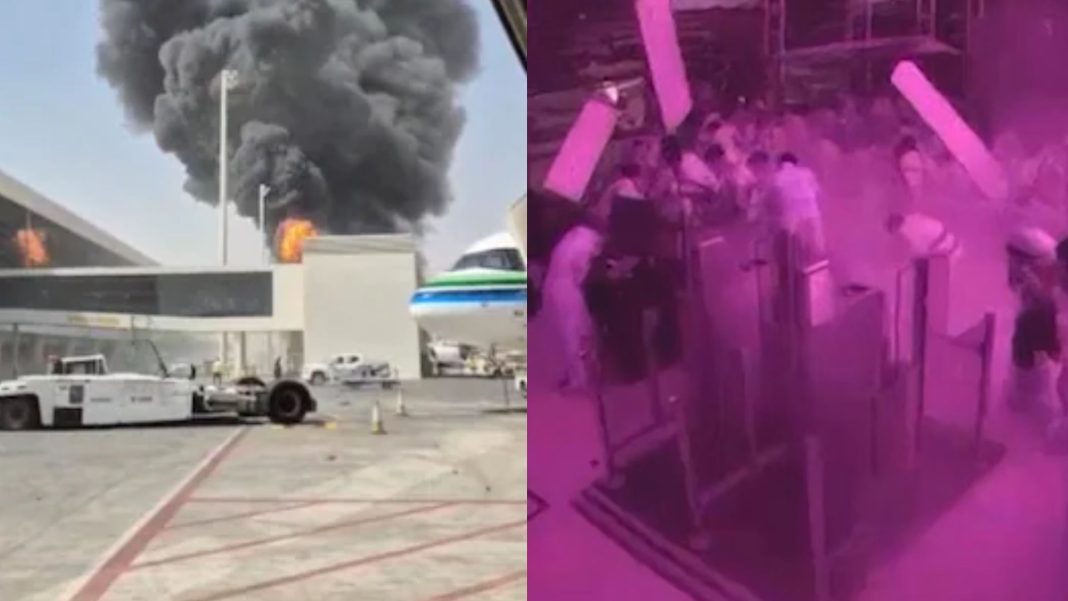

Middle East Crisis: Tensions in the Middle East reached a flashpoint over the weekend following a devastating series of missile and drone strikes targeted directly at King Khalid International Airport in Riyadh.
Conducted by Yemen’s Houthi rebels, the escalations have triggered a full-scale crisis in regional aviation, claimed multiple civilian lives, including an Indian national, and prompted urgent travel warnings across the globe.
The multi-day offensive marks the most catastrophic security breach on Saudi soil in over a decade, sending shockwaves through international diplomatic and business communities.
The Dark Saturday: Riyadh’s Longest Night
Middle East Crisis: The situation worsened dramatically on the night of Saturday, October 10, when Houthi forces launched a high-impact assault on Riyadh’s international airport infrastructure. The catastrophic strike transformed the bustling travel hub into a zone of panic and emergency operations.
Casualty Breakdown: A total of 13 people lost their lives in the Saturday attack. While 12 individuals died on impact or shortly after, an Indian expatriate later succumbed to severe injuries in a Riyadh hospital.
Massive Injuries: Over 300 individuals (309 in total) sustained injuries ranging from minor shrapnel wounds to critical trauma, overwhelming local emergency response units and medical faculties.
Historical Severity: Analysts note that this stands as the deadliest single assault inside Saudi Arabia since May 2015, when an ISIS suicide bombing at a Shia mosque in Qatif left 21 worshippers dead.
Following the horrific event, Saudi civil aviation authorities immediately suspended all international flight operations in and out of the capital to assess damage and secure the airspace.
No Safe Zone: Domestic Terminals Targeted Next
Middle East Crisis: Despite the total halt of international travel, the aggression did not subside. On Sunday evening, the insurgent group turned its sights on the airport’s domestic corridors, proving that no section of the facility was beyond reach.
Around 8:30 PM local time on Sunday, as a commercial passenger jet was taxiing toward its assigned parking gate, an explosive projectile detonated on the active tarmac.
“The projectile landed right near a group of stationary aircraft, immediately igniting a fire on the runway area,” reported a witness trapped inside the terminal.
The Sunday strike targeted Terminal 3 and Terminal 4, the primary gates for inland passenger transit. The attack resulted in the death of a Pakistani national and further damaged ground support equipment, effectively placing domestic operations under extreme distress.
A Timeline of Escalation: 4 Days of Terror
The weekend onslaught was not an isolated incident but the climax of an aggressive four-day campaign directed at Saudi Arabia’s key infrastructure.
Reported Attacks on Saudi Aviation Facilities: October 7–11
| Date | Target Location / Asset | Reported Casualties & Major Damage |
|---|---|---|
| October 7 | Riyadh Airport and Abha Airport | Riyadh: 1 Sudanese national killed and 8 injured. Abha: 2 killed and 28 injured in a separate attack. |
| October 8 | Airport facilities and Saudi Airlines fleet | 3 Saudi nationals killed, including senior pilot Captain Hamoud Ali Al-Kulaisami. An Airbus A320 was reportedly damaged. |
| October 10 | Riyadh Airport — International Operations | 13 reported fatalities, including 1 Indian national, and 309 injured. International flights were reportedly completely suspended. |
| October 11 | Terminals 3 and 4 — Domestic Operations | 1 Pakistani national killed. An explosion reportedly occurred on the tarmac near a taxiing aircraft, triggering fires. |
Global Airlines Ground Operations as Airspace Warnings Issued
In the wake of repeated bombardments, Houthi military spokespersons issued an explicit warning declaring Saudi airspace and civilian airports “unsafe zones.” The group reiterated that these strikes are direct retaliation against Saudi Arabia’s continued military intervention in the ongoing Yemeni civil war.
Responding swiftly to the heightened risk to passengers and crew, major global carriers announced the immediate suspension of routes serving Riyadh and adjacent Saudi terminals:
Air India cancelled all scheduled flights heading to and from Riyadh.
Flydubai temporarily froze its service connections into the affected regions.
Lufthansa Group re-routed transit flights to bypass Saudi airspace.
Pakistan International Airlines (PIA) grounded all local departures bound for the kingdom.
The global aviation industry continues to monitor updates closely, with several other international operators preparing alternative route maps until security guarantees are restored.
Diplomatic Fallout: India Issues Advisory, Condemns Assault
The death of an Indian citizen in the October 10 assault has drawn sharp reaction from New Delhi. India’s Ministry of External Affairs (MEA) issued a stern statement strongly condemning the missile strikes on civilian targets.
“The repeated and deliberate targeting of innocent civilians and non-military public infrastructure is unacceptable and must cease immediately,” the official MEA statement declared.
Concurrently, the Indian Embassy in Riyadh issued a safety advisory urging the large Indian diaspora in Saudi Arabia to:
Exercise extreme caution and limit unnecessary movements.
Remain indoors during active threat alerts or military sirens.
Strictly comply with safety guidelines issued by local Saudi security authorities.
Saudi Retaliation: Retaliatory Airstrikes Hit Sana’a
The conflict escalated into a full-scale cross-border aerial duel as the Saudi-led coalition responded with intense retaliatory strikes inside Yemen.
Media outlets controlled by the Houthi movement reported that Saudi warplanes bombarded Sana’a International Airport on Sunday night. Further strikes hit residential neighborhoods in the capital city. According to Dr. Anees Al-Asbahi, spokesperson for the Houthi-run Health Ministry, a residential strike resulted in the death of a young child.
Houthi health officials claim that since September 3, ongoing airstrikes across Houthi-controlled territories have led to 91 fatalities, with a significant proportion reported as women and children.
What Lies Ahead?
With international and domestic travel severely disrupted, Saudi authorities are working round-the-clock to bolster air defense systems around vital national assets. However, with Houthi forces threatening further strikes until military operations in Yemen cease, the region remains on a knife-edge.
For millions of expatriates living in the Gulf state and international travelers planning trips to the region, uncertainty remains high as diplomatic efforts scramble to prevent a broader regional conflict.