


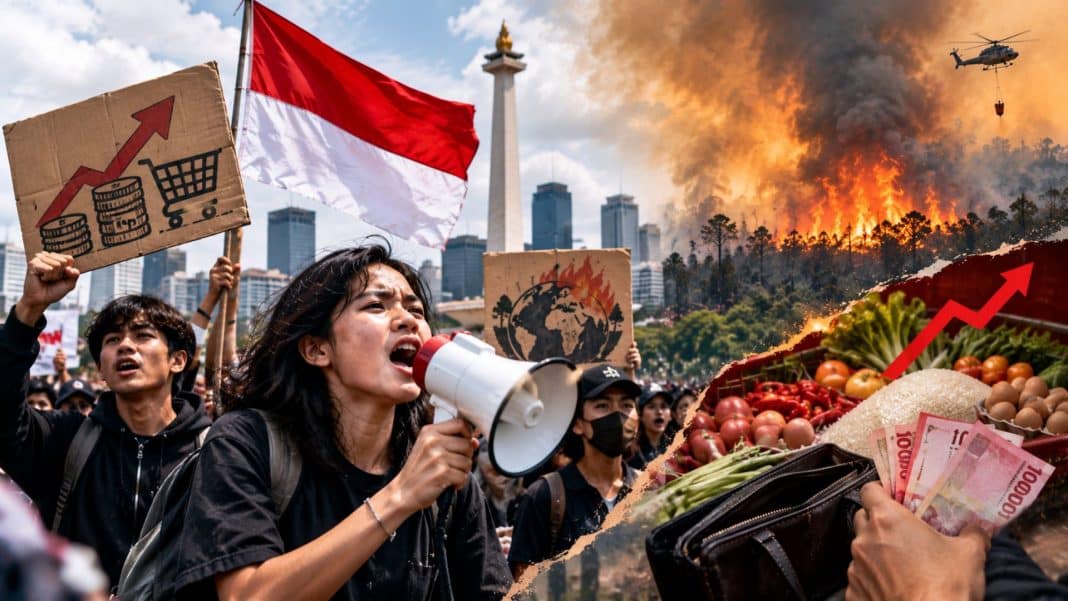

Gen Z Uprising Hits Indonesia: A powerful new wave of youth-driven resistance has erupted across Asia, with Indonesia emerging as the latest battleground. Marking the second anniversary of President Prabowo Subianto’s administration, thousands of university students and civil society activists took to the streets across major cities, launching high-stakes demonstrations against severe economic strain, rampant forest fires, systemic corruption, and shrinking democratic freedoms.
This widespread mobilization in Indonesia aligns with an extraordinary global trend. Over 20 countries across Europe, Asia, Africa, and Latin America have seen major Gen Z-led or youth-dominated anti-government uprisings, according to data from the Carnegie Endowment for International Peace.
Dual Crisis: The Twin Engines Driving Indonesia’s Street Protests
Gen Z Uprising Hits Indonesia: The anger boiling over in Indonesia is fueled by a volatile mix of severe financial distress and environmental destruction.
- Household Financial Strain & Soaring Living Costs
University students and civil society coalitions are sounding the alarm on the crippling cost of living. Soaring inflation, unaffordable higher education, and rising healthcare expenses have pushed everyday households to the brink. Protesters argue that the current government’s economic strategies have failed to protect ordinary citizens, leaving the youth facing a deeply uncertain economic future.
- Environmental Emergency & Choking Forest Fires
Simultaneously, Indonesia is confronting its most devastating wildfire crisis since 2015. Accelerated by an unusually prolonged El Niño dry season, ferocious fires are devouring peatlands and tropical forests across Sumatra, Kalimantan, and Papua.
Toxic haze has blanketed entire communities, forcing schools to close, disrupting transport, and causing transboundary air pollution in neighboring Singapore and Malaysia. Activists heavily criticize land-clearing practices associated with corporate palm oil expansion and demand that the fires be declared a national disaster.
Direct Action on the Streets: Security Crackdowns and High-Stakes Activism
Gen Z Uprising Hits Indonesia: Demonstrations flared across major urban centers, including Jakarta, Yogyakarta, Bandung, Pekanbaru, and Makassar. The scale of the movement prompted authorities to deploy roughly 9,000 police officers in the capital alone to maintain order and secure government installations.
During dramatic scenes in Jakarta, activists unfurled a massive banner reading “Take Action on the Climate Crisis, Bring Down the Cost of Living.” Firefighters and police forces intervened to remove the banner. Media reports indicate that six activists were evacuated from the monument, including one woman who required immediate medical treatment, while at least eight activists were detained and taken to a local police station for questioning.
Key Student Demands: What the Movement is Fighting For
The protesters have laid out an uncompromising set of demands aimed directly at reforming national governance:
Immediate Economic Relief: Direct measures to reduce household financial burdens, lower tuition costs, and ensure affordable access to public healthcare and basic utilities.
Environmental Disaster Declaration: Official declaration of the forest fires as a national disaster, accompanied by strict criminal and financial accountability for corporations responsible for illegal land burning.
Eradication of Corruption: Aggressive legal measures to combat corruption, collusion, and nepotism within state institutions
Protection of Civil Liberties: Stronger legal safeguards for freedom of speech, political expression, and peaceful assembly without police intimidation.
Political Pressure Mounts on President Prabowo’s Administration
The crisis has swiftly transformed from an environmental and economic nuisance into a political trial for President Prabowo Subianto.
In response to the escalating anger, President Prabowo convened an emergency meeting at Merdeka Palace. Presidential Chief of Staff Listyo Sigit Prabowo stated that the President instructed government agencies to intensify aerial firefighting and streamline coordination between the military, police, local authorities, and disaster management agencies.
Furthermore, law enforcement officials revealed that 98 corporate cases linked to illegal forest and land fires have entered active investigation, targeting both domestic corporations and foreign entities. Despite these measures, critics insist the administration’s response is overdue and under-resourced.
A Global Pattern: How Gen Z is Redefining Anti-Government Movements
Indonesia’s youth uprising is not an isolated event; it is part of a global wave of Gen Z-led resistance reshaping political landscapes:
| Country | Key Triggers and Demands | Outcomes and Political Impact |
|---|---|---|
| Indonesia | Rising living costs, severe forest fires, and corruption | Nationwide protests intensified scrutiny of corporate environmental practices and accountability. |
| Nepal | Corruption, political privilege, and social media restrictions | Police crackdowns followed by widespread unrest led to Prime Minister KP Sharma Oli’s resignation and the lifting of the social media ban. |
| Kenya | Death of blogger Albert Ojwang, police brutality, and taxation policies | Protests broadened into a nationwide campaign for better governance and police accountability. |
| Madagascar | Shortages of essential services, particularly water and electricity, and systemic neglect | Protests escalated into a mass anti-government movement, culminating in President Andry Rajoelina’s removal from power. |
| Philippines | Economic inequality, governance concerns, and suppression of youth voices | Protests fostered regional solidarity and expanded into student strikes across multiple cities. |
The Road Ahead: Why the Indonesian Government Cannot Afford Inaction
For President Prabowo Subianto, ignoring this youth movement carries significant political risks. Gen Z constitutes a powerful demographic block across Southeast Asia. By linking immediate pocketbook issues with long-term climate survival and democratic rights, Indonesian students have created a powerful narrative that resonates deeply with the broader public.
Unless the government delivers tangible economic relief, enforces strict action against corporate polluters, and respects civil liberties, the discontent on the streets is likely to intensify, making political stability increasingly elusive.
Also Read: US-India Trade Deal & Oil Pact: US Foreign Minister Marco Rubio Calls India a ‘Refining Superpower’