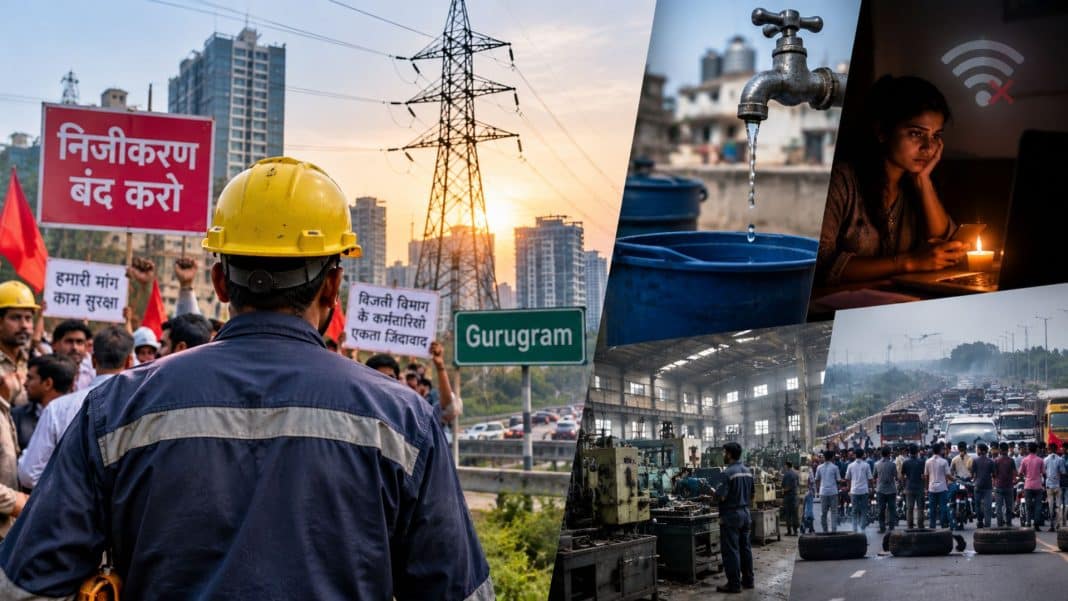

Haryana Electricity Strike: Normal life across Gurugram, Faridabad, Rewari, and several other districts in Haryana has been severely disrupted due to an ongoing three-day strike by state power sector employees.
According to media reports, the statewide protest, which began on October 22 and is scheduled to run through October 24, has left thousands of households without electricity, running water, and Wi-Fi connectivity, while halting production across hundreds of industrial manufacturing units.
The massive disruption follows a regulatory order issued on October 19 by the Haryana Electricity Regulatory Commission (HERC), which granted a 25-year parallel power distribution licence to a private entity, Eleven Power Private Limited, for the Gurugram and Nuh circles.
What Triggered the Haryana Electricity Employees Strike?
Haryana Electricity Strike: According to reports from media outlets, the primary cause of the strike is the entry of private competition into Haryana’s power distribution sector, which has historically been managed by state-run utilities Dakshin Haryana Bijli Vitran Nigam (DHBVN) and Uttar Haryana Bijli Vitran Nigam (UHBVN).
Under Section 14 of the Electricity Act, 2003, HERC granted Eleven Power a parallel distribution licence. Trade unions and power sector associations including the Electricity Employees Federation of India (EEFI) and the All India Power Engineers Federation have strongly opposed the decision.
Key concerns raised by the striking employees include:
Haryana Electricity Strike: Impact on Public Infrastructure: Unions argue that private operators will cherry-pick profitable urban and industrial consumers, leaving state utilities with financially burdensome rural and agricultural sectors.
Job Security Risks: Representatives expressed deep concern over the future of approximately 40,000 regular, contractual, and outsourced employees and power engineers.
Demand for Cancellation: Employee bodies are demanding the immediate revocation of the 25-year parallel distribution licence and a formal state policy barring private distribution entry.
Union representatives told media correspondents that while they regret the severe inconvenience to the public, employees are not intentionally cutting off supplies but are abstaining from attending to feeder breakdowns and technical maintenance repairs.
Daily Life Paralysed Across Gurugram and Neighboring Districts
According to media reports, the helpline systems of power distribution companies have been flooded with complaints. Over 5,500 complaints were registered in Gurugram alone within 24 hours of the disruption.
Protests and severe daily hardships have been reported across multiple sectors:
Household Disruption: Prolonged power outages lasting over 24 hours led to depleted inverter batteries across residential societies in Sector 5, Sector 7, DLF Phase 2, Palam Vihar, and Daulatabad. Without power, water pumps could not lift stored water to overhead tanks, leaving residents without drinking and domestic water.
Impact on Work and Education: Remote workers were unable to log in due to disrupted Wi-Fi and power failures, while students preparing for competitive examinations faced severe study disruptions.
Street Protests: Frustrated residents took to the streets in areas including Rajendra Park, Bhimgarh Kheri, and near the Gurugram railway station. Similar road blockades were reported on National Highway 352 in Rewari and in parts of Faridabad.
Industrial Halts: Industrial associations warned that power outages across manufacturing hubs in Sector 37, Basai, and Kadipur have brought heavy machinery to a standstill, raising fears of losses running into crores of rupees and missed delivery deadlines.
Government Stand and Legal Challenge
In response to the growing public crisis, Chief Minister Nayab Singh Saini and Energy Minister Anil Vij appealed to the striking power employees to return to duty.
According to official administrative briefings, Energy Minister Anil Vij clarified that HERC operates as an autonomous regulatory body and that the state government itself opposed the grant of a private licence.
The Haryana government has announced plans to challenge the HERC order before the Appellate Tribunal for Electricity (APTEL) within five to six days, seeking an immediate stay on the parallel distribution licence.
Meanwhile, the local administration directed power distribution officials to prioritize emergency power restoration for critical infrastructure, including hospitals, public water works pumping stations, and Metro rail networks.