


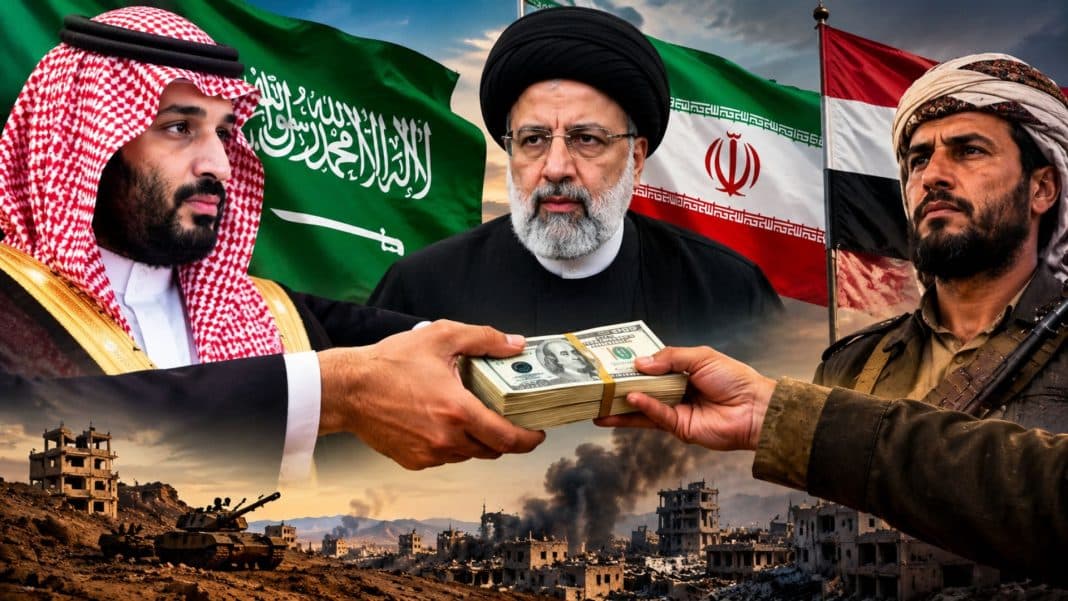

Saudi Arabia Houthis: In a major diplomatic development aimed at halting an escalating three-month cycle of military strikes, Saudi Arabia has reportedly offered a financial deal worth $1 billion (approx. ₹95 billion) to Houthi rebels in Yemen. According to media reports citing Israeli news outlet Israel Hayom, the proposed payout is designed to secure a binding ceasefire and stop direct attacks on Saudi infrastructure.
The high-stakes negotiations reached a critical juncture on Monday as Saudi Defense Minister Prince Khalid bin Salman arrived in Tehran aboard an official aircraft. According to media reports, the flight allegedly carried funds linked to the proposed arrangement as part of mediation efforts hosted by Iran.
Multilateral Talks in Tehran: Key Regional Players Assemble
The diplomatic push in Tehran brought together key regional security chiefs and political leaders:
Saudi Arabia: Defense Minister Prince Khalid bin Salman
Pakistan: Army Chief Field Marshal Asim Munir
Turkey: National Intelligence Organization (MİT) Chief İbrahim Kalın
Iran: President Masoud Pezeshkian
According to media reports, Tehran served as the primary mediator to establish a workable peace framework. The presence of high-level military and intelligence leaders underscores the severe risk the conflict poses to broader Middle Eastern security and global energy markets.
Saudi Arabia’s Core Demand: Territory Return Before Any Agreement
Saudi Arabia Houthis: Despite offering substantial economic incentives, Riyadh maintains a firm diplomatic position. According to media reports, Saudi officials have emphasized that the Kingdom will not sign a truce purely under military pressure.
The Conditions Laid Out by Riyadh:
Territorial Handover: Houthi forces must first surrender and return territories seized from the internationally recognized Yemeni government, which is backed by Saudi Arabia.
Immediate Ceasefire: Complete cessation of drone and missile strikes targeting Saudi airports, urban centers, and oil installations.
Maritime Security: Reopening access around the strategically vital Bab al-Mandeb Strait to ensure unhindered oil exports and commercial shipping.
Strain on the Kingdom: Economic Impacts of the 3-Month Surge
Saudi Arabia Houthis: The latest wave of hostility over the past three months has severely impacted Saudi Arabia’s domestic security and economic stability. Repeated drone and missile strikes against commercial airports and oil facilities have disrupted operations and heightened risks for international trade.
Additionally, Houthi control over key positions along the Bab al-Mandeb Strait has constricted maritime transit, creating shipping delays and elevating transit costs for Saudi crude exports.
Root Cause: Unfulfilled Commitments from a 3-Year-Old Pact
According to media reports, the current flare-up stems largely from unexecuted terms of a agreement made three years ago between Riyadh and the Houthis.
Under that earlier framework:
Saudi Arabia was supposed to fund public sector salaries in Houthi-controlled territories and finance basic civil infrastructure reconstruction.
Houthi Forces were expected to maintain a permanent truce and cease cross-border attacks on Saudi territory.
Recently, Houthi leaders accused Saudi Arabia of failing to honor those financial commitments, using the issue to justify their renewed offensive.
Analysis: Why Superior Military Might Has Not Defeated the Houthis
Despite possessing advanced fighter jets, precision missiles, and extensive intelligence support from the United States, Saudi Arabia has been unable to decisively neutralize Houthi capabilities since the conflict began in 2015. Analysts point to key factors explaining this asymmetry:
- The Cost-Asymmetry Gap
Attacker’s Advantage: Houthis utilize low-cost attack drones and locally assembled missiles that cost a fraction of traditional military hardware.
Defender’s Burden: Saudi Arabia must fire multi-million-dollar air defense interceptors to destroy inexpensive targets, making prolonged air defense economically unsustainable over time.
- Difficult Mountainous Terrain
Yemen’s high, rugged terrain provides natural concealment for mobile launch platforms and underground weapon depots.
While airstrikes can damage specific sites, aerial bombardment alone cannot clear dense, mountainous strongholds or secure land control.
- High Risk of Ground Campaign
The Houthis have entrenched themselves across northern Yemen over decades.
Neutralizing them entirely would require a massive ground operation, risking severe casualties and dragging the Kingdom into an indefinite war of attrition.
What Lies Ahead
The multi-nation delegation in Tehran highlights a growing regional consensus that military action alone cannot resolve the crisis. Whether the reported $1 billion economic package leads to a durable ceasefire now depends on whether both sides can agree on territorial concessions and verification steps on the ground.