
Delhi Pollution Rules From Nov 1: With winter approaching and air quality indices beginning to slip into concerning categories across the national capital region, the Delhi administration has announced a robust set of emergency anti-pollution regulations.
According to media reports and official administrative updates, these strict measures are scheduled to come into effect starting November 1, 2026, aimed at curbing severe smog formation and particulate matter accumulation during the winter months.
The sweeping curbs will directly impact daily commuters, commercial vehicle operators, private office workers, and residents across Delhi and its surrounding satellite towns such as Noida, Gurugram, Faridabad, and Ghaziabad.
Ban on Non-BS-6 Commercial and Out-of-State Vehicles
Delhi Pollution Rules From Nov 1: To prevent highly polluting older-generation vehicles from worsening the city’s air quality, strict entry barriers will be enforced.
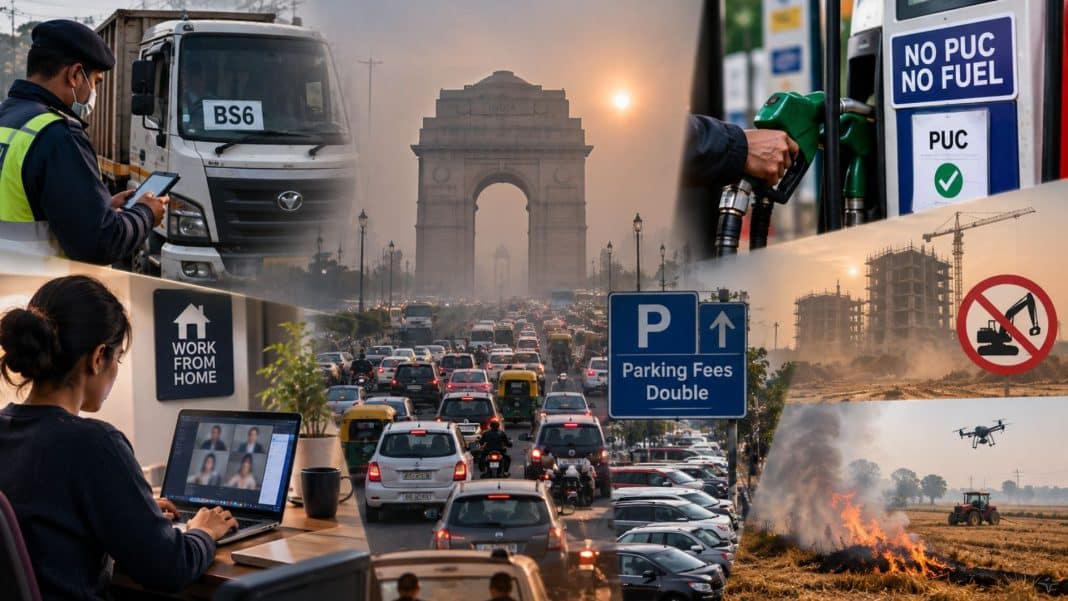
According to media reports, non-BS-6 diesel and petrol vehicles registered outside Delhi particularly commercial carriers and older passenger vehicles coming from neighboring states will face a complete entry ban starting November 1 through January 31, 2027.
Automatic Number Plate Recognition (ANPR) cameras will be deployed at major border check-posts to monitor incoming traffic. Electric vehicles (EVs), CNG vehicles, and essential emergency transport will be exempted from these restrictions.
However, thousands of daily commuters driving older models from neighboring NCR cities are expected to face heavy traffic diversions and congestion at entry points.
Strict Enforcement of ‘No PUC, No Fuel’ Policy
Delhi Pollution Rules From Nov 1: The administration is stepping up enforcement of the ‘No PUC, No Fuel’ mandate across all retail fuel outlets in the capital. According to media reports, vehicle owners will be required to present a valid Pollution Under Control (PUC) certificate before refuelling with petrol, diesel, CNG, or LPG.
Fuel stations will utilize integrated digital systems and automated cameras linked with government transport databases to verify PUC status instantly.
Motorists lacking updated certification will be turned away, a measure expected to drive long queues at testing centers while ensuring non-compliant polluting vehicles are kept off public roads.
50 Percent Work From Home and Staggered Office Timings
Delhi Pollution Rules From Nov 1: To reduce vehicular congestion and peak-hour traffic emissions during high-pollution spells, the government is implementing a 50 percent Work From Home (WFH) mandate for both public and private sector offices starting November 1 through February 28.
Additionally, administrative working hours are being staggered to spread out traffic flow. According to official guidelines, Municipal Corporation of Delhi (MCD) offices will operate from 8:30 AM to 5:00 PM, while Delhi government offices will function from 10:00 AM to 6:30 PM.
Private employers have also been strongly advised to adopt flexible timings, carpooling initiatives, and hybrid remote-working models.
Doubling of Parking Fees and Construction Bans
Delhi Pollution Rules From Nov 1: In an effort to discourage private vehicle usage, parking fees across municipal parking lots managed by MCD will be doubled. Commuters using public transport such as the Delhi Metro will be exempt from these hikes, though metro parking facilities are expected to see a massive surge in daily occupancy.
Simultaneously, a strict ban on open construction, demolition activities, and earthwork will be enforced from November 1 through January 31. The measure is designed to suppress massive dust dispersion during stagnant winter atmospheric conditions.
Only critical public infrastructure projects with specialized dust-mitigation systems will be granted exemptions. Furthermore, large commercial buildings, malls, and high-rise developments will be mandated to install anti-smog guns and mist-spraying systems.
Satellite Monitoring and Regional Stubble Burning Controls
To tackle regional contributors to Delhi’s winter smog, central regulatory bodies including the Commission for Air Quality Management (CAQM) and the Central Pollution Control Board (CPCB) have deployed over 300 specialized monitoring teams across agricultural districts in Punjab and Haryana. These teams will track stubble-burning incidents in real-time.
Within the capital, local authorities have identified 13 high-pollution hotspots including Anand View, Wazirpur, Mundka, and RK Puram where dedicated enforcement squads will monitor open biomass burning, garbage incineration, and localized dust violations using drone surveillance.
While environmental experts note that these proactive restrictions are vital for preventing severe public health hazards, local trade associations and daily commuters have expressed concerns regarding logistical hurdles, increased travel times, and economic disruptions during the upcoming festive and winter season.