


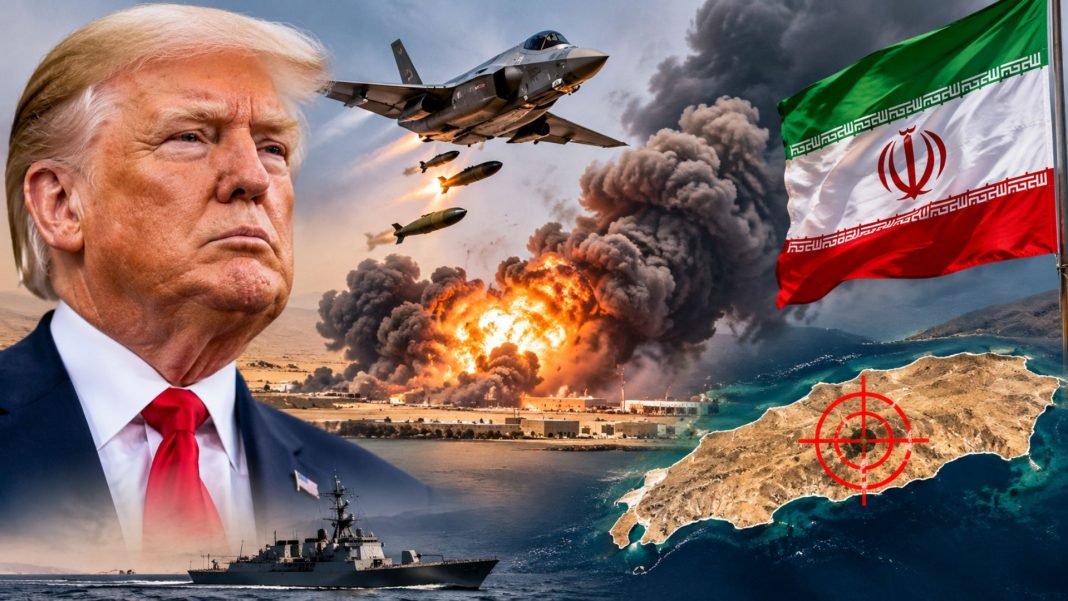

Qeshm Island Attack: In a dramatic turn of events on the eve of the US midterm elections, the American military launched targeted defensive strikes against Iranian military positions on Qeshm Island. The move came just hours after US President Donald Trump publicly suggested that Tehran was eager to negotiate a deal and hinted that an agreement might be close.
The Pre-Election Signals: Peace Talk Followed by Precision Strikes
Qeshm Island Attack: On Monday, President Trump struck an optimistic tone regarding Middle East tensions, telling reporters that Iran urgently wants to negotiate.
“They want to make a deal, and that could happen,” Trump said, adding that global oil prices would continue to drop because the US was “winning easily” against Iran.
During an interview on Fox News, Trump further claimed that the US had severely impaired Iran’s potential nuclear capabilities and warned that Washington retains the power to target remaining sites whenever necessary.
However, within hours of these public remarks, US military forces executed a defensive precision strike against Iranian military infrastructure on Qeshm Island. According to media reports citing US officials, the operation was designed to neutralize surface-to-air missile threats aimed at American military assets operating in the region.
Media reports also reveal that Washington had been conducting targeted, low-profile strikes on Iranian positions for weeks without making formal public announcements, marking a shift from the earlier stages of the conflict.
Why Qeshm Island? The Geography of a Maritime Chokepoint
Qeshm Island Attack: Qeshm Island is not just another piece of land; it is the strategic heart of the Persian Gulf. Situated in Iran’s southern Hormozgan province, Qeshm lies barely 22 kilometers south of the critical port city of Bandar Abbas.
Spanning nearly 1,200 square kilometers, Qeshm is the largest island in the Persian Gulf. Measuring roughly 135 kilometers in length and up to 40 kilometers wide, its sheer scale and location allow Iran to project military power directly over the northern entrance of the Strait of Hormuz, the narrow waterway responsible for carrying a massive share of the world’s petroleum supply.
Strategic Location Highlights
Proximity: Lies right off Bandar Abbas, separated from mainland Iran by the Clarence (Khoran) Strait.
Chokepoint Control: Serves as the geographical “cork” controlling access to and from the Persian Gulf.
Corridor Monitoring: Overlooks key maritime lanes running between Qeshm and nearby Larak Island.
Inside Iran’s “Unsinkable Aircraft Carrier”
Military analysts frequently refer to Qeshm Island as Iran’s “unsinkable aircraft carrier” due to its heavily fortified infrastructure built both above and below ground.
Deep beneath the island’s terrain lies a vast network of reinforced military facilities, often called an underground “missile city.” Designed to protect key weaponry from air strikes, these subterranean complexes house an undisclosed number of missile systems, mobile launchers, and tactical equipment.
Defense experts note that Qeshm also shelters hidden fleets of fast-attack craft and coastal defense batteries. This combination allows Iran to maintain a persistent threat over surrounding waters without relying on vulnerable surface installations.
The Maritime “Toll Booth”: How Iran Exerts Control
Beyond its raw military infrastructure, Qeshm Island serves as the operational hub for Iran’s control over regional shipping lanes.
Media reports indicate that since early 2026, Iranian authorities established a regulated shipping corridor running through territorial waters near Qeshm and Larak Islands. Maritime intelligence firms have described this setup as a functional “toll booth” for commercial vessels operating when primary shipping routes in the Strait face restrictions.
The Clearance Process
Mandatory Reporting: Passing ships must submit detailed manifests including cargo, ownership, destination, and crew info.
IRGC Screening: The Islamic Revolutionary Guard Corps inspects documentation and performs physical boardings when deemed necessary.
Transit Fees: Reports suggest some commercial operators paid fees ranging from $150,000 to nearly $2 million to secure safe passage through the corridor.
This clearance regime and its associated maritime insurance structures recently drew scrutiny from Washington, leading to targeted US Treasury sanctions on affiliated Iranian maritime entities.