


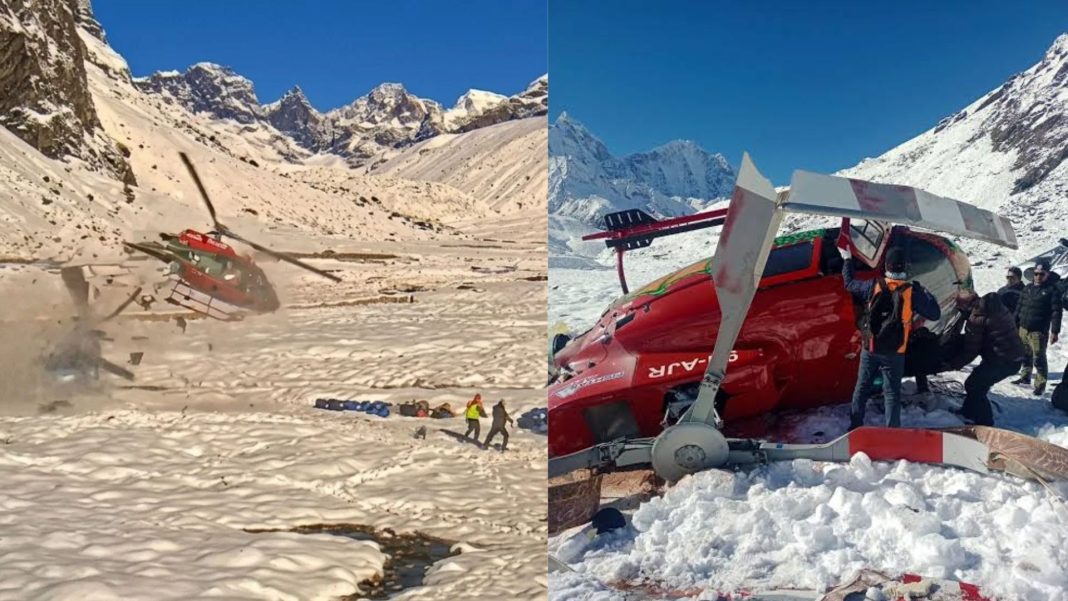

Nepal Helicopter Crash: A devastating aviation tragedy unfolded in Nepal’s high-altitude Everest region on Tuesday morning when two helicopters crashed into each other while attempting to land at the same helipad. The mid-air collision resulted in the unfortunate death of an Indian tourist, while a New Zealand national of Indian origin sustained injuries.
According to media reports, the accident occurred around 8:11 AM at the Feriched Helipad in the Solukhumbu district. The two aircraft involved belonged to local private operators, Fishtail Air and Air Dynasty.
Preliminary assessments suggest that the rotor blades of both choppers clipped each other mid-flight as both pilots maneuvered to touch down almost simultaneously at the high-altitude landing spot.
Victims Identified: Rescue Operation Swiftly Launched
Nepal Helicopter Crash: Officials confirmed that the deceased passenger has been identified as Vasant Kumar Balaramaramadu, an Indian tourist who was on board the Fishtail Air helicopter at the time of the collision.
Another passenger traveling in the same aircraft, Sailesh Krishna Patel, a citizen of New Zealand of Indian origin, suffered injuries during the crash.
Following the impact, local response teams and rescue personnel acted swiftly despite the harsh terrain:
Medical Evacuation: Patel was rescued using a Prabhu Helicopter and airlifted to Nepal’s Medicity Hospital in Kathmandu for urgent medical treatment.
Body Retrieval: The body of the deceased Indian national was transferred to a local hospital in Lukla for necessary legal and post-mortem procedures.
Pilot Status: Media reports indicate conflicting details regarding the exact condition and injuries sustained by the two pilots involved, and official updates are awaited.
How the Mishap Happened: Converging Flights at a Busy Hub
Nepal Helicopter Crash: Reconstructing the sequence of events, Nepali officials noted that the two helicopters were arriving from entirely different trajectories:
Flight 1: Coming from Lukla, a key gateway town for Everest expeditions.
Flight 2: Returning from the direction of Gorakshep, situated close to the Everest Base Camp.
Both aircraft converged on the Feriched Helipad at the exact same moment. As both pilots attempted to land, their rotor blades made contact, causing immediate instability and crash landings.
Was Snow on the Landing Strip a Factor?
While an official investigation has been ordered, early inputs hint that extreme weather conditions may have aggravated the situation. Media reports indicate that heavy snow accumulation on the helipad might have reduced visual clarity or affected ground friction, preventing the pilots from safely executing their landing patterns.
However, authorities have emphasized that the exact cause of the collision will only be established after a thorough safety inquiry.
Feriched Helipad: A Lifeline in the High Himalayas
The location where the accident occurred is not just an ordinary landing strip, it is one of the most critical aviation hubs in the Himalayas.
High-Altitude Hub: Situated at an altitude of 4,371 meters (14,340 feet), Feriched sits deep within the rugged Everest trekking corridor.
Emergency Rescue Center: It serves as the primary base for air-ambulance services, search-and-rescue ops, and medical evacuations for mountaineers suffering from acute mountain sickness (AMS), severe oxygen deprivation, or sudden injuries.
Essential Transport Link: Given the lack of motorable roads, choppers operating through Feriched remain the sole fast transport option for thousands of trekkers and local villagers every year.
Nepal’s Himalayas: A Perilous Sky for Aviation
This collision once again highlights the severe risks associated with flying in high-mountain zones. Nepal’s aviation sector, while vital for tourism and emergency support, constantly battles extreme hazards:
Unpredictable Microclimates: Weather in the Himalayas can shift within minutes, from bright sunshine to dense fog, severe winds, or sudden blizzards.
Narrow Valleys and High Altitudes: Reduced air density at 14,000+ feet limits helicopter engine performance and rotor lift, leaving pilots with zero margin for error.
Challenging Infrastructure: Helipads and airstrips are often carved into tiny patches of mountain slopes with unpredictable wind shears and slippery, snow-bound surfaces.
Growing Concerns Over Himalayan Aviation Safety
This tragic event comes right on the heels of another major helicopter crash in the region, raising serious safety concerns for mountain air travel.
Just four days earlier, on October 30, a helicopter operated by Trans Bharat Aviation crashed in the Chamoli district of Uttarakhand, India. The chopper, carrying five pilgrims from Karnataka back from Badrinath to Dehradun, crashed near Chai village in the Joshimath valley shortly after takeoff. All six individuals on board, including the pilot, lost their lives. That crash is currently under investigation by India’s Aircraft Accident Investigation Bureau (AAIB).
What Lies Ahead?
Nepali aviation authorities have initiated a formal inquiry to inspect the wreckage, analyze radio communications, and interview eyewitnesses. Key aspects of the investigation will focus on:
Air traffic coordination and communication protocols at un-towered high-altitude helipads like Feriched.
Environmental factors, including snow coverage, wind currents, and visibility at 8:11 AM.
Pilot situational awareness during simultaneous approaches.
As the Everest trekking season brings hundreds of adventurers to the region daily, this accident underlines the imperative need for stricter air-traffic management, improved landing infrastructure, and enhanced safety safety protocols in the skies above the world’s tallest peaks.
Also Read : Florida Private Jet Crash: 9 Dead as Business Jet Plunges Near Trump’s Mar-a-Lago