


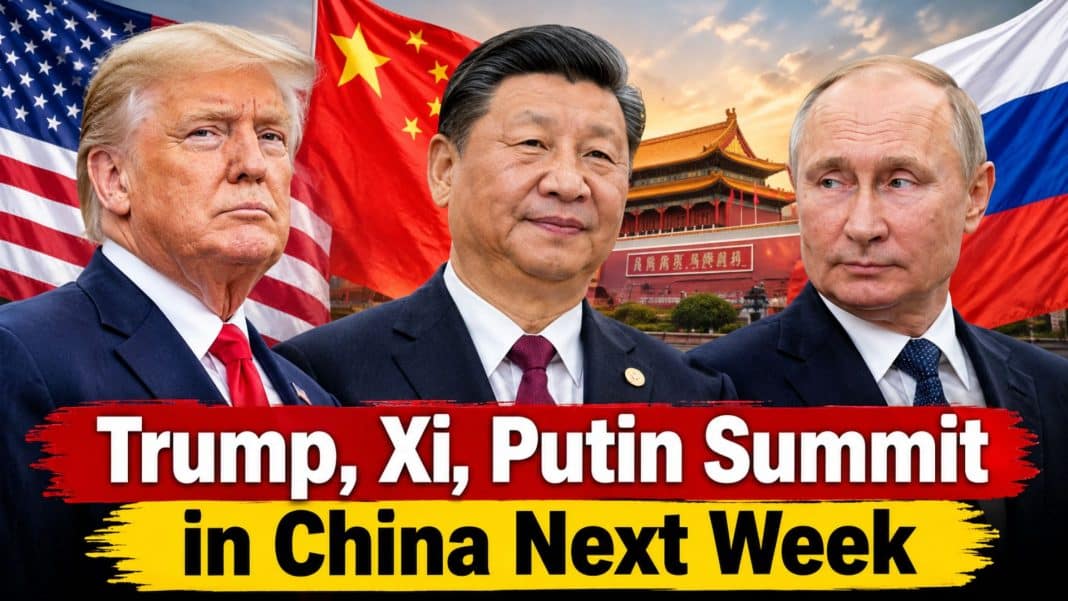

Historic ‘Big Three’ Summit: In a diplomatic development unseen since the closing days of World War II, US President Donald Trump, Chinese President Xi Jinping, and Russian President Vladimir Putin are set to sit down together for a high-stakes trilateral meeting next week, the White House officially confirmed on Friday.
The landmark gathering will take place on the sidelines of the Asia-Pacific Economic Cooperation (APEC) summit in the southern Chinese tech hub of Shenzhen. According to media reports, the primary focus of this unprecedented three-way dialogue will be global nuclear arms reduction, alongside growing geopolitical tensions surrounding Iran.
Echoes of Yalta: A Rare Gathering of Global Superpowers
Historic ‘Big Three’ Summit: This upcoming summit marks the first time in over eight decades that the leaders of the world’s three dominant military and economic powers will convene in a formal trilateral format.
According to media reports, the last comparable meeting occurred in February 1945 at the Yalta Conference in Crimea, where US President Franklin D. Roosevelt, Soviet Premier Joseph Stalin, and British Prime Minister Winston Churchill mapped out the post-war governance and division of Europe.
While the geopolitical landscape has shifted dramatically since 1945, diplomatic observers note that bringing Washington, Beijing, and Moscow to the same table carries immense weight for global stability.
Nuclear Arms Control Takes Center Stage
Historic ‘Big Three’ Summit: At the heart of President Trump’s agenda is the urgent need to curb the proliferation of nuclear weapons. According to White House officials, Trump intends to push strongly for a new, three-way arms control framework that brings China directly into the fold alongside the United States and Russia.
The urgency stems from a vacuum in international treaties. The last remaining bilateral nuclear arms reduction pact between Washington and Moscow expired earlier this year in February, leaving two of the world’s largest nuclear arsenals without formal treaty limits. Meanwhile, US defense assessments indicate that China has been rapidly expanding its own nuclear stockpile.
Trump is aiming to replace the defunct bilateral pact with a comprehensive trilateral agreement. Historically, Beijing has been reluctant to join such negotiations, arguing that its nuclear arsenal is significantly smaller than those of the US and Russia. Tempering expectations ahead of the trip, a senior US administration official noted that Washington does not anticipate a finalized treaty to emerge from Shenzhen. Instead, the objective is simply to break the ice and initiate formal dialogue that could pave the way for future arms control agreements.
Iran on the Table, Ukraine Left Off the Agenda
Beyond nuclear weapons, the situation in the Middle East will feature prominently in the discussions. According to US officials cited in media reports, President Trump is expected to raise concerns regarding Iran during the joint session.
However, one of the world’s most pressing conflicts, the ongoing war between Russia and Ukraine, will notably be absent from the trilateral agenda. Explaining the omission, a senior US official pointed out that while Washington has held numerous direct consultations with Moscow regarding the conflict in recent weeks, Beijing has not been a party to those specific negotiations.
Consequently, American officials concluded that bringing the Ukraine war into a three-way setting with China would not be productive at this stage.
Elon Musk Joins the Presidential Delegation
Adding an intriguing business dimension to the diplomatic mission, Tesla and SpaceX CEO Elon Musk will accompany President Trump on his trip to China, a detail officially verified by the White House.
According to US officials, Musk possesses substantial commercial interests that bridge both the American and Chinese economies, particularly through Tesla’s massive manufacturing footprint in Shanghai. Officials indicated that Musk is expected to serve in an advisory capacity to the President throughout the visit, offering insights on trade, technology, and bilateral business dynamics. However, the White House clarified that the tech billionaire will not be seated at the table during the formal joint summit between Trump, Xi, and Putin.
Bilateral Talks: Rare Earth Minerals vs. The Nvidia Controversy
Outside of the trilateral format, President Trump is scheduled to hold a separate, one-on-one bilateral meeting with President Xi Jinping on Thursday. A major talking point for the US side will be securing a steadier supply of rare earth minerals.
While the United States currently receives rare earth elements and processed materials from China, Washington maintains that the volume falls short of American industrial demand.
Because these minerals are vital components in everything from electric vehicles, smartphones, and computers to advanced fighter jets and modern weaponry, China’s near-monopoly over their supply chain remains a critical vulnerability for the US. Trump is expected to press Xi to ease export bottlenecks and increase shipments.
Conversely, one major recent flashpoint in US-China tech relations is expected to be steered clear of during the bilateral talks. According to US officials, Trump is unlikely to bring up the sudden controversy surrounding American chipmaker Nvidia.
The scandal erupted on Thursday when Nvidia CEO Jensen Huang abruptly resigned following revelations regarding his personal relationships. Among the disclosures was a relationship with Alice Huang, an executive at Megaspeed, a prominent Nvidia client company.
US intelligence agencies reportedly suspect that Alice Huang may have been operating on behalf of Chinese interests. Beijing has forcefully rejected the espionage allegations, dismissing them as entirely baseless. Despite the high-profile nature of the fallout in Silicon Valley and Washington, officials suggest the matter will not be raised during Thursday’s leader-to-leader discussions.
Also Read : Nvidia Row: CEO Jensen Huang Resigns Amid Alleged Affair With Suspected Chinese Spy Despite Trump’s Backing