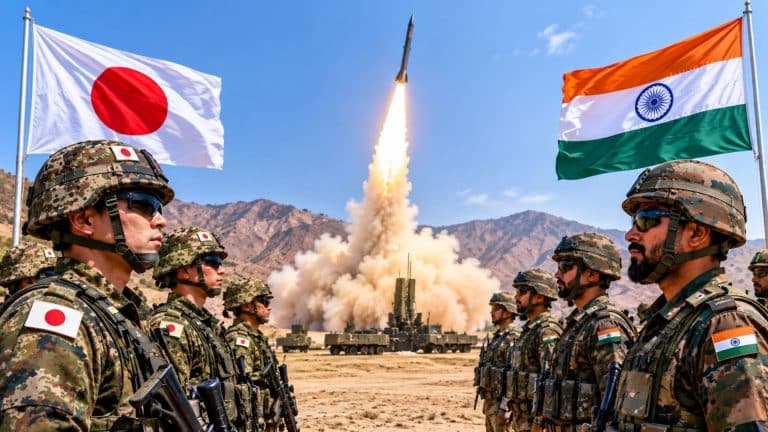
Military Training 2027: In a landmark move that signals a new era of strategic trust in the Indo-Pacific, India has agreed to let Japan’s military test its long-range missiles on Indian firing ranges starting next year.
The agreement was reached during high-level ministerial talks held in Tokyo on Thursday, according to media reports. For the first time in history, the Japan Self-Defense Forces (JSDF) will use Indian soil and maritime zones to conduct live-fire drills, a step that carries heavy geopolitical weight across Asia.
Why Japan Needs India’s Vast Open Spaces
Military Training 2027: At the heart of this deal is a simple geographical problem. Japan is an island nation with a high population density and some of the busiest commercial shipping lanes and airspaces in the world. Finding a safe, empty stretch of land or sea to test long-range weapons has been a persistent headache for Tokyo.
Specifically, Japan is looking to test its Type-25 anti-ship missile, which boasts a strike range of nearly 1,000 kilometers, alongside smaller attack drones. Testing weapons of that reach requires massive, isolated zones where military teams can track the entire flight path and monitor the impact area without putting civilian ships or commercial aircraft at risk.
India, by contrast, possesses sprawling military training grounds and vast, controllable maritime operational spaces. By opening these ranges to Japanese forces, New Delhi is giving Tokyo a rare opportunity to evaluate its missile capabilities under realistic conditions.
Speaking after the talks, Japanese Defense Minister Shinjiro Koizumi highlighted the importance of the pact. He confirmed that both sides agreed the JSDF will utilize Indian firing ranges for the first time next year, calling it a major strategic step forward, according to media reports.
‘Design with Japan, Make in India’: Stealth Tech for the Indian Navy
Military Training 2027: The partnership goes well beyond lending out testing grounds. Both nations are accelerating joint defense manufacturing and technology sharing, with a sharp focus on naval stealth.
Top officials from both countries expressed their intent to finalize the UNICORN (Unified Complex Radio Antenna) stealth naval mast project as quickly as possible. Under the ‘Design with Japan, Make in India’ framework, India is expected to clear the necessary regulatory approvals by February 2027, according to media reports.
Originally developed by Japan, the UNICORN system is an advanced, integrated antenna structure. Instead of cluttering a warship’s deck with dozens of separate antennas and communication dishes, UNICORN houses them all inside a single, sleek, horn-shaped mast. India plans to co-develop and install this technology on its future naval warships.
How UNICORN upgrades India’s naval fleet:
Radar Evasion: Smooth, integrated surfaces drastically reduce a warship’s radar cross-section, making it much harder for enemy sensors to spot.
Stealth Tracking: Adversaries will struggle to identify and lock onto Indian vessels from a distance.
Superior Electronic Warfare: Combining sensors into one unified hub boosts communication clarity and electronic warfare capabilities.
Cleaner Deck Design: Eliminating multiple scattered antennas frees up space and reduces signal interference on board.
Deeper Coordination Across Sea and Sky
Maritime and aerial cooperation between the two democracies is also expanding into daily operational territory. The Indian Navy and the Japan Maritime Self-Defense Force have agreed to work closely on maritime and aerial surveillance, real-time intelligence sharing, search-and-rescue operations, and disaster relief.
Beyond routine patrols, both navies will collaborate on upgrading technologies to detect and neutralize underwater sea mines. They also plan to explore joint shipbuilding projects for future naval vessels, according to media reports.
In the skies, momentum is building rapidly. Earlier, Japanese fighter jets visited India for the first time to participate in the ‘Veer Guardian-26’ air exercise.
Now, both militaries are preparing to modernize their joint drills by integrating unmanned aerial vehicles (UAVs) and autonomous military hardware. Notably, the two nations have also agreed to conduct joint exercises on short notice whenever strategic situations demand rapid coordination.
A Sharp Warning on Cross-Border Terrorism
While defense hardware dominated the headlines, the diplomatic message coming out of Tokyo was equally firm. In a strongly worded joint statement, India and Japan condemned terrorism and violent extremism in all its forms, specifically calling out cross-border terrorism, a clear diplomatic signal aimed at Pakistan.
The statement explicitly named United Nations-proscribed terrorist outfits, including Al-Qaeda, ISIS, Lashkar-e-Taiba (LeT), and Jaish-e-Mohammed (JeM), according to media reports. Both nations stressed the urgent need to dismantle terror safe havens, choke off illicit financial networks, and halt the cross-border movement of militants.
The Bigger Strategic Picture
Taken together, the outcomes of Thursday’s talks show that the India-Japan partnership has moved well past polite diplomatic summits and basic naval pass-throughs. By allowing Japanese missiles to test in Indian waters, co-building stealth warship components, and aligning against state-sponsored terrorism, New Delhi and Tokyo are quietly building one of the most consequential security partnerships in the Indo-Pacific.
Also Read : APEC Summit 2026: US, China, and Russia Agree on UN Reforms, Oil Supply, and Nuclear Risk Reduction