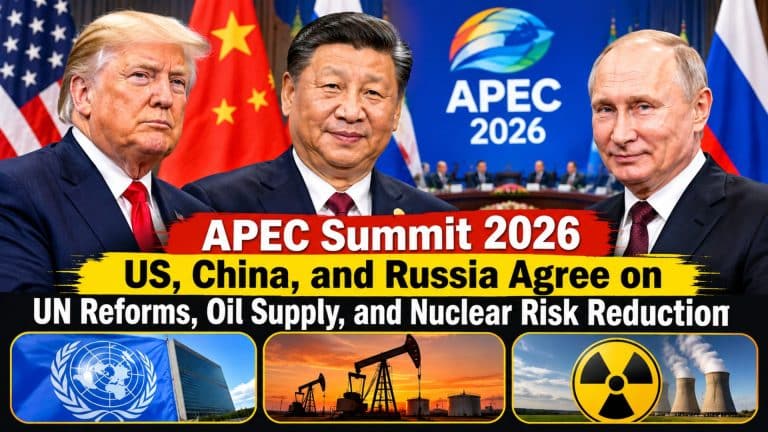
APEC Summit 2026: In a major diplomatic development that could reshape global politics, the leaders of China, Russia, and the United States have agreed to push for reforms at the United Nations, boost global oil supplies, and hold talks aimed at lowering nuclear risks.
According to officials from Beijing and Moscow, this consensus was reached during a historic trilateral summit held on Thursday between US President Donald Trump, Chinese President Xi Jinping, and Russian President Vladimir Putin.
While the White House has not yet officially released the document, a joint declaration shared by Chinese and Russian officials outlines several key areas of agreement. However, media reports indicate that the statement remained entirely silent on the ongoing wars in Ukraine and Iran, two major global crises that President Trump had stated he discussed with both leaders earlier in the day.
Key Takeaways from the Joint Declaration
APEC Summit 2026: The three global powers focused their official statement on broad institutional and economic goals, signaling a willingness to find common ground despite deep geopolitical rivalries. According to the declaration, the leaders committed to:
United Nations Reforms: Working together to modernize the UN so it can “more effectively address global challenges.”
Energy Stability: Increasing the production and supply of oil products to ensure a steady, uninterrupted flow of energy across global markets.
Nuclear Safety: Engaging in discussions to reduce nuclear risks and prevent the spread of nuclear weapons.
Criticism of the ICC: In a pointed message, the three nations pushed back against the International Criminal Court (ICC). The statement asserted that government officials must be shielded from ICC prosecutions and warned against any “abuse” of the court’s jurisdiction.
This shared stance against the ICC highlights a rare overlap in their national interests. President Putin currently faces an active arrest warrant from the ICC, while the Trump administration has slapped heavy sanctions on the court and its officials over its recent investigations.
Xi Hails “Fruitful” Talks as Trump Departs
APEC Summit 2026: Following the conclusion of the summit, President Trump departed Shenzhen. Meanwhile, Chinese state media highlighted the positive atmosphere of the talks. In remarks carried by the state news agency Xinhua, President Xi described the three-way engagement as “positive, constructive, and fruitful.”
“The three countries share a common perspective on safeguarding world peace,” Xi stated, adding with optimism that the “seeds sown during today’s trilateral meeting will undoubtedly take root, sprout, and bear fruit.”
A Return to Great Power Politics
President Trump had promoted this unprecedented sit-down with America’s two primary rivals as a vital opportunity to draft new rules for nuclear arms control and jumpstart peace efforts in Ukraine and Iran. Yet, ahead of the meeting, diplomatic experts had kept expectations low for any immediate breakthroughs.
Media reports suggest that Trump’s approach reflects a return to an older era of “great power politics,” where the world’s most powerful nations negotiate the fate of global affairs directly among themselves. Notably, Trump entered these discussions without Ukraine at the table, and without the direct involvement of key US allies, such as the United Kingdom, France, Germany, Japan, and South Korea, all of whom have major security stakes in the outcomes of these talks.
Warm Handshakes, Subtle Friction
President Trump has frequently expressed confidence that his personal rapport with foreign leaders gives him a unique diplomatic advantage. On Wednesday, Xi made a rare symbolic gesture by greeting Air Force One directly on the airport tarmac, where the two leaders shared a handshake that turned into a brief, one-armed hug.
However, beneath the cordial optics, media reports point out that the warmth between the leaders is not always equal. While Trump has praised both leaders, Xi and Putin appear to share a much deeper strategic bond.
At the APEC summit on Wednesday, Xi warmly greeted Putin as “my old friend,” to which the Russian leader replied by calling Xi his “dear friend.” Since Russia’s 2022 invasion of Ukraine, Beijing has served as a crucial economic lifeline for Moscow, helping buffer the impact of Western sanctions.
In contrast, Xi’s tone toward Trump has been noticeably more measured. During his state visit to the White House in September, Xi kept his remarks restrained, noting only that they had built a “personal rapport and stayed in touch.” The two leaders are scheduled to meet once more this year at the G20 summit in Florida this December.
Behind-the-Scenes Tensions
Despite the public praise, signs of underlying friction between Washington and Beijing surfaced throughout Thursday’s events:
Media Restrictions: Chinese officials barred Bloomberg journalist Annmarie Hordern from entering the trilateral meeting room after she posed a question during the earlier bilateral session between Trump and Xi.
Competing Narratives on Camera: A subtle war of optics played out across media channels. Chinese state television aired footage showing President Trump appearing drowsy during the proceedings, while the White House quickly countered by posting a video clip of Trump assisting Xi up an escalator.
Whether Thursday’s summit marks a genuine turning point in international relations or simply a high-profile photo opportunity remains to be seen, as the world watches to see if these promises translate into concrete action.