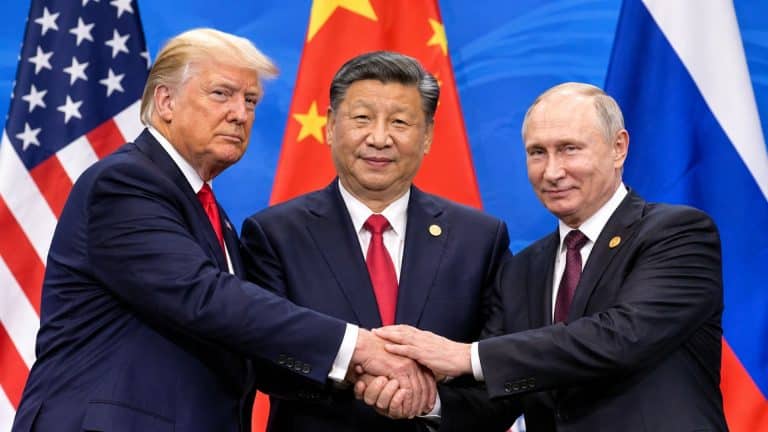
Historic Trilateral in Shenzhen: In a rare diplomatic convergence that has captured global attention, the leaders of the world’s three foremost nuclear powers, Chinese President Xi Jinping, US President Donald Trump, and Russian President Vladimir Putin, concluded a pivotal 90-minute trilateral meeting on the sidelines of the 33rd Asia-Pacific Economic Cooperation (APEC) Economic Leaders’ Meeting.
Hosted in China’s premier technology hub following a formal welcome reception on Wednesday evening, the high-stakes dialogue culminated in the release of a joint four-point “Peace Declaration.” According to Chinese state media reports, the document signals an attempt by Washington, Beijing, and Moscow to establish common ground on urgent global security challenges, ranging from nuclear arms control to energy stability.
A Rare Convergence of Global Superpowers
Historic Trilateral in Shenzhen: While the broader APEC summit is heavily centered on international trade, tariffs, supply chain resilience, and artificial intelligence governance, the closed-door session between Xi, Trump, and Putin quickly emerged as the centerpiece of the diplomatic gathering.
According to media reports, the 90-minute discussion addressed pressing geopolitical flashpoints, most notably the ongoing conflict in Ukraine and the escalating risks of nuclear proliferation. Despite deep-seated strategic rivalries among the three nations, the resulting declaration highlights specific areas where their interests align to prevent global instability.
The Four-Point Peace Declaration: Key Takeaways
Historic Trilateral in Shenzhen: Following the conclusion of the talks, Chinese state media reports outlined the four foundational pillars agreed upon by the three leaders:
- Preventing Nuclear Conflict and Reducing Risks
At the core of the declaration is a unified stance on nuclear restraint. All three leaders reaffirmed the long-standing principle that a nuclear war cannot be won and must never be fought.
During the discussions, President Xi Jinping called for a complete prohibition and thorough destruction of nuclear weapons.
Echoing the need for de-escalation, President Donald Trump advocated for direct trilateral cooperation to shrink global nuclear stockpiles.
The three nations formally pledged to maintain open channels of dialogue to mitigate nuclear risks and curb further proliferation.
- Boosting Global Energy Security
Recognizing the volatility in global energy markets, the three powers committed to stabilizing supply chains. According to media reports, China, Russia, and the United States proposed expanding the production and supply of refined petroleum products. The leaders underscored that maintaining steady, uninterrupted energy flows is vital for global economic recovery and growth.
- Pledging United Nations Reforms
In an effort to modernize multilateral diplomacy, Beijing, Moscow, and Washington vowed to push for structural reforms within the United Nations. The joint statement noted that updating the international body is necessary to ensure it can respond more effectively to emerging global crises and uphold international peace and security.
- Upholding Sovereignty and International Law
The declaration placed strong emphasis on state sovereignty, state consent, and the legal immunity of state officials. Notably, the leaders issued a pointed warning regarding global judicial bodies, stating that the International Criminal Court (ICC) and similar institutions must operate strictly within their mandates and refrain from abusing their jurisdiction.
Addressing the Ukraine Conflict
Beyond the four-point framework, the ongoing Russia-Ukraine war featured prominently during the 90-minute exchange. According to media reports, President Vladimir Putin stated that the United States, Russia, and China share a common interest in resolving global conflicts and bear a collective responsibility to safeguard international peace.
However, no specific ceasefire framework, peace deal, or immediate diplomatic breakthrough regarding Ukraine was announced in the materials released after the meeting.
Trade, Tariffs, and Tech Dominate Broader APEC Agenda
Outside the trilateral room, the wider 33rd APEC summit continues to navigate a complex economic landscape. With Shenzhen serving as a global beacon for technological innovation, delegates are heavily focused on the future of artificial intelligence, digital infrastructure, and cross-border tech governance.
Simultaneously, world leaders are grappling with persistent friction over global trade policies, protective tariffs, and the urgent need to secure fragile supply chains. As bilateral and multilateral meetings continue throughout the summit, observers note that the unexpected alignment between Xi, Trump, and Putin on nuclear and energy issues sets a pragmatic, albeit cautious, tone for the remainder of the gathering.