
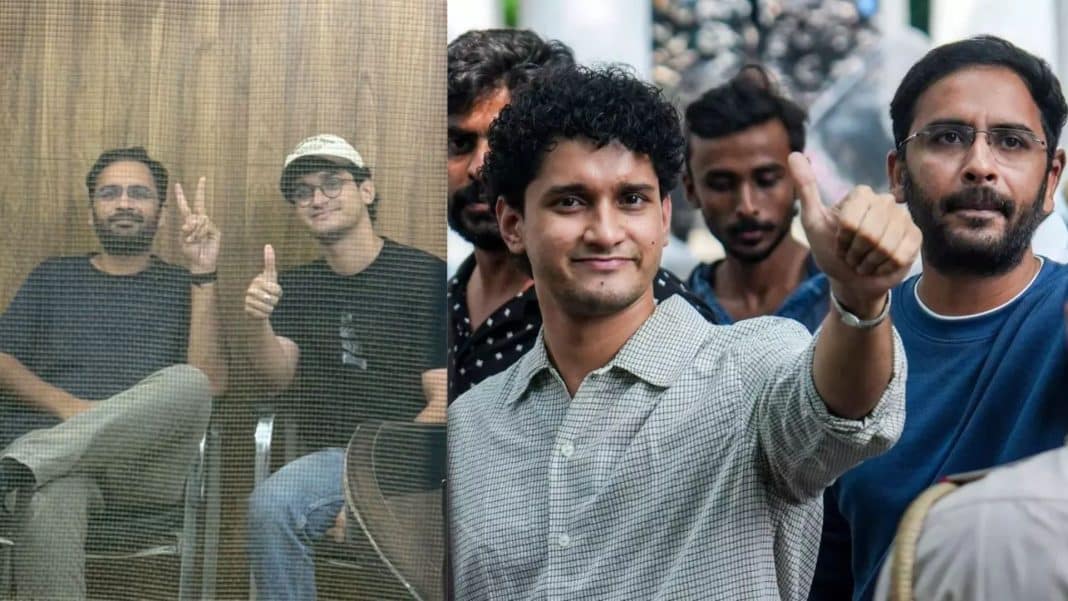

Delhi HC to CJP Leaders: In a major legal development surrounding the ongoing political agitations in the national capital, Cockroach Janata Party (CJP) co-conveners Saurav Das and Ashutosh Ranka on Wednesday withdrew their writ petition from the Delhi High Court.
The petition challenged their extended judicial custody following protests against Chief Election Commissioner Gyanesh Kumar.
The withdrawal came after a bench headed by Justice Subramonium Prasad raised critical questions regarding the procedural validity of filing a writ petition when statutory remedies under the Bharatiya Nagarik Suraksha Sanhita (BNSS) remained available.
The High Court clarified that it was permitting the withdrawal without expressing any opinion on the merits of the case.
High Court Questions Petitioners on Procedural Remedies and “Gen-Z” Identity
Delhi HC to CJP Leaders: During the hearing, the High Court questioned why the CJP leaders approached the High Court via a writ petition instead of waiting for the outcome of scheduled proceedings before the Special Executive Magistrate (SEM).
Justice Prasad noted that a writ petition primarily examines the decision-making process rather than the factual merits of an order extending custody.
The court orally suggested that the petitioners should observe the SEM proceedings scheduled for later in the day and pursue appropriate appellate channels under the BNSS if necessary.
In a lighthearted yet sharp exchange regarding the evolution of the group’s agitations, the court referred to the leaders’ earlier involvement in student-led demonstrations against exam irregularities in July and inquired about their ages.
When informed that Saurav Das was 27 and Ashutosh Ranka was 31, the judge remarked, “Then you are not Gen Z.”
The bench observed that while earlier protests involved students, the nature, scope, and objectives of the current proceedings had shifted, making the identity and activities of the organization relevant for local authorities assessing potential breaches of peace.
Alleged Breach of Peace Bonds at Denotified Jantar Mantar Site
Delhi HC to CJP Leaders: The legal dispute traces back to preventive action taken by law enforcement authorities. According to media reports, Das and Ranka were initially detained at an airport on October 10 under Sections 126 and 170 of the BNSS ahead of planned demonstrations.
They were released the same day after executing peace bonds worth ₹50,000.
However, the duo was apprehended again on October 14 following an attempt to organize a “Tiranga” rally at Jantar Mantar—a location recently de-notified as a designated protest venue by the Ministry of Home Affairs.
Key arguments raised during the High Court hearing included:
Breach of Peace Bonds: The bench noted allegations that the leaders breached their undertaking by mobilizing at Jantar Mantar.
While the petitioners pointed out that the challenge to the site’s denotification is pending before the Supreme Court, the High Court observed that the notification had not been stayed.
Crowd Dynamics and Public Order: The court highlighted reports of barricade disruptions, noting that unpermitted rallies risk attracting unvetted crowds whose actions may fall outside the control of organizers.
SEM Order Details: An order issued by SEM Ritu Raj on October 19 extended their custody, citing intentional bond breaches and law enforcement concerns regarding repeated protest calls at non-designated sites.
Disputes Over Surety Verification and Statutory Options
Advocate Abhik Chimni, representing the petitioners, argued that the October 19 custody extension lacked adequate justification regarding an immediate threat to public peace.
The defense counsel also challenged the repeated rejection of submitted sureties as arbitrary, urging the court to release the leaders on personal bonds.
According to media reports, the SEM order noted that submitted sureties were rejected after discrepancies were identified between documentation photographs and identification cards, as well as unsatisfactory responses during routine verification inquiries.
Addressing concerns that withdrawing the petition might leave the leaders without immediate relief, the High Court emphasized that statutory remedies under the BNSS provide dedicated appellate frameworks to address grievances regarding surety rejections and custody orders.
Following the bench’s observations, counsel for the petitioners withdrew the writ petition on instructions from his clients, shifting the immediate focus back to magistrate-level proceedings.
Also Read: UNESCO World Heritage List: 3 New Indian Sites Added to UNESCO Tentative List, See Full Details