


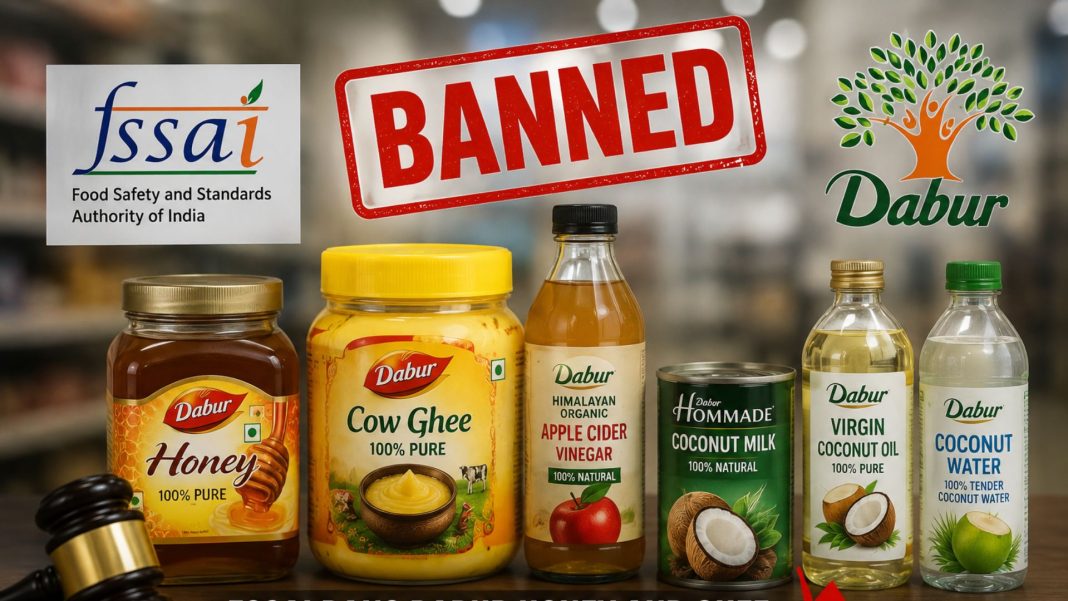

FSSAI Bans Dabur Honey: India’s apex food safety regulator, the Food Safety and Standards Authority of India (FSSAI), has issued a prohibition order halting the sale of several flagship food items manufactured by Dabur India.
The regulatory action targets key consumer staples including honey, cow ghee, apple cider vinegar, and virgin coconut oil due to the company’s continued use of “100 per cent” purity and organic claims in its online marketing and packaging.
According to official updates, the regulator clarified that the prohibition stems entirely from non-compliance with advertising and labelling standards rather than product safety or contamination concerns.
What Triggered the Regulatory Enforcement?
Fssai news today: The central issue behind the regulatory order relates to marketing terminology used across Dabur’s official digital portals and promotional materials.
FSSAI flagged several widely used product descriptions, including claims such as “100% Pure,” “100% Natural,” “100% Organic,” “100% Purity Guaranteed,” and “100% Tender Coconut Water.”
According to the food safety authority, such absolute claims violate the Food Safety and Standards (Advertising & Claims) Regulations, 2018.
Officials noted that terms claiming complete purity are ambiguous, scientifically unverifiable, and capable of creating a misleading impression of absolute superiority over competing market alternatives.
The current directive follows a broader industry advisory issued in May 2025, where the regulator explicitly instructed all food business operators (FBOs) across India to eliminate “100 per cent” claims from their product labels, packaging, and commercial advertisements.
Scope of Affected Products and ‘Jaivik Bharat’ Logo Violations
Dabur fssai news: The prohibition order applies to a significant portfolio of Dabur’s fast-moving consumer goods (FMCG) line. As reported by media outlets, the specific items cited in the regulatory notice include:
Dabur Honey and Dabur Organic Honey
Dabur Cow Ghee
Dabur Himalayan Organic Apple Cider Vinegar
Dabur Hommade Coconut Milk
Virgin Coconut Oil, Sesame Oil, and Coconut Water
FSSAI Bans Dabur Honey: In addition to the “100 per cent” claims, FSSAI highlighted compliance failures regarding organic certifications.
The regulator revealed that certain products, such as Dabur Organic Honey and Himalayan Organic Apple Cider Vinegar, displayed the official “Jaivik Bharat” logo without possessing valid, active organic endorsements required by law.
The Jaivik Bharat mark serves as India’s official green indicator verifying that a food product meets certified organic farming and handling criteria.
Regulatory Ultimatum and Dabur’s Response
In its formal communication, the regulator stated that prior notices had been issued to Dabur India directing the voluntary removal of these misleading claims.
However, because the corrective measures taken by the consumer goods major were deemed unsatisfactory, FSSAI ordered an immediate suspension of sales for the flagged products in their current labelled formats.
The regulator has mandated that Dabur submit an official Action Taken Report (ATR) within 15 days, detailing the steps initiated to comply with labelling codes and recall non-compliant promotional stock.
Responding to the development, Dabur India confirmed receipt of the regulatory notice.
According to official company statements, the enterprise is thoroughly reviewing the specific content and digital listings cited by the authority to ensure full alignment with regulatory expectations.
Market Reaction: Dabur Shares Decline in Early Trade
Following news of the sales prohibition, Dabur India Limited experienced immediate selling pressure on Indian stock exchanges.
In Tuesday’s trading session, shares of the FMCG giant dropped nearly 3 per cent in morning trade on the Bombay Stock Exchange (BSE), touching an intraday low around ₹414 per share.
Market analysts attribute the stock decline to concerns over potential short-term operational disruption, inventory repackaging costs, and the temporary loss of digital sales momentum for core revenue-generating SKUs like honey and ghee.
Industry Implications and Tighter Oversight
FSSAI Bans Dabur Honey: The enforcement action against Dabur marks a major step in FSSAI’s ongoing campaign against deceptive food advertising.
Over recent months, the food regulator has significantly expanded its scrutiny over front-of-pack claims, warning brands against utilizing unsubstantiated health declarations, exaggerated purity metrics, or unauthorized organic stamps.
According to industry observers, this development serves as a strong precedent for the entire packaged foods sector.
Manufacturers across India are expected to audit their product packaging, e-commerce listings, and marketing slogans to ensure absolute adherence to statutory advertising frameworks.
Also Read: LIC OFS Alert: Govt to Sell 6.5% Stake at ₹382 Floor Price — Should You Buy or Avoid?