

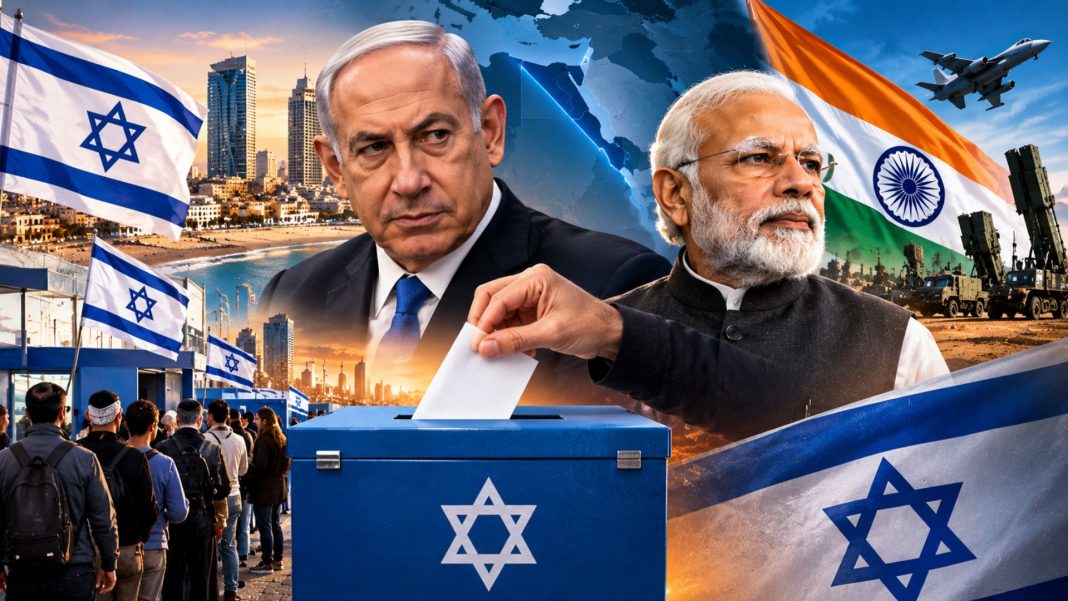

High Stakes in Tel Aviv: Israel is voting today in a high-stakes parliamentary election that will decide whether Prime Minister Benjamin Netanyahu stays in office or makes way for a new leadership.
In New Delhi, policymakers, security experts, and trade analysts are monitoring the situation with intense interest. Only eight months ago, India and Israel elevated their bilateral relationship to a “Special Strategic Partnership.“ With massive economic, defense, and security investments across a region rocked by conflict, India has significant stakes tied to the outcome in Tel Aviv.
What is Happening in Israel Today?
High Stakes in Tel Aviv: Around 7.3 million eligible voters are casting their ballots to elect the 26th Knesset, which consists of 120 seats.
Under Israel’s electoral system, citizens vote for party lists rather than directly for a prime minister.
The 61-Seat Requirement: To form a government, a coalition must secure the support of at least 61 members. No single party in Israel’s history has ever won an outright majority on its own.
Historical Significance: The Knesset dissolved on July 17 earlier this year. Today’s vote is historic, it marks the first election since 1988 to take place on its legally scheduled date, and it is the first national vote since the October 7, 2023 attacks that sparked the Gaza war.
The Threshold: Parties must cross a electoral threshold of 3.25% to secure representation in parliament.
Netanyahu’s handling of pre-war security failures, the subsequent war effort, domestic economic pressures, and contentious military-service exemptions for the ultra-Orthodox have become central campaign battlegrounds.
Netanyahu, leading the right-wing Likud, heads a coalition that includes far-right allies like Bezalel Smotrich and Itamar Ben-Gvir alongside ultra-Orthodox groups.
His main challenger is Gadi Eisenkot, a former military chief of staff who leads the newly formed centrist Yashar party. Other key players include former Prime Minister Naftali Bennett and Yair Lapid, allied under the B’Yachad (Together) umbrella, alongside Avigdor Lieberman and the left-wing Democrats.
With polls suggesting neither major bloc may hit the magic number of 61 seats, the real power play will begin during post-election coalition bargaining. Analysts note that another election cannot be ruled out if negotiations hit a wall.
Why India is Watching the Israel Elections
- Defense: New Delhi’s Top Priority
Defense and security form the bedrock of the India-Israel partnership, traceably rooted in the 1999 Kargil conflict when Israeli military equipment arrived at a crucial juncture.
Over the years, Israel has grown into one of India’s top arms suppliers. Between 2020 and 2024, India accounted for nearly 34% of Israel’s total defense exports.
Key Defense Highlights:
Media reports indicate India’s Defence Acquisition Council approved a major package worth approximately $8.7 billion (₹78,217 crore) for advanced Israeli weapon systems, including SPICE-1000 bombs, Rampage air-to-surface missiles, Air LORA ballistic missiles, and Ice Breaker missiles.
Cooperation focuses heavily on technology transfer and joint manufacturing supporting the Aatmanirbhar Bharat initiative.
Under a November 2025 MoU, joint ventures involve co-development in cyber defense and artificial intelligence.
Israeli hardware plays a key role in India’s multi-layered air defense initiative, “Mission Sudarshan Chakra.”
New Delhi will be closely observing whether a new administration in Tel Aviv ensures seamless execution of existing defense contracts and supply chains while managing its own war-time defense requirements.
- The Personal Bond & Diplomatic Continuity
Prime Minister Narendra Modi and Benjamin Netanyahu have developed a well-documented rapport. In February this year, during a two-day state visit to Israel, PM Modi addressed a special plenary session of the Knesset, elevating bilateral relations to a “Special Strategic Partnership for Peace, Innovation and Prosperity.”
The leadership personal touch remained evident when Netanyahu spoke with PM Modi on the phone, reaffirming strategic momentum. Netanyahu also invited PM Modi and Indian pilot Captain Smit Machchhar, who was injured while preventing a tragedy aboard flydubai flight FZ1073, to light a ceremonial torch at Israel’s 2027 Independence Day.
While leadership changes can alter personal chemistry, Israeli diplomats in India emphasize that institutional foundations remain solid. Israel’s embassy spokesperson stated that state-to-state relations will remain steadfast regardless of who wins. Furthermore, opposition leader Gadi Eisenkot has publicly highlighted India as an essential strategic partner to diversify Israel’s international ties.
- Trade, Tech, and Job Opportunities
Economic collaboration between both nations is expanding into futuristic sectors. Agreements signed earlier this year cover:
Artificial Intelligence research and education integration.
Establishment of an Indo-Israel Cyber Centre of Excellence.
Agricultural innovation centers.
Digital payment linkages connecting India’s UPI with Israel’s MASAV.
A mobility pact facilitating up to 50,000 Indian workers moving to Israel over five years.
With bilateral merchandise trade crossing $3.5 billion in 2024–25 and Free Trade Agreement (FTA) negotiations ongoing, Indian business sectors are eagerly watching for policy continuity from the incoming Israeli leadership.
West Asian Balancing Act: Energy, Iran, and Trade Corridors
India’s stakes extend beyond bilateral agreements into broader West Asian stability. Ongoing regional conflicts, including US-Israeli operations involving Iran and maritime friction, directly affect critical Indian interests.
Sectoral Impact on India
| Sector | Impact / Strategic Stake for India |
|---|---|
| Energy Security | Over 80% of India’s crude oil imports transit West Asian sea lanes. Nearly 90% of LPG and 69% of LNG move through the Strait of Hormuz. |
| Shipping Safety | Recent maritime incidents in the region have heightened security risks for Indian commercial vessels and merchant navy personnel. |
| GCC Trade & Diaspora | India–GCC trade reached $178.63 billion in 2025–26. Around 10 million Indian expatriates work across the Gulf, making their safety a key priority. |
| IMEC Project | The India–Middle East–Europe Economic Corridor (IMEC) depends on regional stability and normalized ties, including stability around Israeli ports. |
On key geopolitical issues, India maintains a delicate balance:
Two-State Solution: India continues to back a negotiated two-state framework, whereas both Netanyahu and Eisenkot have voiced strong skepticism toward a Palestinian state during their respective campaigns.
Iran & Strategic Links: New Delhi maintains diplomatic channels with Tehran for trade access via the Chabahar Port to Central Asia, even as Israeli leaders maintain a firm stance against Iran.
The Verdict: Will the Outcome Alter India-Israel Relations?
Diplomatic experts overwhelmingly agree that the core trajectory of India-Israel ties will remain unchanged. Strategic commitments have evolved over three decades through both right-wing Likud and centrist Israeli administrations.
A Netanyahu victory would mean immediate continuity in leadership dynamics, defense deals, and alignment with Washington’s regional policies.
An Eisenkot or centrist coalition victory might shift the tone on regional diplomacy, Gaza humanitarian access, and Western alliances, while preserving core defense and economic partnerships with India.
A political deadlock could delay operational decisions regarding trade negotiations, defense procurement schedules, and diplomatic initiatives.
Regardless of who claims victory in Tel Aviv, the strategic, technological, and security compulsions binding India and Israel are built to endure political transitions.
Also Read : Saudi Arabia Houthis: Saudi Arabia Offers $1 Billion to Houthis via Iran to End Escalating Conflict