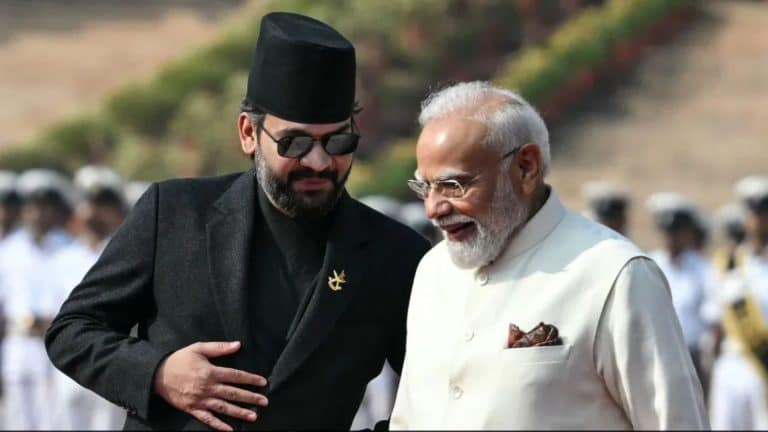
India and Nepal Ink 8 Major Pacts: Marking a fresh chapter in bilateral diplomacy, Nepal’s Prime Minister Balendra Shah sat down for high-level talks with Indian Prime Minister Narendra Modi in the national capital on Monday.
During the summit, which is Shah’s maiden foreign visit since assuming office in March 2026, the two neighbours sealed eight key agreements and accelerated six major cross-border infrastructure and energy projects.
Arriving in New Delhi for a two-day state visit from November 22 to 23, Prime Minister Shah’s trip focused heavily on post-disaster reconstruction, regional connectivity, and institutional cooperation.
According to media reports, the newly signed Memorandums of Understanding (MoUs) cover a wide spectrum of sectors, including policing, forensic science, civil service training, traditional medicine, satellite communication, urban planning, healthcare, and agriculture
A $1.62 Billion Lifeline for Flood-Ravaged Nepal
India and Nepal Ink 8 Major Pacts: The centerpiece of Monday’s joint press briefing was India’s commitment to helping Nepal recover from nature’s fury. Prime Minister Modi announced a massive economic assistance package worth 240 billion Nepalese rupees, roughly equivalent to $1.62 billion.
This financial lifeline comes just months after catastrophic floods swept through Nepal in August, claiming nearly 1,500 lives and leaving around 5,200 people missing and feared dead. Addressing the press, PM Modi highlighted that despite global and regional hurdles in oil supplies this year, New Delhi ensured that fuel and essential commodities continued reaching Nepal without interruption.
“We will together write a golden chapter of India-Nepal relations,” PM Modi remarked, emphasizing that the bond between the two countries goes far beyond shared borders. He noted that the partnership is anchored in deep trust, where both nations stand shoulder-to-shoulder in times of celebration as well as crisis.
Echoing the sentiment, Prime Minister Shah described the bilateral relationship as one built on mutual respect and enduring goodwill. In a poetic nod to their shared geography, Shah stated that the ties between India and Nepal are “as firm as the Himalayas and as vast as oceans”
Upgrading Security, Governance, and Healthcare
India and Nepal Ink 8 Major Pacts: Beyond immediate financial aid, both governments moved to modernize their institutional frameworks through targeted partnerships:
Policing and Forensics: To sharpen criminal investigation capabilities, Gandhinagar’s National Forensic Sciences University will team up with the Crime Investigation Department of the Nepal Police for joint research and academic programs. Simultaneously, Rashtriya Raksha University signed a pact with Nepal’s National Police Academy to boost law enforcement training.
Civil Service Training: India’s National Centre for Good Governance, operating under the Department of Administrative Reforms and Public Grievances, joined hands with the Nepal Administrative Staff College to run specialized capacity-building workshops for Nepalese bureaucrats.
Traditional Medicine and Health: Recognizing their shared heritage in holistic healing, both sides agreed to collaborate closely on Ayurveda and other traditional medical practices, alongside broader technical cooperation in modern healthcare and medicine.
From Space Tech to Grassroots Livelihoods
The diplomatic push also extended into high-tech communications and everyday rural livelihoods. As per media reports, the Indian Space Research Organisation (ISRO) entered into an agreement with Nepal’s Ministry of Information and Communication to establish a dedicated satellite communication network utilizing the South Asia Satellite.
The remaining agreements aim to bring technical expertise to sustainable urban development, helping Nepal build resilient cities, while also boosting livestock and fisheries management to support rural farmers.
Fast-Tracking Rail, Road, and Energy Links
Physical connectivity and energy trade formed the backbone of the six infrastructure initiatives pushed forward during the talks:
New Cross-Border Train: To strengthen cultural and passenger ties, the two leaders advanced the Saryu-Kamala Express rail service, linking Ayodhya in Uttar Pradesh with Janakpur in Nepal.
Seamless Border Trade: India laid the foundation stone for a brand-new Integrated Check Post (ICP) at Banbasa, while confirming steady progress on existing ICPs at Bhairahawa, Sunauli, and Dodhara Chandani. Additionally, a newly built motorable bridge connecting Dharchula in Uttarakhand with Darchula in Nepal was officially inaugurated, easing daily travel for border residents.
Hydropower and Fuel Security: In the energy sector, both countries laid the foundation stone for the ambitious 669-MW Lower Arun Hydroelectric Project. They also dedicated Phase II of the Motihari-Amlekhgunj petroleum pipeline and initiated groundwork for a new petroleum storage terminal in Jhapa, which will eventually connect to the proposed Siliguri-Jhapa pipeline.
With reconstruction funds secured and critical trade corridors moving from blueprints to reality, Prime Minister Shah’s first diplomatic outing to New Delhi has laid a pragmatic roadmap for bilateral growth.
Also Read : Military Training 2027: Japan’s Military to Use Indian Firing Ranges for Live-Fire Drills in 2027