


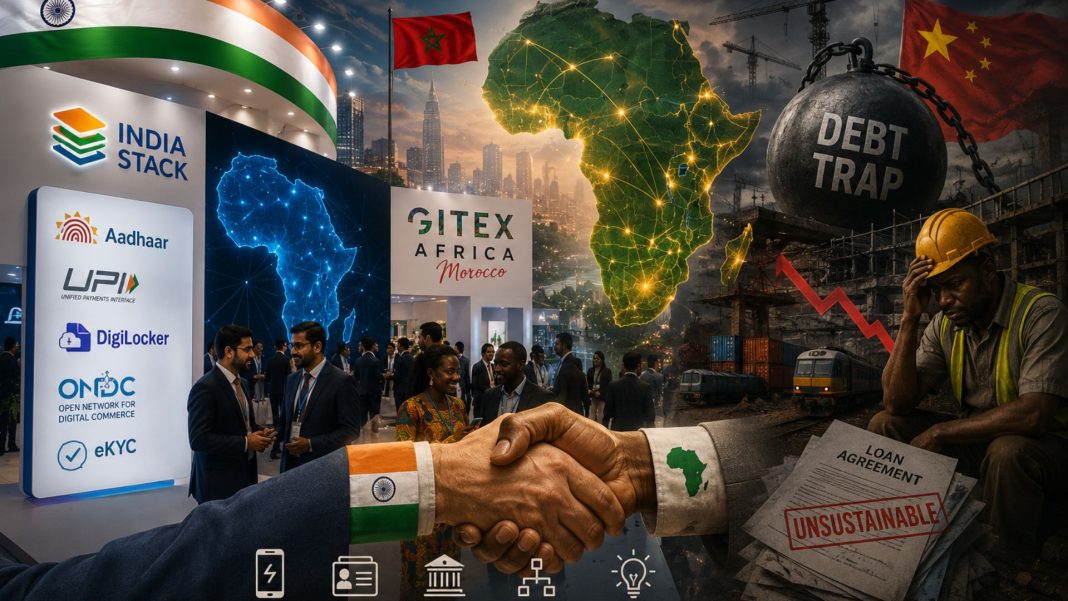

India Stack in Africa: A major geopolitical shift is unfolding across the African continent. For over a decade, Beijing viewed Africa as its exclusive economic playground, expanding its footprint through multi-billion-dollar infrastructure loans.
However, New Delhi has launched a quiet but powerful counter-strategy. By leveraging its homegrown Digital Public Infrastructure (DPI), India is successfully winning over African nations without pushing them into a spiral of unpayable debt.
The defining moment of this diplomatic paradigm shift came at GITEX Africa, the continent’s largest technology and startup summit held in Marrakesh, Morocco. Led by Union Minister of State Jayant Chaudhary, the Indian delegation presented a blueprint of financial empowerment that directly challenges China’s state-backed, extractive investment model.
The Shift: Why Africa is Turning Away from Beijing’s Financial Cage
India Stack in Africa: For years, China’s Belt and Road Initiative (BRI) dominated African infrastructure development. While it built roads, ports, and railways, it came at a devastating cost, a strategy global analysts call “Debt-Trap Diplomacy.”
Chinese lending to Sub-Saharan Africa, which stood at less than 2% of total external debt before 2005, jumped significantly to roughly 17% (amounting to around $134 billion) by the early 2020s. When local governments failed to repay these massive commercial loans, they were often forced to cede control of strategic national assets or suffer severe economic crises, as seen in parts of East and Southern Africa.
In stark contrast, India’s pitch is entirely non-coercive. Speaking at high-level bilateral forums at the summit, Union Minister Jayant Chaudhary made India’s stance clear: “Our development partnership with Africa is demand-driven. It is focused on building local capacities and creating local opportunities. Our objective is not just to invest, but to empower, to help develop self-sustaining ecosystems.”
GITEX Africa: India’s Digital Trilogy Steals the Show
India Stack in Africa: At GITEX Africa, India showcased its globally acclaimed technological stack, demonstrating how open-source public systems can transform a developing economy at a population scale.
The African nations showed immense interest in three foundational pillars of the “India Stack”:Aadhaar (Digital Identity System): A secure foundation that cuts out corruption, reduces welfare leaks, and gives millions an official identity.
UPI (Unified Payments Interface): An interoperable, low-cost instant payment network that integrates central banks, private fintech apps, and small street vendors seamlessly.
ONDC & DigiLocker: Tools that democratize e-commerce and allow secure, paperless verification of documents.
The Power of Open-Source Collaboration
Unlike proprietary western systems or tightly monitored Chinese tech applications, India is offering its DPI blueprints as open-source digital public goods through its “India Stack Global” initiative. This means African nations can adapt, build, and run these platforms independently, ensuring complete digital sovereignty
Currently, 9 out of 11 countries globally implementing the Aadhaar-inspired MOSIP platform are in Africa. Namibia has already collaborated with India to build its national real-time payment system based on the UPI framework, setting up its regional rollout. Furthermore, the Indian government announced that six major African nations,
Sierra Leone, Tanzania, Kenya, Ethiopia, The Gambia, and Lesotho, have officially signed cooperation agreements to adopt up to 18 Indian digital governance platforms. This seamless integration of DPI with the African Continental Free Trade Area (AfCFTA) is projected to help double bilateral trade to $200 billion by 2030.
Skilling and AI: The New Frontier of India-Africa Ties
The strategy isn’t limited to exporting software; it focuses heavily on human capital. At the Marrakech summit, India highlighted its role as a global powerhouse for Artificial Intelligence (AI) and tech professionals.
According to the AI Stanford Index, India recorded an astonishing 33.39% year-on-year growth in AI talent hiring, driven by concerted government and industry investments.
Through platforms like the Skill India Digital Hub (SIDH), which has onboarded over one crore users, and specialized training slots under the Indian Technical and Economic Cooperation (ITEC) program, India is training thousands of African professionals in cyber security, AI, and fintech. This focus on local skill building directly contrasts with China’s reliance on importing its own labor force for African projects.
The Verdict: Partnership vs. Exploitation
The consensus among geopolitical experts is clear: India’s digital diplomacy has hit China where it hurts the most. Beijing’s heavy capital investments are losing traction because they do not prioritize local jobs or technology transfers. Indian companies operating across Africa, ranging from healthcare providers like Cipla to digital networks like Airtel, focus instead on grass-roots entrepreneurship and localized market integration
By presenting a model of “Digital Non-Alignment” that prioritizes peer-to-peer business partnerships over borrower-lender dependencies, New Delhi has successfully positioned itself as the trusted voice of the Global South. As the digital race intensifies, India’s low-cost, scalable, and non-exploitative tech ecosystem is rapidly becoming Africa’s preferred choice for a sovereign digital future.
Also Read : India-Japan Relations: 75 Years of Friendship and 10 Historic Moments