


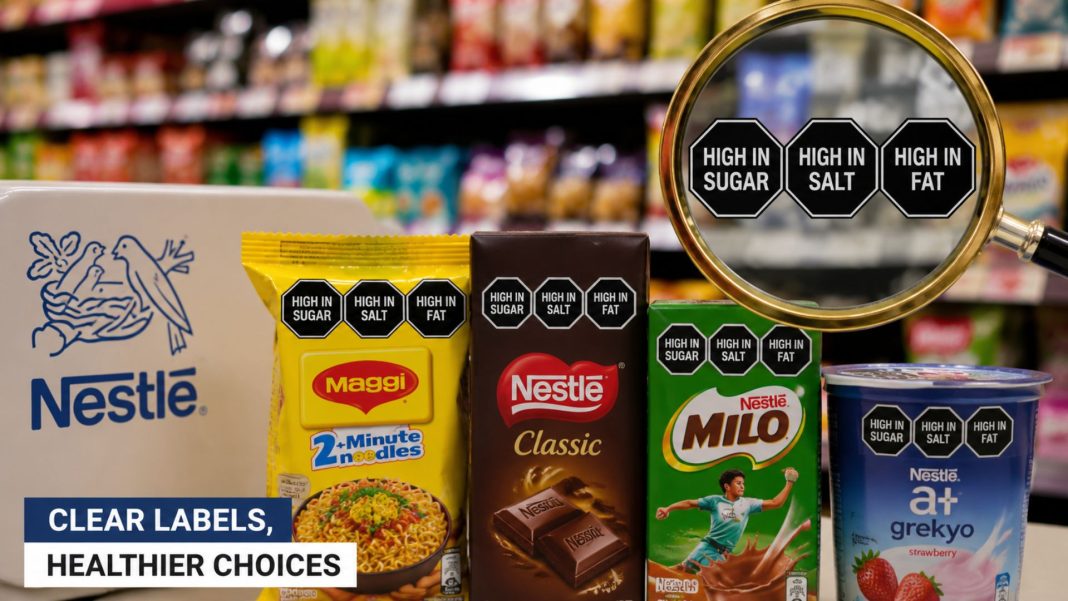

India’s Front-of-Pack Food Warning Labels: India’s fast-moving consumer goods (FMCG) market is undergoing intense regulatory and public scrutiny over the nutritional quality of packaged foods.
According to media reports, global food giant Nestle has urged the Indian government to consult food manufacturing companies before finalizing rules for mandatory Front-of-Pack Labelling (FOPL).
The push comes at a time when health activists, regulatory agencies, and the Supreme Court of India are advocating for clear warning labels on products high in fat, sugar, and salt (HFSS).
According to industry estimates, nearly 80 percent of products sold in India’s more than $100 billion packaged food and beverage sector fall into the high-fat, high-sugar, or high-salt category.
Nestle CEO Backs Transparency but Demands Industry Input
India’s Front-of-Pack Food Warning Labels: Speaking on the company’s positioning, Nestle CEO Philipp Navratil stated that the brand supports greater transparency in food labelling, including front-of-pack disclosures for HFSS products.
However, Navratil emphasized that manufacturers should be allowed to contribute their scientific research and international market experience during the regulatory design phase.
“If we are asked to, we are happy to collaborate and give our scientific point of view and share our learnings from other countries,” Navratil noted.
Key industry arguments raised by Nestle regarding the proposed labelling framework include:
Portion-Based vs. Grammage Metrics: Navratil argued that nutritional warnings should be calculated per serving size rather than per 100 grams or 100 milliliters, as consumers typically eat individual portions rather than bulk measurements.
Voluntary Declarations: According to media reports, Nestle India already prints Recommended Dietary Allowance (RDA) information on the front of its product packages voluntarily.
Global Precedents: The company maintains that warning systems must be grounded in peer-reviewed scientific evidence to prevent unjust penalization of packaged food formulations.
Regulatory Tug-of-War: Industry Opposition vs. Supreme Court Intervention
India’s Front-of-Pack Food Warning Labels: The debate around front-of-pack warning labels has simmered for years.
India’s food safety regulator, the Food Safety and Standards Authority of India (FSSAI), previously explored various front-of-pack rating models, including star ratings and percentage daily limits.
However, strict black-box style warning symbols faced resistance from major food and beverage conglomerates and industry trade bodies, leading to delays in mandatory implementation.
The issue regained significant momentum following strong observations by the Supreme Court of India.
According to media reports, while hearing petitions filed by public health advocates, the top court criticized regulatory delays in enacting front-facing warnings and called for swift action to safeguard consumer health.
Public outcry on social media has also grown, with consumers pointing out disparities between the higher sugar levels present in Indian packaged food variants compared to identical brands sold in European markets.
India Emerges as Nestle’s Key Global Growth Engine
The controversy over labelling comes as India solidifies its position as one of Nestle’s most lucrative global operations. Navratil revealed that India was Nestle’s highest-performing market in terms of volume growth during the first half of calendar year 2026.
Currently ranked among Nestle’s top ten global markets, India is projected to move into the top five in the coming years.
To support this rapid expansion, Nestle plans to ramp up investments across Indian manufacturing facilities, research and development centers, and supply chain networks.
Approximately 90 percent of the raw materials used by Nestle India are sourced domestically, and the local entity exports finished products to nearly 28 international markets.
While global manufacturers remain eager to capture India’s expanding urban middle-class market, the ongoing battle over front-of-pack health warnings underscores a tightening regulatory environment aimed at combating lifestyle diseases and ensuring consumer transparency.