


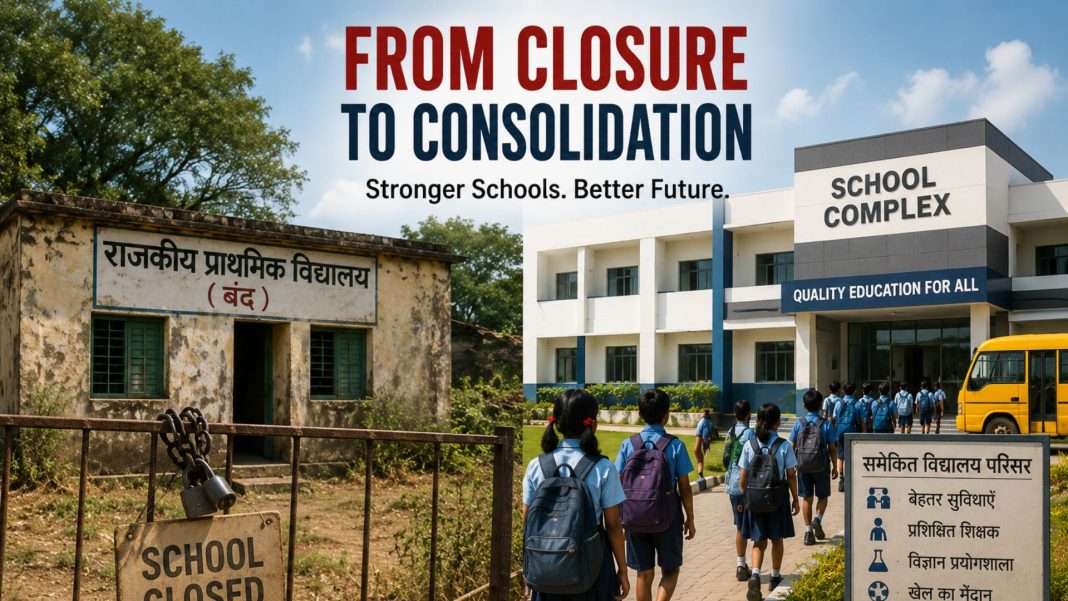

India’s Government School Consolidation: Over the past decade, India’s public education ecosystem has undergone a massive structural shift.
According to media reports citing a NITI Aayog study titled School Education System in India: Temporal Analysis and Policy Roadmap for Quality Enhancement, the country lost nearly 94,000 government-run schools between 2014-15 and 2024-25 translating to an average of roughly 25 public school closures per day.
While the sharp contraction in public education infrastructure has raised concerns regarding equitable access under the Right to Education (RTE) Act, official disclosures suggest the trend is driven primarily by strategic school rationalization, demographic shifts, and resource optimization policies rather than a simple withdrawal of state support.
What the Data Reveals: Changing Dynamics of School Infrastructure
India’s Government School Consolidation: Based on official UDISE+ (Unified District Information System for Education Plus) datasets analyzed in the NITI Aayog report, the physical blueprint of Indian schooling has experienced a notable re-alignment:
Government School Drop: The absolute count of government-run schools dropped from 11.07 lakh in 2014-15 to 10.13 lakh in 2024-25.
Overall Contraction: Total schools across public and private sectors hit a high of 15.58 lakh in 2017-18 before tapering down to 14.71 lakh by 2024-25.
Expansion of Private Sector: Contrastingly, private unaided recognized institutions recorded steady growth, rising from 2.88 lakh to 3.39 lakh over the same ten-year timeframe.
Enrolment Shift: Total nationwide school enrolment dropped by 2.26 crore students. Meanwhile, public school enrolment share saw a steep decline from historic levels of 71% in 2005 down to 49.24% in 2024-25.
As per media reports, government schools still continue to represent over two-thirds of the country’s entire basic educational network despite the sharp decline in physical units.
Consolidation vs. Crisis: Core Drivers Behind the Decline
India’s Government School Consolidation: NITI Aayog and policy analysts caution against equating fewer school buildings directly with reduced educational access. The report outlines several overlapping factors that explain the widespread closures:
1.School Rationalization Under NEP 2020
Under the Samagra Shiksha framework and the National Education Policy (NEP) 2020, state governments have actively merged small, under-enrolled, or single-teacher schools into consolidated “school complexes”.
The primary objective is to pool sparse resources, improve teacher availability, provide specialized subject educators, and establish modern science labs and sports facilities that were unsustainable in tiny, isolated units.
2.Demographic Transition
India’s Total Fertility Rate (TFR) has dropped below replacement level to roughly 2.0. With smaller youth cohorts entering the primary schooling system each year, rural primary schools that once catered to dozens of children have seen admissions dwindle down to single digits.
3.Migration and Shifting Parental Preferences
Rapid urban development, rural-to-urban family migration, and a growing demand for English-medium education have drawn significant student populations toward low-cost private options, leaving thousands of public facilities underutilized.
Geographical Disparities and State-Level Impact
The rationalization drive has not played out evenly across India. According to media reports, two states Uttar Pradesh and Madhya Pradesh together accounted for nearly 40,000 school mergers and closures over the decade.
In union territories like Jammu & Kashmir, administrative restructuring led to the systematic merger of under-populated schools to address staffing imbalances and reallocate educational funding effectively.
On the other hand, states in Southern India, alongside regions like Puducherry, successfully preserved exceptionally strong student retention achieving over 99% progression from Class 8 to 9 demonstrating that educational continuity can survive large-scale institutional restructuring.
Key Challenges and Policy Roadmaps Ahead
India’s Government School Consolidation: While consolidation aims to build more robust educational hubs, public interest groups and education advocates warn that closing neighborhood schools presents distinct operational trade-offs:
Travel Disincentives: Increased travel distances following school mergers disproportionately impact young children, female students, and marginalized rural communities (SC/ST), creating safety concerns and higher dropout risks.
RTE Act Compliance: The Right to Education Act guarantees a neighborhood primary school within a 1 km radius, making free and safe public transport mandatory wherever mergers occur.
Quality Assurance: Merging schools resolves physical inefficiencies, but improving learning outcomes requires filling teacher vacancies and upgrading classroom technology in the remaining consolidated institutions.
The NITI Aayog study concludes that India’s educational policy is pivoting away from mere physical expansion toward quality enhancement, structural sustainability, and long-term learning outcomes.
Moving forward, state governments will face the crucial task of ensuring that infrastructure consolidation does not compromise equitable access for disadvantaged sections of society.