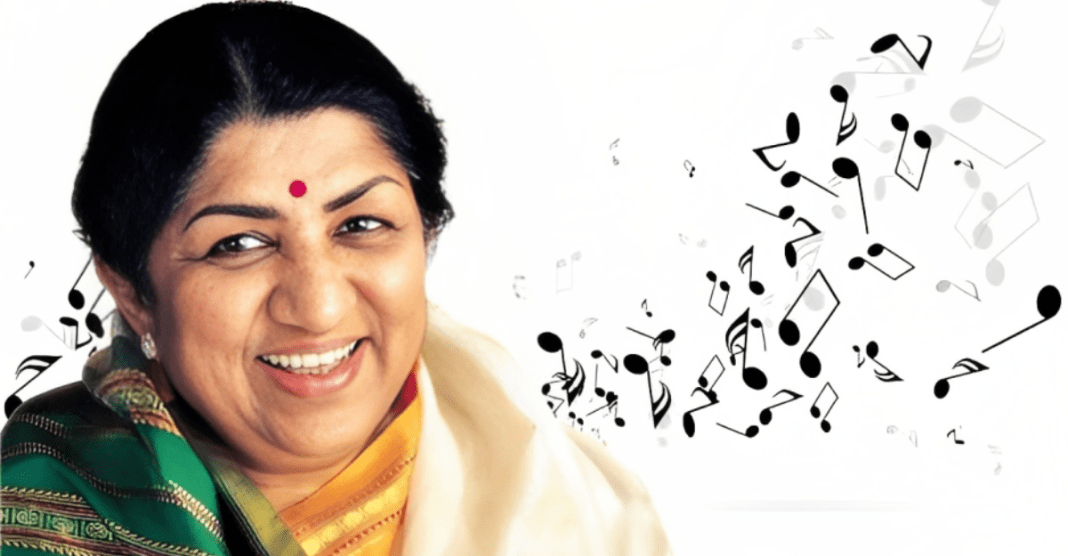

Lata Mangeshkar Biography: Imagine a hot afternoon in 1942. A thin, 13-year-old girl is standing in a quiet house, looking at the lifeless body of her father. In that one moment, her childhood was over. She didn’t have a school degree.
She didn’t have a pile of money. She was just a kid, but now she was responsible for her mother and four younger brothers and sisters who were hungry.
All she had was a voice. A voice that some experts at the time said was “too thin” and “not good enough.”
She had to sell her small pieces of jewelry just to buy food. She had to walk miles to movie studios, wearing a simple saree, hoping someone would give her a chance to sing.
She was rejected many times, but she never gave up. She practiced until her throat hurt, mastered languages she didn’t know, and worked day and night to make sure her siblings could go to school.
This little girl was Hema Mangeshkar, but the world would soon know her by a different name.
Lata Mangeshkar Biography: She would go on to record over 25,000 songs, move Prime Ministers to tears with her melodies, and become the “voice of a billion people.” This is the incredible, emotional journey of the legendary Lata Mangeshkar.
Personal Overview
| Full Name | Hema Mangeshkar (later named Lata) |
| Known As | Lata Mangeshkar |
| Other Names / Titles | Queen of Melody · Nightingale of India |
| Birth Date | 28 September 1929 |
| Place of Birth | Indore |
| Date of Death | 6 February 2022 |
| Place of Death | Breach Candy Hospital |
| Profession | Playback Singer · Music Composer · Producer |
| Years Active | 1942 – 2022 |
| Net Worth | Roughly ₹100–₹150 crore INR |
| Father | Deenanath Mangeshkar |
| Mother | Shevanti Mangeshkar |
| Siblings | Meena Khadikar · Asha Bhosle · Usha Mangeshkar · Hridaynath Mangeshkar |
| Marital Status | Unmarried |
| Nationality | Indian |
Family Background and Roots
Lata was born on September 28, 1929, in Indore.
Musical Blood: Her father, Pandit Deenanath Mangeshkar, was a famous classical singer and actor. He started teaching her music when she was a toddler.
The Name Story: At birth, her name was Hema. Later, her father changed it to Lata after a character in one of his famous plays.
The Siblings: She was the eldest of five children. Her sisters Meena, Asha, Usha and her brother Hridaynath all became very successful in music because of her support.
Education: The One-Day Schooling
Lata Mangeshkar’s formal education is one of the shortest and most famous stories in India.
Duration: Exactly one day.
The Incident: On her first day of school, she brought her younger sister, Asha Bhosle, with her.
When the teacher said children weren’t allowed, Lata got angry, took Asha’s hand, and walked out forever.
Her Real Teacher: Her father, Pandit Deenanath Mangeshkar, became her primary teacher. He taught her classical music from the age of five.
Self-Taught Genius: Even without school, she mastered Urdu by hiring a tutor (after Dilip Kumar critiqued her accent) and eventually sang in over 36 languages with perfect pronunciation.
The Irony: Although she never finished first grade, she later received honorary doctorates from prestigious places like New York University and the University of Pune.
Career Timeline
1940s: The Struggle & The Breakthrough
1942: Recorded her first song for a Marathi film (Kiti Hasaal), but it was cut from the movie.
1942-1948: Acted in 8 films just to earn money for her family. She hated it!
1949: The Game Changer. She sang “Aayega Aanewala” for the movie Mahal. This song made her a superstar overnight.
1950s: The Unstoppable Queen
Lata Mangeshkar Biography: She became the first choice for every big music director (Naushad, S.D. Burman, Madan Mohan).
Famous Songs: Pyar Kiya To Darna Kya (Mughal-e-Azam) and Aaja Re Pardesi.
By the end of this decade, she was the undisputed Queen of Bollywood.
1960s: The Voice of the Nation
1963: After the war with China, she sang “Ae Mere Watan Ke Logon.” It became the “National Anthem” of emotions.
She dominated the decade with soulful hits in movies like Guide, Woh Kaun Thi, and Aradhana.
1967: She recorded the famous song “Honton Pe Aisi Baat”—a technical masterpiece.
1970s: Global Fame & Giving Way
1970: She showed great humbleness by asking Filmfare to stop giving her awards so that younger singers could win.
1974: She became the first Indian to perform at the Royal Albert Hall in London.
Famous Hits: Pakeezah, Abhimaan, and the classic Satyam Shivam Sundaram.
1980s: Adapting to Change
Even when music styles changed to disco and pop, Lata stayed relevant.
She sang for young actresses like Sridevi and Madhuri Dixit.
Famous Hits: Ram Teri Ganga Maili, Chandni, and the blockbuster Maine Pyar Kiya.
1990s: The Living Legend
At an age when most people retire, she gave the biggest hits of the decade.
Yash Chopra Era: She became the “soul” of movies like Darr, Dil To Pagal Hai, and the legendary Dilwale Dulhania Le Jayenge (DDLJ).
Everyone in India, from kids to old people, knew her voice as “Didi.”
2000s – 2022: The Final Chapter
2001: Received the Bharat Ratna, India’s highest honor.
2004: At age 75, she sang the entire album of Veer-Zaara, proving her voice was still ageless.
2006: Sang for Lagaan and Rang De Basanti.
2019: Recorded her last song, “Saugandh Mujhe Is Mitti Ki,” as a tribute to the Indian army.
Masters who shaped her into a legend
- Aman Ali Khan (Bhendibazaar Gharana)
He was her first major teacher after her father. Under him, Lata learned the “Bhendibazaar” style, which focuses on breath control and singing long passages without taking a break. This is why she could sing difficult songs so smoothly.
- Amanat Khan Devaswale
He taught her the technical side of Indian Classical music. He was very strict about “Sur” (tune). He made sure that every note she hit was 100% perfect.
- Pandit Tulsidas Sharma
He was a student of the legendary Ustad Bade Ghulam Ali Khan. He helped Lata understand the “soul” of a Raga. He taught her how to put emotion into classical notes, which later helped her express sadness or joy in Bollywood songs.
- Ghulam Haider (The “Godfather”)
While he was a Music Director, he acted like a Guru in the film world.
The Riyaz (Practice): He made her practice for hours in local trains and studios.
The Breakthrough: He taught her how to sing for the microphone (which is different from singing on a stage). He told her to “sing from the heart, not just the throat.”
The Result of Her Training
Because of these Gurus, Lata developed a unique skill:
Perfect Diction: She could sing in Urdu, Bengali, or Tamil so perfectly that people from those states thought she was one of them.
Range: She could sing very high notes (soprano) without her voice cracking or sounding sharp.
The Golden Timeline
1950s “Established dominance with composers like C. Ramchandra, S.D. Burman, and Naushad.”
1960s “Sang the immortal ““Ae Mere Watan Ke Logon”” (1963) which moved PM Nehru to tears.”
1970s Became the first Indian to perform at the Royal Albert Hall (1974).
1980s-90s “Collaborated with a new generation (R.D. Burman, Laxmikant-Pyarelal, A.R. Rahman).”
2000s Received the Bharat Ratna and continued to sing for modern hits like Lagaan and Rang De Basanti.
Rise and Fame
- The “Godfather” and the Prediction
In the mid-1940s, Lata was struggling. A big producer, Sashadhar Mukherjee, rejected her saying her voice was “too thin.”
Music director Ghulam Haider (her mentor) got very angry. He told the producer: “Listen to me.
A day will come when you and every other producer will fall at this girl’s feet and beg her to sing!”
He then gave her a break in the movie Majboor (1948), which finally made people notice her.
- The “Aayega Aanewala” Explosion (1949)
The real “Superstar” moment came with the movie Mahal.
She sang “Aayega Aanewala” for actress Madhubala.
At that time, the singer’s name wasn’t printed on the records (only the character’s name “Kamini” was there).
The song was such a massive hit on the radio that the All India Radio office was flooded with thousands of letters asking: “Who is this singer?” * Finally, AIR had to call the record company to find out her name and announce it on air. Lata Mangeshkar became a household name that day.
- Replacing the “Heavy” Voices
Before Lata, the industry loved heavy, nasal voices (like Noor Jehan). Lata brought a “crystal clear” and high-pitched style.
Within a few years, her voice became the standard for the “Indian Heroine.”
If a movie had Lata’s songs, it was almost guaranteed to be a hit.
- Becoming the “Didi” of India (1960s)
Her fame reached its peak during the 1962-63 India-China war.
When she sang “Ae Mere Watan Ke Logon” live in Delhi, the entire country cried.
From that moment, she wasn’t just a Bollywood singer; she became a National Treasure. People started calling her “Lata Didi” out of respect.
Collaborations and Peer Connections
Lata was the “thread” that tied generations of Indian music together.
The Duet Kings: She formed legendary pairings with Mohammed Rafi, Kishore Kumar, and Mukesh.
The Great Royalty War: She famously stopped singing with Mohammed Rafi for several years due to a disagreement over royalty payments for singers.]
She believed singers deserved a share of the long-term profits; Rafi disagreed. They eventually reconciled.
The Sibling Rivalry: Her relationship with sister Asha Bhosle was often the subject of media speculation.
While they were competitive professionals, they maintained a deep personal bond, with Asha often stating that Lata was the “Everest” no one could scale.
“Anandghan”
The Mystery Name
In the 1960s, a new music composer named “Anandghan” appeared in the Marathi film industry. This composer was making beautiful, soulful music that everyone loved.
People started asking: “Who is this talented new guy?”
Nobody had ever seen him. He never came to award shows or parties.
“Anandghan” won several awards for movies like Sadhi Mansa.
Finally, the secret came out. Anandghan was actually Lata Mangeshkar.
She used a fake name because she wanted to see if people would like her music for its quality, not just because it had the famous “Lata Mangeshkar” brand attached to it.
She composed music for 5 Marathi films under this secret name.
She even won the Maharashtra State Government’s Best Music Director award as “Anandghan.”
Awards and Honors
- The “Big Four” Civilian Awards
Lata Didi is one of the very few people to receive all four of India’s highest civilian honors.
Padma Bhushan (1969): Awarded for her early contribution to Indian music.
Padma Vibhushan (1999): India’s second-highest honor.
Bharat Ratna (2001): India’s highest possible honor. When she received this, she became only the second singer (after M.S. Subbulakshmi) to get it.
Dadasaheb Phalke Award (1989): This is India’s highest award in the world of cinema.
- National & Filmfare Awards
National Film Awards: She won 3 times for best female playback singer (Parichay, Kora Kagaz, and Lekin…).
Filmfare Awards: She won so many in the 1950s and 60s that she eventually retired from the competition in 1970 to promote new talent. After that, Filmfare gave her a Lifetime Achievement Award in 1993.
- International Honors
Lata Didi’s voice was loved globally, not just in India.
Officer of the Legion of Honour (2007): This is the highest award in France.
Guinness World Record (1974): She was listed as the “Most Recorded Artist” in history for singing over 25,000 songs.
Honorary Doctorates: She received honorary degrees from New York University, Oxford University, and many Indian universities.
- State & Other Special Honors
Maharashtra Bhushan (1997): The highest honor from her home state.
NTR National Award: Given by the Government of Andhra Pradesh.
Platinum Disc: To celebrate her 25th, 50th, and 60th years in the film industry.
Controversies
- The “Monopoly” Accusation
This is the biggest cloud over her career. Many critics and singers (like Vani Jairam and Suman Kalyanpur) felt that Lata and her sister Asha Bhosle controlled the industry so tightly that they didn’t let new female singers grow.
The Rumor: It was said that if a music director worked with another female singer, Lata would refuse to sing for them.
The Reality: Lata always denied this, saying she was just hardworking and people chose her because she was the best.
- The “Royalty War” with Mohammed Rafi
As we discussed, they didn’t speak for nearly 4 years.
The Fight: Lata wanted singers to get a share of the song’s profits (Royalty). Rafi Sahab thought the one-time payment was enough.
The Twist: In her later years, Lata claimed she received a written apology from Rafi to end the fight.
Rafi’s son, Shahid Rafi, got very angry and called this a “lie,” saying his father would never apologize for standing his ground.
- The Fight with Raj Kapoor
Lata had a huge fallout with the legendary filmmaker Raj Kapoor during the making of Mera Naam Joker.
She didn’t like the way the music was being handled and felt she wasn’t given enough respect.
She stopped working with him for several years until they patched up for the movie Satyam Shivam Sundaram.
- The Pedder Road Flyover Dispute
This was a very famous public controversy in Mumbai.
The government wanted to build a flyover right in front of her house (Prabhu Kunj) to reduce traffic.
Lata Didi was very upset. She said the noise and pollution would ruin her peace and her voice.
The Threat: She famously said that if the flyover was built, she would leave Mumbai and move to Pune.
Because of her power, the project was cancelled/delayed for decades!
- The Guinness World Record Dispute
In 1974, the Guinness Book of World Records named her the “most recorded artist.”
Her own sister Asha Bhosle and singer Mohammed Rafi challenged this. Rafi Sahab even wrote a letter to Guinness saying he had recorded more songs than her.
Eventually, Guinness removed the category for a while because it was too hard to count every single song accurately.
- The “Tanmay Bhat” Video (2016)
A comedian named Tanmay Bhat made a “roast” video using a Snapchat filter of Lata Mangeshkar and Sachin Tendulkar.
The video showed “Lata” and “Sachin” arguing.
The entire country, including top politicians and Bollywood stars, got extremely angry.
They felt it was an insult to a national icon.
Lata herself remained very dignified and simply said she didn’t know who the comedian was.
Top 10 iconic songs
1 Lag Jaa Gale Woh Kaun Thi (1964) Ultimate Romance
2 Ae Mere Watan Ke Logon Patriotic Single (1963) Emotional / National
3 Pyar Kiya To Darna Kya Mughal-E-Azam (1960) Rebel / Classic
4 Ajeeb Dastan Hai Yeh Dil Apna Aur Preet Parai Nostalgic / Sweet
5 Tujhse Naraz Nahin Zindagi Masoom (1983) Deep / Emotional
6 Satyam Shivam Sundaram Satyam Shivam… (1978) Divine / Prayer
7 Tujhe Dekha To DDLJ (1995) 90s Romance
8 Ek Pyar Ka Nagma Hai Shor (1972) Philosophical
9 Kora Kagaz Tha Yeh Man Aradhana (1969) Duet (with Kishore)
10 Luka Chuppi Rang De Basanti (2006) Heartbreaking
Quick Facts about her Songs
First Song: Naachu Yaa Gade (Marathi, 1942) – unfortunately, it was cut from the film.
Breakthrough Song: Aayega Aanewala (1949) – made her a superstar.
Last Major Hit: Tere Liye (Veer-Zaara, 2004) – recorded at age 75.
Famous connection with the 1983 Cricket World Cup
The Problem: No Money to Reward Champions
In 1983, the Indian Cricket Team did the impossible they won the World Cup by beating the mighty West Indies.
The whole of India was celebrating, but the BCCI (the cricket board) was very poor back then.
They didn’t even have ₹1 Lakh to give as a prize to the players.
The BCCI President, Raj Singh Dungarpur (who was a close friend of Lata), was worried about how to reward the heroes.
The Solution: A Golden Voice to the Rescue
When Lata Didi heard about this, she immediately stepped in to help.
She agreed to do a Grand Concert for free at the Indraprastha Stadium in Delhi.
The concert was a massive hit. People crowded the stadium just to hear her sing.
The Result: ₹20 Lakhs Collected!
The concert raised enough money that the BCCI was able to give ₹1 Lakh to every player in the team. At that time, ₹1 Lakh was a huge amount!
Interestingly, Lata Didi did not charge a single rupee for her performance.
To say thank you, the BCCI kept two VIP seats reserved for her at every stadium in India for the rest of her life.
The Sachin Connection
Lata Didi was a huge fan of Sachin Tendulkar.
She called him her “son,” and Sachin called her “Aai” (Mother).
Sachin once said that whenever he was under pressure, he would listen to her songs to calm his mind.
Political Background: The Reluctant Patriot
Lata Mangeshkar was never a typical politician, but she held a very powerful position in Indian public life.
Member of Parliament: She was a nominated member of the Rajya Sabha (1999–2005).
The “No-Salary” MP: She set a record for honesty by refusing to take any salary, government house, or travel allowances. She didn’t take a single rupee from the government.
Ideology: She was a strong Nationalist. She deeply admired Veer Savarkar and grew up with his patriotic values.
Political Friends: Atal Bihari Vajpayee: She shared a poetic bond with him and called him a father figure.
Narendra Modi: She shared a “brother-sister” bond with him; he famously visited her frequently to seek her blessings.
Controversy: She was often criticized for low attendance in Parliament.
She admitted she felt like a “misfit” there and preferred her music room over political debates.
Influence: She used her power only once famously, to stop a flyover project near her Mumbai home, threatening to leave the city if it was built.
Books on Mangeshkar
“Lata: A Life in Music” by Yatindra Mishra (The most detailed one).
“Lata Mangeshkar… in Her Own Voice” by Nasreen Munni Kabir (A great interview book).
Illness, Death, and the End of an Era
In January 2022, she was admitted to Breach Candy Hospital with COVID-19. After a month-long battle, the “Golden Voice” fell silent on February 6, 2022.
She was given a State Funeral at Shivaji Park, attended by PM Narendra Modi and stars from across generations.
The Indian government declared two days of national mourning, with the national flag flying at half-mast.
Cultural Impact & Public Image
Lata Didi wasn’t just a celebrity; she was a living monument.
The “White Saree” Brand: Her image was so clean and pure that people would literally take off their shoes before entering a room where she was sitting.
The Mother Figure: She never married and dedicated her whole life to her siblings and her music. This made her a symbol of “sacrifice” in Indian culture.
The Perfectionist: It is said that she never sang a song without first understanding the meaning of every single word.
If she didn’t like a lyric, she would refuse to sing it.
Vision & Impact on Today’s Singers
Lata Didi’s vision was to make singing a respected profession.
Opening Doors: Before her, singing in films was seen as a “low” job for women. She changed that image and made it prestigious.
Impact on Singers: Every singer today from Shreya Ghoshal to Sunidhi Chauhan considers her their “Godmother.” They all try to copy her “clean” and “sweet” style of singing.
The Standard: In India, if a girl sings well, people don’t say “She’s good”; they say “She sounds like Lata.” That is the highest compliment possible
Biography By: Singdha
Also Read: Guru Dutt Biography: The Untold Story of India’s Most Beloved Filmmaker