


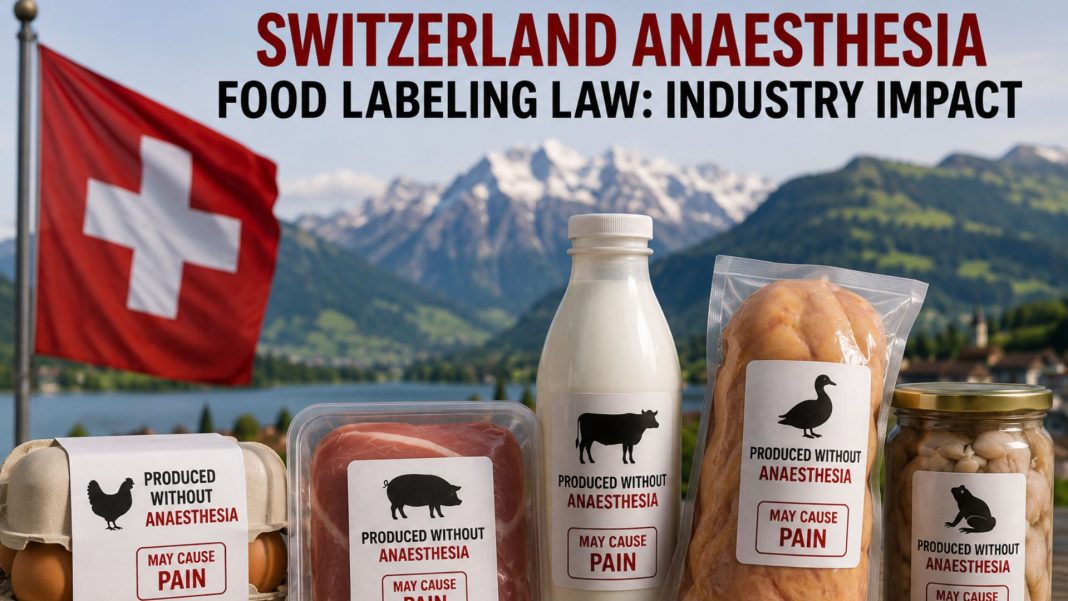

Switzerland Anaesthesia Food Labeling Law: The global food industry is experiencing a massive regulatory shift as Switzerland cements its position as a pioneer in animal welfare.
In a historic move, the Swiss Federal Council has enacted a groundbreaking law making Switzerland the first and only country in the world to legally mandate explicit disclosures on food packaging if an animal was subjected to painful procedures without anaesthesia.
Taking effect on July 1, 2025, through amendments to the Ordinance on Foodstuffs and Utility Articles (LGV) and the Ordinance on Information on Foodstuffs (LIV), this legislation marks a revolutionary step toward radical transparency.
It forces the domestic and international supply chains to bare their practices directly to the end consumer.
What Does the New Swiss Law Cover?
Switzerland Anaesthesia Food Labeling Law: The scope of this regulation is comprehensive, spanning across all grocery retailers, small businesses, and hospitality establishments (including restaurants) nationwide.
It applies not just to domestically produced items, but critically to all imported food goods as well.
The law explicitly targets several routine factory farming practices, mandating clear consumer warnings for:
Beef and Dairy: Meat or milk derived from cattle that underwent dehorning or castration without stunning or pain relief.
Pork: Products originating from pigs whose tails were docked, teeth clipped, or testicles removed without the administration of anaesthesia.
Poultry and Eggs: Eggs and meat coming from chickens or hens that underwent beak trimming/clipping without pain management.
Foie Gras: Liver and meat sourced from ducks and geese subjected to force-feeding (a practice banned within Switzerland for over 40 years but still legally imported).
Frogs’ Legs: Meat obtained via the live amputation of limbs without stunning.
Timeline, Enforcement, and Penalties for Non-Compliance
Switzerland Anaesthesia Food Labeling Law: The law officially rolled out on July 1, 2025, but recognizing the logistical complexities of overhauling food supply chains, the Swiss government has granted businesses a two-year transition period to achieve full compliance.
By mid-2027, the grace period will expire, and full accountability will be legally enforced.
Prior to this law, Swiss cantonal authorities reported a shocking 60% non-compliance rate in voluntary or baseline labeling during market audits.
Under the new strict regime, the consequences for failing to declare these practices accurately are severe.
If an establishment or importer mislabels a product or hides information regarding painful procedures without anaesthesia:
Product Seizure: Offending food items will be immediately withdrawn from store shelves and distribution networks.
Regulatory Fines: Massive administrative penalties will be levied against the brand, retailer, or importer.
Criminal Prosecution: For systemic or intentional consumer deception, business owners and corporate executives face formal legal prosecution under Switzerland’s stringent Animal Welfare Act and consumer fraud statutes.
The Immediate Effect on Business Operations and Global Exporters
For global food exporters looking to retain access to the affluent Swiss consumer base, the law serves as an immediate ultimatum: modify farming practices or accept a potentially damaging “cruelty label” on the shelf.
Because Switzerland imports a significant portion of its poultry, pork, and specialty items like foie gras, international suppliers across the European Union and South America must now implement rigorous traceability systems.
Every farm-level practice must be documented, audited, and passed up the supply chain. Companies are already seeking specialized labeling machinery capable of executing multi-language, highly specific welfare disclosures.
Economic Ripple Effects: Production Costs vs. Premium Margins
The implementation of this law is profoundly altering the economics of animal agriculture. Farmers shifting away from performing painful procedures without anaesthesia must absorb higher veterinary bills to pay for sedatives, analgesics, and professional medical supervision.
However, market data suggests that this regulatory hurdle could turn into a lucrative competitive advantage.
A benchmark study by the University of Zurich revealed that 75% of Swiss consumers are willing to pay a financial premium for foods certified with higher animal care standards.
Historically, when Switzerland introduced mandatory labeling for non-free-range eggs, imports of those products plummeted to virtually zero.
Industry analysts expect a similar trend here, where items carrying the “without anaesthesia” disclosure will experience a massive collapse in sales, forcing the industry to phase out these procedures altogether.
The Future of Ethical Consumption
While animal welfare organizations celebrate this law as a monumental breakthrough in transparency, they remind the public that disclosure is just the first milestone. The ultimate objective is a total international ban on these mutilations.
By pushing the ethical financial burden onto businesses and exposing operational realities on the packaging, Switzerland is successfully using consumer purchasing power to reshape global agricultural standards.
As European neighbors observe the execution of this law, the Swiss model is highly anticipated to become the blueprint for future European Union food regulations.
Also Read: PM Modi Norway Visit: First Indian PM in Norway After 43 Years for India-Nordic Summit 2026