


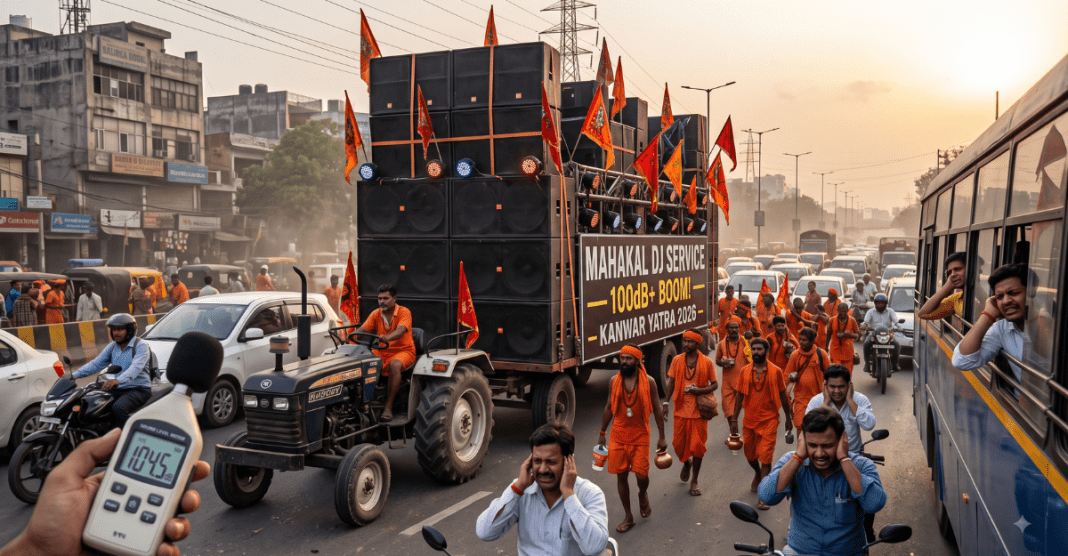

The Hidden Cost of Devotion: As the annual Kanwar Yatra winds its way through Delhi-NCR and western Uttar Pradesh, towering speaker rigs mounted on DJ trucks are once again driving the beat of the pilgrimage.
However, behind the vibrant energy lies a growing public health concern regarding high-decibel processions operating well above permissible limits, impacting urban residents, commuters, and pilgrims alike.
The Sound Reality: Official Rules vs. Street Volume
The Hidden Cost of Devotion: Under standard environmental guidelines, noise levels in residential zones are capped at 55 decibels during daytime hours and 45 decibels overnight, which is roughly the sound level of a quiet office.
In practice, sound systems attached to Kanwar Yatra trolleys often reach 100 decibels or higher, equivalent to full-scale concert rigs.
Within just a few days during peak season, authorities in the National Capital Region logged hundreds of noise and traffic complaints across major corridors, including ITO, Anand Vihar, Dhaula Kuan, Mehrauli, and the Outer Ring Road.
Understanding the Decibel Scale: Exponential Risk
The Hidden Cost of Devotion: Noise intensity is measured on a logarithmic scale rather than a linear one, meaning every 10-decibel increase represents a tenfold jump in sound energy.
While the World Health Organization considers sound at or below 70 decibels safe for long-term exposure, the threshold where extended exposure begins to risk permanent hearing loss starts at 85 decibels.
At 100 decibels, the National Institute for Occupational Safety and Health recommends no more than 15 minutes of exposure per day before hearing damage becomes likely.
Because of this exponential curve, a DJ truck running at 100 decibels delivers hundreds of times more acoustic energy to human ears than the allowable legal limit.
Permanent Inner Ear Damage: Why Hair Cells Don’t Regenerate
The Hidden Cost of Devotion: According to health experts at the National Institute on Deafness and Other Communication Disorders, prolonged acoustic trauma damages the fragile structures inside the cochlea.
Within this inner ear structure, microscopic sensory hair cells convert sound vibrations into electrical impulses for the brain to process as hearing.
Once these delicate hair cells are destroyed by intense sound pressure, they do not regenerate, making the resulting hearing loss permanent.
Sound-induced damage can occur suddenly from brief high-volume blasts or develop gradually through repeated exposure, with ringing or buzzing in the ears, known as tinnitus, usually acting as the first warning sign.
Cardiovascular Impact: Beyond Hearing Loss
The Hidden Cost of Devotion: High noise levels affect far more than just auditory health, as research published in medical journals such as Circulation Research and Hypertension demonstrates that chronic noise exposure triggers systemic stress responses.
Sustained high-decibel sound activates the body’s fight-or-flight pathway, elevating stress hormones like cortisol and adrenaline even during sleep.
Over time, these nocturnal disruptions and sustained stress responses keep the body’s system on high alert, contributing directly to higher long-term risks of elevated blood pressure, hypertension, cardiovascular strain, and stroke.
Bridging the Enforcement Gap
The Hidden Cost of Devotion: While authorities establish strict regulations regarding vehicle sizes, transit routes, and maximum sound outputs, social media footage and urban complaints frequently highlight oversized sound setups operating far past standard limits while causing traffic gridlock.
Closing the gap between regulatory limits and street-level sound requires consistent real-time decibel monitoring, effective crowd management, and public health awareness regarding safe sound exposure.
Ensuring a safer acoustic environment ultimately protects both the general public and the pilgrims traveling alongside these high-volume speaker systems.