


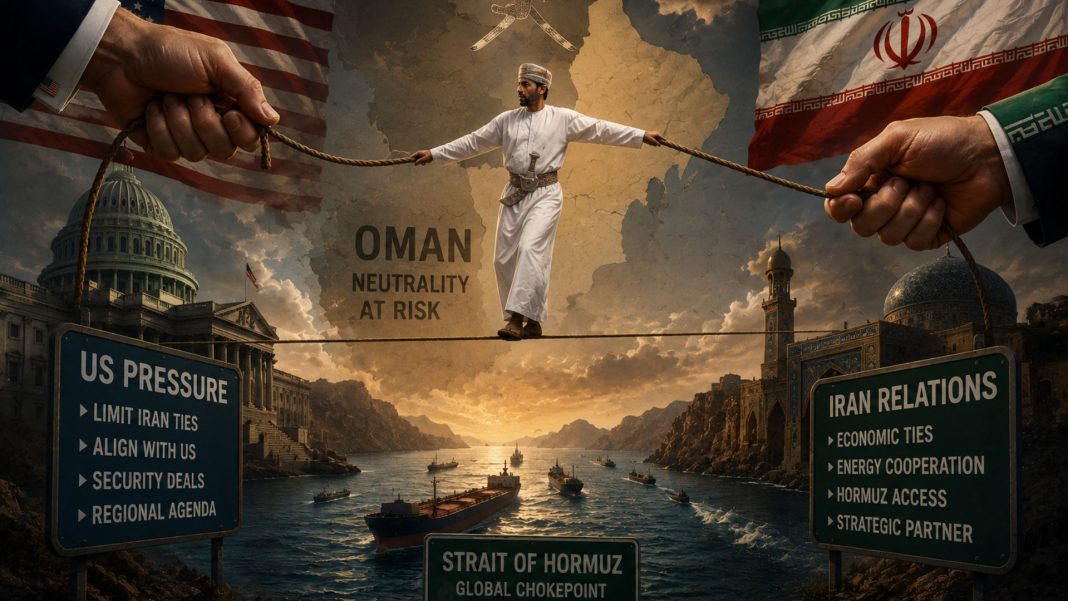

THE MIDDLE EAST TIGHTROPE: For decades, the Sultanate of Oman has prided itself on being the “Switzerland of the Middle East”, a quiet, neutral mediator capable of talking to anyone, from Washington to Tehran. However, that legendary neutrality is now facing its greatest existential threat.
According to an explosive report by The Wall Street Journal, citing US and Arab officials, Washington’s patience has officially run out. The United States is reportedly placing heavy diplomatic pressure on Oman to abandon its neutral stance, pick a side in the ongoing US-Iran conflict, and sever its diplomatic ties with Iran.
The stakes have escalated dramatically, with President Trump reportedly issuing warnings that include potential sanctions and even the threat of military action, if Oman continues to straddle the fence.
The Flashpoint: The Strait of Hormuz and Secret Levies
THE MIDDLE EAST TIGHTROPE: The sudden spike in US frustration stems from alarming intelligence reports regarding the Strait of Hormuz the world’s most critical chokepoint for global oil supplies.
The Intelligence Trigger: Reports suggest that Iranian and Omani officials recently discussed the possibility of imposing and collecting joint levies/fees from commercial ships transiting through the Strait of Hormuz.
For Washington, any attempt by Iran and Oman to control or monetize traffic through this international waterway is a massive red line. President Trump’s recent warnings of potential bombardment and sanctions were directly triggered by these intelligence findings, signaling that the US views Oman’s diplomatic wiggle room as a direct threat to global maritime security.
Caught Between a Rocket and a Hard Place
THE MIDDLE EAST TIGHTROPE: Oman’s diplomatic strategy has suddenly turned into a high-stakes gamble. The Wall Street Journal highlights that Muscat’s balancing act is becoming mathematically and politically impossible to maintain.
Oman faces a brutal double-edged sword:
The US Risk: Defying Washington could mean economic isolation, crippling sanctions, or devastating military strikes.
The Iran Risk: If Oman openly aligns with the US, it risks immediate and violent retaliation from Tehran. Oman fears it could face the same kind of proxy warfare and direct attacks that Iran unleashed against other Gulf nations during previous regional conflicts.
Regional Isolation: Gulf Neighbors Turn Their Backs
It isn’t just Washington that is losing faith in Muscat. Oman’s closest regional neighbors, the United Arab Emirates (UAE) and Saudi Arabia, are increasingly frustrated with what they perceive as Oman’s pro-Tehran bias. They believe that Muscat’s ties with Tehran have grown unacceptably close during this crisis.
Arab officials have pointed out several key instances where Oman actively broke ranks with its regional allies. Specifically, Oman has repeatedly refused to sign joint statements issued by the US and other nations that condemned Iranian attacks.
Furthermore, even when drone attacks targeted Omani ports, Muscat chose a highly cautious path. Rather than publicly blaming Tehran for the strikes, Omani officials limited their public statements strictly to confirming that the incidents had taken place.
While the rest of the Gulf Cooperation Council (GCC) has moved toward a unified, hardened stance against Iranian aggression, Oman has chosen silence and diplomatic shielding, further alienating itself from its Arab peers.
The Succession Greeting That Stunned Washington
Perhaps the most telling sign of Oman’s deep alignment with Tehran came during a moment of major political transition in Iran. Following the death of Iran’s Supreme Leader Ali Khamenei, his successor, Mojtaba Khamenei, assumed control.
Amid intense regional conflict, Oman’s Sultan Haitham bin Tariq Al Said was the only Gulf leader to send official congratulations to the new Supreme Leader.
This move sent shockwaves through Western intelligence circles, cementing the belief that Muscat is no longer just a neutral mediator, but a silent partner to Iran’s leadership.
What Lies Ahead for Muscat?
Oman now stands at a historic crossroads. Its traditional foreign policy, built on the principle of “friend to all, enemy to none,” is collapsing under the weight of a polarizing regional war.
If Muscat bows to US pressure, it secures its Western alliances but invites the wrath of a heavily armed neighbor right across the water. If it maintains its ties to Tehran, it risks becoming a pariah state in the eyes of the West and its own Gulf neighbors.
The coming weeks will determine whether Oman can successfully navigate this diplomatic minefield or if it will become the next major casualty of the US-Iran cold war.
Also Read : Iran Halts Ceasefire Talks with US: Threats to Close Strait of Hormuz Loom Large