


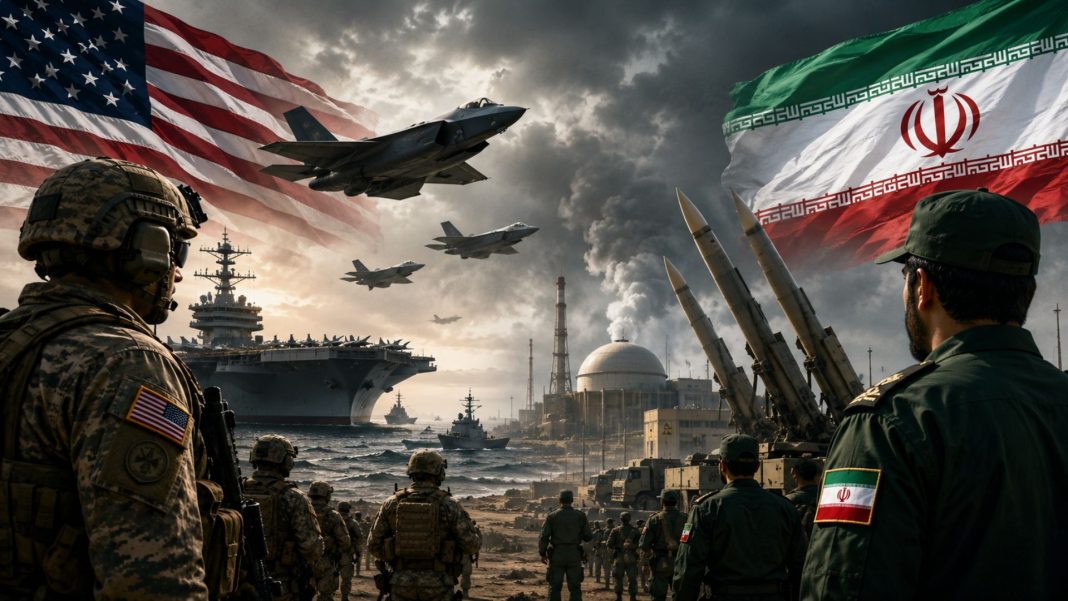

U.S. READY FOR WAR: In a bold and direct diplomatic message, U.S. Defense Secretary Pete Hegseth announced that the United States is fully prepared to launch military operations against Iran if negotiations fail. Speaking at the prestigious Shangri-La Dialogue security forum in Singapore, Hegseth dismissed any doubts regarding America’s military strength.
Despite ongoing diplomatic talks aimed at easing tensions in the Middle East, the Pentagon chief made it clear that the U.S. military is not letting its guard down. He reassured global leaders that America’s weapons stockpiles are robust enough to handle multiple global conflicts at once.
“Our ability to restart operations if necessary proves we are fully capable. Our stockpiles are perfectly suited for this, whether there or anywhere else around the world,” Hegseth stated, emphasizing that the U.S. maintains an “excellent and abundant balance of ammunition.”
The Ultimate Goal: Stopping an Iranian Nuclear Bomb
U.S. READY FOR WAR: At the heart of Washington’s aggressive stance is one primary objective: preventing a nuclear-armed Iran. The U.S. views Iran’s potential nuclear capabilities as a direct threat to global security and regional stability in West Asia.
While diplomats continue to push for peaceful solutions, Hegseth’s remarks signal that the military option remains firmly on the table. He reiterated that the U.S. bears a “global responsibility” to ensure that Tehran never crosses the nuclear threshold, implying that force will be used as a last resort if diplomacy collapses.
Two Fronts, One Strategy: Balancing Iran and China
U.S. READY FOR WAR: While the threat of war with Iran loomed large in his speech, Hegseth spent a significant amount of time addressing America’s broader strategic priorities, particularly in the Indo-Pacific region.
The Pentagon is currently playing a complex geopolitical balancing act. Even as it monitors the crisis in West Asia, Washington is deeply concerned about China’s rapidly growing military and economic influence in Asia. Hegseth made it clear that the U.S. will not allow any single nation to dominate the region.
The Vision for the Indo-Pacific
A Stable Balance: Washington aims for a sustainable balance of power where no country can impose its hegemony.
Protecting Alliances: Ensuring that the security and economic prosperity of both Americans and their regional allies remain uncompromised.
A Free and Open Region: Reaffirming the U.S. commitment to keeping the Indo-Pacific free from coercion.
The Ultimatum to Rich Allies: ‘The Era of U.S. Subsidies is Over’
In what might be the most surprising shift in tone, Hegseth issued a sharp wake-up call to America’s wealthy global allies. While promising that the U.S. would stand by its partners, he demanded that these nations start paying their fair share for defense.
Hegseth bluntly declared that Washington will no longer tolerate policies where wealthy nations disproportionately benefit from American military funding.
“The era of giving American subsidies to wealthy nations has ended,” Hegseth warned.
The Pentagon chief argued that for true stability and prosperity to exist, allies must step up and shoulder more security responsibilities. A region dominated by a single superpower, or an alliance relying entirely on American money, is no longer sustainable under current U.S. strategic policies.
Hegseth’s powerful address at the Shangri-La Dialogue serves a dual purpose. To Iran, it is a warning of devastating military action if red lines are crossed. To China, it is a message of deterrence, proving that America has the resources to counter Beijing’s ambitions despite distractions in the Middle East.
Ultimately, the U.S. is signaling a new era of foreign policy: one where it remains the world’s ultimate military deterrent, but expects its wealthy global partners to stand firmly on their own two feet.
Also Read: GLOBAL ENERGY RELIEF: US LIFTS STRAIT OF HORMUZ NAVAL BLOCKADE