


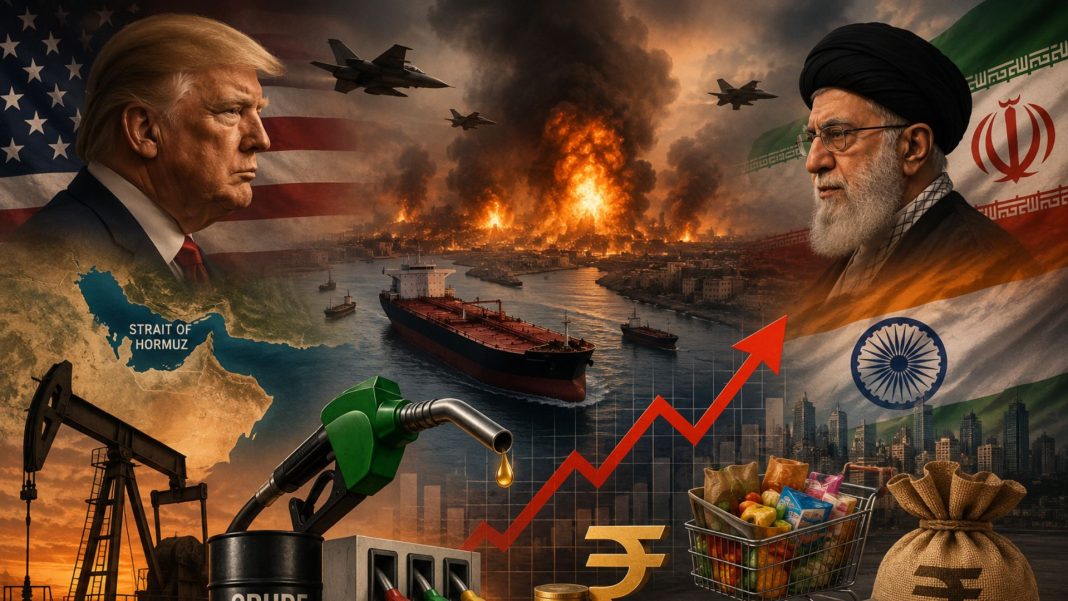

US-Iran Conflict 2026: The fragile peace in West Asia has shattered. Following US President Donald Trump’s declaration that the mid-June Memorandum of Understanding (MoU) with Iran is “all over,” the shadow of a full-scale war looms once again over the Strait of Hormuz.
With the US military launching heavy airstrikes against Iranian targets and Tehran retaliating in Bahrain and Kuwait, global energy markets and stock exchanges are already reeling.
While the battle lines are drawn in the Gulf, the shockwaves will travel fast and hard across the Arabian Sea. For India, this isn’t just a distant geopolitical skirmish, it is a direct threat to its economic stability, energy security, and daily household budgets.
THE ENERGY CRUNCH: Fuel, Gas, and the Shadow of Inflation
US-Iran Conflict 2026: India relies heavily on the Strait of Hormuz for its energy survival. Before the brief pause in hostilities earlier this year, this narrow body of water carried roughly 40% of India’s crude oil imports and a staggering 60% of its Liquefied Natural Gas (LNG).
The Immediate Threat to Cooking Gas and Fuel
While Indian oil refiners have spent recent months diversifying their supply chains, buying more oil from Russia and other regions, the country remains deeply vulnerable when it comes to LNG and Liquefied Petroleum Gas (LPG).
A blockade or active conflict in the Strait means shipping insurance premiums will skyrocket, and tankers may refuse to sail. If the shipping lanes freeze, the price of petrol, diesel, and household cooking gas cylinders will jump.
The Double-Whammy Inflation Risk
Higher fuel prices trigger a domino effect across the Indian economy. When transportation costs rise, the price of moving fruits, vegetables, grains, and fertilizers from farms to cities goes up. Coming at a time when an unpredictable monsoon is already stressing domestic food production, a war-driven fuel spike could push India’s retail inflation to dangerous levels.
THE FMCG SQUEEZE: From Costly Soaps to Shrinking Wallets
US-Iran Conflict 2026: The impact of the US-Iran conflict will quickly move from international shipping lanes directly onto Indian supermarket shelves.
Rising Raw Material Costs
Crude oil is the base ingredient for thousands of daily-use products. Fast-Moving Consumer Goods (FMCG) companies rely on petroleum derivatives to manufacture everyday essentials. Linear Alkyl Benzene (LAB), used to make detergents and soaps, will become more expensive. Similarly, the cost of plastic packaging for everything from milk packets to potato chips will climb.
The Shift in Consumer Behavior
Faced with rising prices, Indian households are likely to adjust their spending habits. When inflation pinches, families cut back on discretionary items, like buying new clothes, electronics, or premium skincare, and stick strictly to essentials.
Even within daily groceries, consumers often “trade down,” swapping premium brands for cheaper, local alternatives to protect their monthly budgets.
EXPORT ROADBLOCKS: Shipping Hurdles and Tariff Hangovers
The revival of conflict threatens India’s trade routes to both West Asia and the West, putting vital export sectors at risk.
The West Asian Market: The Middle East is a massive consumer of Indian goods, ranging from basmati rice and meat to engineering equipment. A regional war disrupts local economies, reduces their purchasing power, and stalls trade contracts.
The Shipping Bottleneck: With the Strait of Hormuz turned into a military zone, commercial vessels will be forced to take longer, more circuitous routes. This adds weeks to delivery timelines and drastically increases freight charges, making Indian exports less competitive globally.
The Textile and Apparel Struggle: India’s export-oriented textile sector is already vulnerable, still recovering from the heavy economic impact of tariffs previously imposed by the US. Higher shipping costs and delayed deliveries could cause international buyers to cancel orders, hurting jobs in major textile hubs.
THE OIL DILEMMA: The Frozen Deals with Tehran
The sudden breakdown of the ceasefire has also thrown New Delhi’s strategic energy planning into total confusion.
When the US signed the brief MoU with Iran in June, the US Treasury’s Office of Foreign Assets Control (OFAC) had issued a 60-day waiver on Iranian oil sanctions. This window allowed countries to legally buy, sell, and transport Iranian crude and petroleum products.
India, looking for affordable energy options, had started evaluating long-term oil deals with Tehran. However, with the ceasefire dead and Trump declaring that negotiations are over, those talks are frozen. Indian state and private refiners maintain a strict policy of not buying sanctioned oil to avoid being cut off from the global financial system. The prospect of cheap Iranian crude flowing into Indian refineries is gone for the foreseeable future.
MARKET TURMOIL: The $50 Billion IPO Threat
The timing of this geopolitical flare-up is particularly painful for India’s financial sector. Following the brief pause in Middle East tensions last month, Indian companies confidently announced plans for a massive corporate milestone: a combined $50 billion wave of Initial Public Offerings (IPOs) on the domestic stock market.
Global Market Panic
The financial markets have already shown their nervousness. Immediately after the US airstrikes, global benchmarks reacted sharply:
Brent Crude: Spiked past the $80-a-barrel mark before settling around $78.80.
Global Indexes: Major European markets in Paris and Frankfurt plunged over 2%, London dropped 1.6%, and Wall Street saw the Dow Jones drop 1.1%.
The Chill on Dalal Street
International market panic quickly dampens investor sentiment in India. When geopolitical risks rise, foreign institutional investors (FIIs) often pull capital out of emerging markets like India and move it into “safe-haven” assets like gold or US Treasury bonds.
If this global market sell-off deepens, institutional appetite for new equity will dry up. The highly anticipated $50 billion IPO boom on Dalal Street could face severe delays or cancellations, as companies choose to wait out the storm rather than launch public listings in a volatile, fearful market.
The Path Ahead: New Delhi now finds itself in a classic position of “hoping for the best, but preparing for the worst.” Whether these heavy exchange of strikes are a temporary escalation to gain diplomatic leverage or the opening salvos of a prolonged war remains to be seen. For India, a swift diplomatic resolution isn’t just preferable, it is an economic necessity.