
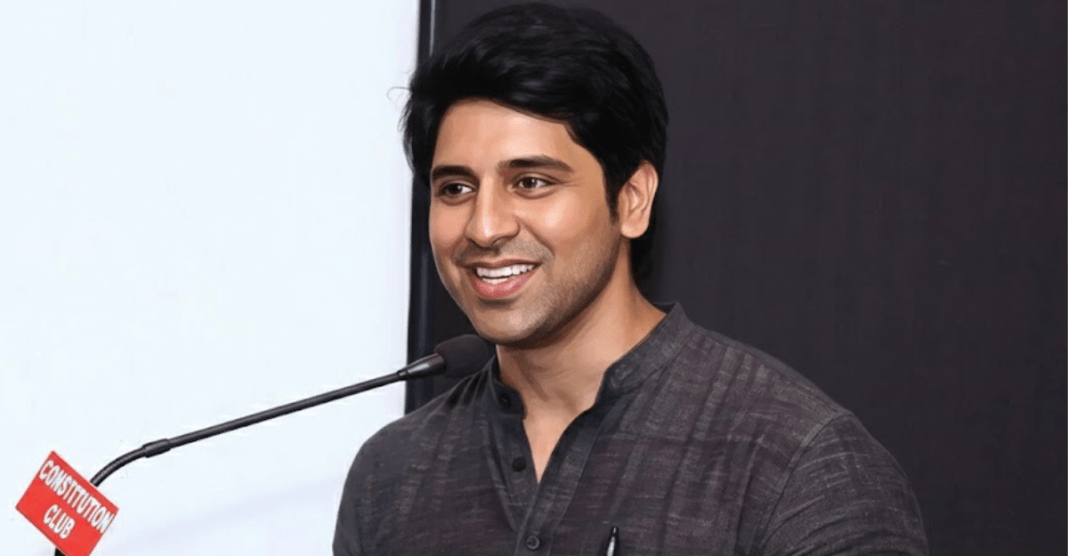

Shehzad Poonawalla Biography: In the high-stakes arena of Indian political communication, few individuals possess the ability to blend legal acumen with prime-time punchlines as effectively as this figure.
Often seen at the forefront of the nation’s most intense ideological battles, he has carved out a unique space for himself as a “rebel with a cause.”
His journey is a dramatic narrative of personal sacrifice, political transformation, and a relentless pursuit of what he calls a “merit-based democracy.”
This man is Shehzad Poonawalla.
Personal Overview
| Full Name | Shehzad Poonawalla |
| Date of Birth | 17 October 1987 |
| Age (as of 2025) | 38 Years |
| Place of Birth | Pune, Maharashtra, India |
| Profession | Politician, Lawyer, Columnist |
| Political Party | Bharatiya Janata Party (BJP) |
| Former Political Party | Indian National Congress (INC) |
| Career Highlights | NSUI Vice-president Pune, AICC Media Cell Member, BJP Delhi Social Media Head |
| Known For | BJP National Spokesperson, Political Debates |
| Height | 5 feet 8 inches (173 cm) |
| Weight | Approx. 70 kg |
| Father | Sarfraz Poonawalla (Deceased Businessman) |
| Mother | Yasmin Poonawalla (Homemaker) |
| Brother | Tehseen Poonawalla (Congress Supporter) |
| Marital Status | Unmarried |
| Net Worth (Approx.) | $1 – 5 Million |
| Nationality | Indian |
| Religion | Islam |
Family and Early Roots
Shehzad Poonawalla Biography: Born into a respected family in Pune, Maharashtra, his early years were shaped by a blend of traditional values and modern intellectual rigor.
Family Loss and Resilience: He faced a significant personal tragedy at the age of five with the passing of his father. Raised by his mother, whom he describes as a “committed Congress supporter” and a pillar of strength, his upbringing was deeply rooted in his faith.
He often recalls a childhood where he accompanied his mother to the mosque every evening, a practice that shaped his early understanding of spirituality and community.
The Brotherly Bond: For much of his early life, he was inseparable from his elder brother, Tehseen Poonawalla. The two were a formidable duo in Delhi’s social and political circles. However, the political “earthquake” of 2017 led to a public and painful separation.
Tehseen, who had practically raised Shehzad, publicly disowned him after Shehzad’s rebellion against the Congress leadership, a rift that remains one of the most talked-about personal-political divides in India.
The Vadra Connection: Through Tehseen’s marriage to Monica Vadra (cousin of Robert Vadra), Shehzad was once an insider in the extended circles of India’s most powerful political family.
His eventual departure was not just a political shift; it was a severance of personal and social ties to the very top of the Congress hierarchy.
Education and Professional Background
Before entering the political fray, he established a foundation in law and advocacy.
Academic Credentials: He is a trained lawyer and a graduate from a reputable institution in Pune.
Early Career: He began his professional journey as a civil rights activist and legal expert. He was notably a petitioner in the 2013 National Commission for Minorities (NCM) housing discrimination cases, advocating against communal bias in urban housing.
Media and Writing: An articulate communicator, he has been a columnist for major publications like The Indian Express, Mail Today, and Hindustan Times, writing on topics ranging from climate crisis to strategic foreign policy.
Career Journey
Shehzad Poonawalla Biography: Shehzad’s career can be broken down into three main stages:
Legal Profession
- Shehzad entered the legal field as a lawyer following his graduation with an LLB.
- Specialized in civil rights issues and constitutional law
- Gained in-depth knowledge of the political/legal system
Advocacy/Public Speaking
- Engaged in youth forums
- Wrote commentary articles and op-eds
- Participated in various televised debates Through these experiences, Shehzad established himself as a prominent public figure.
Political Activity
- Originally aligned with the Indian National Congress
- Was in the spotlight in 2017 for attacking Congress for how it conducted its internal elections
- Subsequently joined the BJP
- Presently serves as a national spokesperson for the BJP
- A frequent presence on news panels defending governmental policies
His effective communication style and logical arguments have earned him substantial viewership and support.
Career Timeline: From Congress to BJP
- The Congress Years (2008–2017)
Rising Star: He joined the Congress in 2008 and quickly rose through the ranks due to his oratory.
Key Roles: He served as a member of the AICC Media Cell’s research team and was a Vice-President of the NSUI in Pune. He also held a secretary position in the Maharashtra Congress.
The Rebellion: In late 2017, during the internal elections for the Congress President post, he famously challenged the process as “rigged” and “dynastic,” calling for a “selection-free” election. This move led to his eventual exit from the party.
- Transition and BJP Appointment (2018–Present)
The “Modian” Shift: Following his exit from Congress, he became a staunch supporter of Prime Minister Narendra Modi’s policies.
- National Spokesperson of BJP: He was officially appointed as a National Spokesperson for the Bharatiya Janata Party (BJP), where he has become a fixture on prime-time news debates, representing the party’s stance on national and international issues.
Connection with BJP
The “Dynasty” Rebellion & PM Modi’s Recognition
The foundation of his connection with the BJP was laid during a 2017 rally in Surendranagar, Gujarat.
The Catalyst: While still in the Congress, Shehzad challenged the process of Rahul Gandhi’s elevation to Party President, calling it a “sham” and “dynastic coronation.”
Modi’s Endorsement: Sensing a powerful narrative, Prime Minister Narendra Modi publicly lauded Shehzad’s bravery during a campaign speech, stating:
“A brave young man, Shehzad, has exposed the lack of democracy in the Congress ..those who have no internal democracy cannot work for people.”
The Turning Point: This high-profile acknowledgement from the Prime Minister effectively sealed Shehzad’s fate with the Congress (who distanced themselves from him) and opened the doors to the BJP.
Role within the BJP
Shehzad didn’t just join the party; he became its frontline defender.
National Spokesperson: He serves as an official National Spokesperson of the BJP. He is frequently tasked with representing the party at its headquarters in New Delhi during crucial press conferences.
Prime-Time Defender: He is the party’s “go-to” person for high-decibel TV debates, especially when the topic involves the Gandhi family, constitutional law, or minority issues.
Digital Warrior: He acts as a bridge for the party to reach younger, English-speaking, and digitally-savvy audiences, often using the hashtag #ModiKaParivar to showcase his loyalty.
Alignment with “Modi’s Vision”
His connection to the BJP is built on a vocal defense of what he calls “New India” under Modi’s leadership.
Anti-Dynasty Narrative: He is the face of the BJP’s attack on “Pariwarwaad” (dynastic politics), often using his personal experience in the Congress as “proof” of the BJP’s meritocratic nature.
Reformist Stance: He aggressively supports the Prime Minister’s flagship schemes, such as the Ujjwala Yojana and the abolition of Triple Talaq, often framing them as civil rights victories for Muslim women.
Policy Advocacy: In recent years (2024–2026), he has been a key advocate for the Uniform Civil Code (UCC) and the Viksit Bharat 2047 roadmap, mirroring the Prime Minister’s long-term developmental goals.
Nature of the Relationship
From Outsider to Insider: Unlike many who join the BJP for electoral tickets, Shehzad’s value to the party is primarily intellectual and communicative.
Mutual Benefit: For the BJP, he is a articulate Muslim face who can critique the Congress from the “inside.” For Shehzad, the BJP provides a national platform that values his aggressive rhetoric and legal background.
Controversies & Public Challenges
Internal Party Disputes
His criticism of Rahul Gandhi’s leadership in INC and claims about internal party elections being “rigged” led to isolation within Congress circles.
Misidentification Controversy
Initiated legal action for defamation against an AAP legislator who linked him to an unrelated criminal case due to shared surname, asserting no relation to the accused.
Personal Family Incident
In early February 2026, he alleged that his mother was deliberately run over by a car in Pune a case reported as under investigation.
Famous Speeches and Acronyms
- The “GITA” Vision (His Signature Positive Line)
In almost every economic debate, especially regarding the Union Budget 2026, he uses this to define PM Modi’s governance:
“GITA means G for Growth, I for Infrastructure, T for Technology, and A for Atmanirbhar Bharat.”
- On the Gandhi Family & Dynasty
He often uses his own name to point out the difference between merit and birthright:
The Name Game: “I am Shehzad (a prince) by name, but the Congress only has room for the Shehzada (the prince) by birth.”
The “EMI” Remark: “Congress is suffering from the EMI—the Emergency Mentality of Indira, where the family is always placed above the Constitution.”
Gen-D: “Congress doesn’t have Gen-Z with them; they only have Gen-D, Generation Dynasty and Generation Darbari.”
- Sharp Acronyms for Opponents
He is famous for redefining the names of opposition parties and titles:
L-O-P (Leader of Opposition): “If LOP means Leader of Propaganda or Leader of Pakistan, then Rahul Gandhi is doing a great job.”
T-M-C (Trinamool Congress): In 2025-26, he redefined it as:
“T for Tribals par Atyachar, M for Mahilaon par Atyachar, and C for Citizens huye lachar.” (Atrocities on Tribals, Atrocities on Women, and Citizens left helpless).
D-M-K: He calls it the “Divisive Mansikta (Mindset) of Khandan (Family).”
- “New India” & National Security
On Terrorism: “In the UPA era, we had ‘Most Favored Nation’; in the Modi era, we give MTJ, Muh Tod Jawab (A crushing reply).”
The 26/11 Promise: “New India has a simple policy: We will never forget, and we will never forgive.”
- Biting One-Liners
On “Mohabbat Ki Dukaan”: “It is not a shop of love; it is a Bhrashtachar Ke Bhaijaan (Big brother of corruption) outlet.”
On EVMs: “The opposition doesn’t have a problem with the machine; they have a problem with the Jan-Mat (People’s Mandate). Soon they will say they don’t trust the voters.”
On Secularism: “Nehruvian secularism gave nothing to India but division; Modi’s secularism is Sabka Saath, Sabka Vikas (Development for all).”
The Impact of His Speeches
-Shehzad’s speeches are designed to be “clip-friendly.” He often pauses after a punchline, ensuring it can be easily shared on social media platforms like Instagram Reels and X.
-This has made him one of the most effective “attack dogs” for the BJP, as he can condense complex political history into a 30-second viral soundbite.
Achievements & Recognition
-National spokesperson of a major national party (BJP) a significant communication and policy role.
-Known in media circles for debate appearances, strategic communication, and civil rights advocacy.
-Recognized for raising the profile of issues like dynastic influence in Indian politics.
Net Worth
As of 2025, approximately USD $1 – 5 million
Key Facts
Professional Background: Beyond politics, he is a lawyer and civil rights activist.
Identity: He has spoken openly about his Shia Muslim identity and his support for “Sanatan Sanskriti” and national interests.
Family Ties: He is the brother-in-law of Monicka Vadra (sister of Robert Vadra), through his brother Tehseen, though the brothers remain politically and personally estranged.
Vision ,Impact and Public Image
Shehzad Poonawalla’s political philosophy, particularly since joining the BJP, is centered on the idea of “GITA”—an acronym he coined to represent:
G rowth
I nfrastructure
T echnology
A tmanirbhar Bharat (Self-reliant India)
He has been a vocal advocate for the abolition of Triple Talaq and the implementation of the Uniform Civil Code (UCC), framing these issues through the lens of women’s empowerment and constitutional equality.
Public Image: To his supporters, he is a “Truth Teller” who sacrificed a comfortable life for his principles.
To his critics, he is a fierce “Attack Dog” of the ruling party. Regardless of the perspective, he is widely respected for his preparation and “debate-ready” data points.
Also Read: Surya Kumar Yadav Biography: The Man with the Art of 360-Degree Batting