


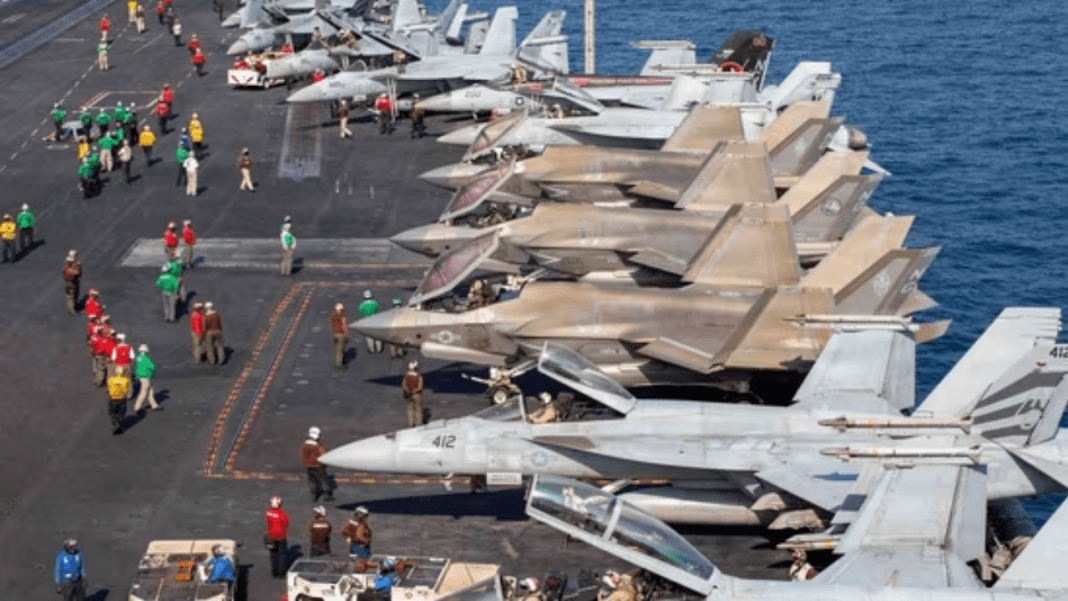

Operation Epic Fury: The air over the Persian Gulf is thick with a silence that feels less like peace and more like a tactical intake of breath.
While President Donald Trump’s “10-day energy pause” dominates the headlines, the massive mobilization of the 82nd Airborne and the 31st Marine Expeditionary Unit suggests that the conflict has reached a point of no return.
What began on February 28 as the high-altitude decapitation of “Operation Epic Fury” is now grounding itself in a high-stakes terrestrial reality, centered on a tiny coral outpost that has been a strategic obsession of the Commander-in-Chief for nearly forty years: Kharg Island.
As the world watches the “D-Day” speculation surrounding Saturday, March 28, it is becoming clear that the “pause” in Washington is not a diplomatic olive branch, but the final staging window for a ground war designed to dismantle Iran’s economic lung and reset the global financial order.
The 10-Day Pause: Diplomacy or Military Tactic?
President Trump announced the pause in a post on Truth Social, citing an “Iranian Government request” and claiming that “talks are going very well.”
The message referenced a 15-point peace framework known as the “Witkoff Proposal,” after U.S. envoy Steve Witkoff delivered through Pakistani mediators.
The plan reportedly demands two key concessions from Tehran: the full reopening of the Strait of Hormuz to international shipping, and the dismantling of Iran’s ballistic missile programme.
Iranian officials responded publicly with scorn. Senior figures in Tehran dismissed the negotiations as deliberate “deception,” accusing Washington of using the ceasefire window not for genuine diplomacy, but to move heavy military assets into forward positions without coming under fire.
The timing has lent credibility to that suspicion. Within the same week that the pause was declared, the 82nd Airborne’s Immediate Response Force troops specifically trained for rapid seizure operations arrived in the region, and the USS Tripoli, carrying the 31st Marine Expeditionary Unit, took up position within sight of the Iranian coast.
Military analysts point out that a bombing pause is a classic element of pre-invasion staging.
Operation Epic Fury: Without the threat of active airstrikes overhead, ground forces can conduct final coordination, confirm drop zones, and integrate drone and cyber warfare units into their battle plans.
Whether the pause is a genuine diplomatic gesture or a cover for operational preparation or both may only become clear when the April 6 deadline arrives.
Kharg Island: Why a Small Island Holds Such Large Stakes
Kharg Island sits in the northern Persian Gulf, roughly 25 kilometres off Iran’s southwestern coast.
It is not large only about one-third the size of Manhattan and it has no significant civilian population to speak of.
Yet it is arguably the single most important piece of real estate in the Iranian economy.
The island’s deep-water terminals are the only facilities in Iran capable of loading Very Large Crude Carriers (VLCCs) the massive tanker ships that carry Iranian oil to customers in China, India, and beyond.
By most estimates, Kharg handles close to 90% of Iran’s crude oil exports, making it what analysts have called the country’s “economic lung.”
If the island were seized or destroyed, the financial consequences for Tehran would be immediate and severe.
Iran’s state budget and the IRGC’s funding both depend heavily on oil revenues.
Cutting off that supply would not require occupying Iran’s vast and mountainous interior a logistical nightmare but would achieve much of the same economic strangulation through a single, concentrated operation.
The island also holds strategic military significance. According to intelligence reports, it has served as a primary launch site for Iranian “Scorpion Strike” drones unmanned aerial vehicles that have harassed U.S. naval assets throughout the conflict.
Seizing Kharg would therefore serve both an economic and a tactical purpose simultaneously.
Trump’s 1988 Blueprint: From Interview to War Plan
Operation Epic Fury: The current focus on Kharg Island has prompted many observers to revisit a striking piece of historical context.
In a 1988 interview with The Guardian, a 41-year-old Donald Trump then a prominent New York developer was asked about how he would deal with Iran.
His answer was remarkably specific: “I’d be harsh on Iran. They’ve been beating us psychologically… One bullet shot at one of our men or ships, and I’d do a number on Kharg Island. I’d go in and take it.”
At the time, the remark was dismissed as the bravado of a businessman with no prospect of holding office.
Nearly four decades later, that same man is the Commander-in-Chief, and the same island he named in 1988 appears to be the centrepiece of the U.S. military’s current campaign.
Historians and military analysts have begun describing Trump’s approach not as a reactive response to Iranian aggression, but as the fulfilment of what they are calling a long-held “Trump Doctrine” for the Gulf one built on the idea that economic leverage, not regime change, is the goal.
A Different Kind of War: 2003 Iraq vs. 2026 Iran
Comparisons to the 2003 invasion of Iraq have been widespread, but experts warn the two conflicts are fundamentally different in almost every respect that matters.
In terms of strategy, the 2003 Iraq War was built on “Shock and Awe” a rapid, massive conventional thrust toward Baghdad designed to achieve total regime change within weeks. Operation Epic Fury in 2026 takes the opposite approach.
The goal is not to capture a capital city or topple a government overnight, but to achieve what planners call “Systemic Degradation” a surgical campaign focused on seizing economic chokepoints and nuclear facilities to force a diplomatic collapse from within.
The force profile is equally different. The 2003 invasion involved nearly 170,000 troops and thousands of M1 Abrams tanks rolling across the Iraqi desert from Kuwait.
The 2026 campaign is leaner but more technologically intensive roughly 8,000 elite troops, including paratroopers and Marines, supported by autonomous drone swarms and dedicated cyber warfare units.
The modern soldier in this conflict is not just a rifleman but a sensor node in a vast digital battlefield.
The nature of the enemy is perhaps the most important distinction.
Iraq’s military in 2003 was a conventional force, weakened by a decade of international sanctions, with identifiable frontlines that could be broken by armoured advances.
Iran’s IRGC in 2026 has deliberately built a decentralised, insurgent-style defence network. There is no single command centre to neutralise, no front line to collapse.
This makes the prospect of a ground operation vastly more dangerous for U.S. forces than the early days of the Iraq War ever were.
The stated objectives also differ sharply. The 2003 war was publicly justified by the need to eliminate weapons of mass destruction and remove Saddam Hussein from power.
The 2026 conflict is openly framed around the global financial order specifically, Washington’s desire to prevent Iran and China from bypassing the U.S. dollar in oil trade by conducting transactions in Chinese yuan.
The stakes, in other words, are not just regional stability but the dominance of American economic power worldwide.
Forces on the Move: The Military Picture
The military buildups on both sides have accelerated dramatically.
On the American side, the most significant development has been the deployment of the 82nd Airborne Division’s rapid-reaction force a unit specifically designed and trained not for long blockades, but for swift “seize and hold” operations against defined targets.
Their presence alongside the 31st Marine Expeditionary Unit gives U.S. commanders a combined force capable of both airborne and amphibious assaults on a target like Kharg Island.
Iran has used the 10-day pause to turn Kharg itself into a heavily fortified position.
Satellite imagery released during the ceasefire window reportedly shows the deployment of advanced MANPADS shoulder-fired anti-aircraft missiles across the island, along with dense coastal minefields designed to complicate any amphibious landing.
The IRGC has also implemented what is described as its “Scorpion Strike” defence protocol: a decentralised plan using massed First-Person View drones operated in swarms, with eight layers of command redundancy built in so that the defence network continues to function even if senior commanders are killed or captured.
The Global Stakes: Oil, Currency, and Regional Fallout
The conflict has already begun reshaping the global economy. Brent crude oil prices have surged above $120 per barrel, putting intense pressure on energy-importing nations across Asia and Europe.
For India which relies heavily on Gulf oil and has a diaspora of roughly nine million workers employed in Gulf Cooperation Council countries the crisis is both an economic and a humanitarian concern.
The Indian rupee has come under serious devaluation pressure as energy import costs continue to climb.
China, which is the primary buyer of Iranian crude oil, faces a particularly acute strategic dilemma.
If Kharg Island is seized, Beijing would lose access to a major source of discounted oil purchased in Chinese yuan an arrangement that has formed a key part of Iran and China’s effort to reduce global dependence on the U.S. dollar in energy trade.
Analysts warn that Beijing could respond to such a move with aggressive cyber operations targeting U.S. and allied financial infrastructure, turning a Gulf military conflict into a global economic crisis.
It is a test of whether economic pressure, elite military force, and technological dominance can substitute for the kind of comprehensive political plan that was absent in 2003 and whose absence cost the world dearly.
The world is watching, and the clock is ticking toward April 6.
By- Namita Deora
Also Read: The Hormuz Standoff: Is the World Standing at the Threshold of World War 3?