


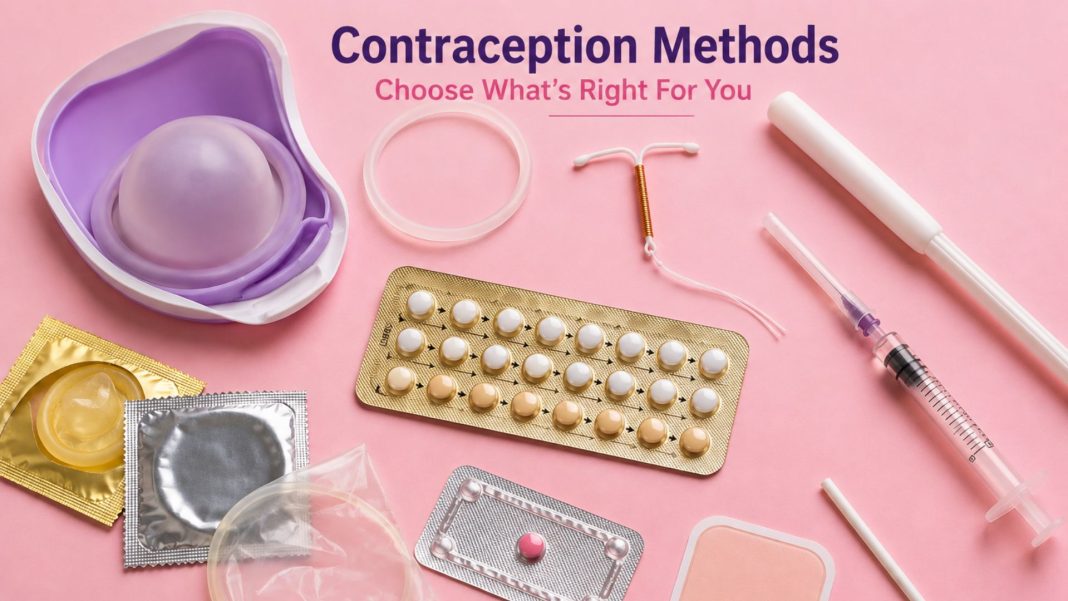

More Than Just Condoms: When we talk about preventing unwanted pregnancies and family planning, the first thing that usually pops into our minds is a condom.
While condoms are fantastic especially because they are the only option that protects you from Sexually Transmitted Infections (STIs) they are certainly not the only choice available.
Today, medical science gives us a variety of contraception options tailored to different bodies, lifestyles, and needs.
Choosing the right one can feel overwhelming, but it doesn’t have to be. Let’s break down the most common birth control methods, along with their pros and cons, so you can make an informed choice that fits your life perfectly.
Daily Birth Control Pills (Oral Contraceptive Pills)
More Than Just Condoms: Birth control pills are one of the most popular contraception options globally. These are small pills that a woman takes every single day at the exact same time. They contain hormones (estrogen and progestin) that stop the ovaries from releasing an egg.
Pros: Highly effective (around 91% with typical use, up to 99% with perfect use). They can also make your periods lighter, more regular, and significantly reduce painful menstrual cramps.
Cons: You must remember to take it every single day at the same time. If you miss a pill, its effectiveness drops. It can also cause mild initial side effects like mood swings, nausea, or breast tenderness.
Intrauterine Devices (IUDs) – The “Set It and Forget It” Option
More Than Just Condoms: An IUD is a tiny, T-shaped plastic device that a trained healthcare professional inserts inside a woman’s uterus. It is a long-acting reversible contraceptive (LARC), meaning once it’s in, you don’t have to think about it for years. There are two types: Copper IUDs (hormone-free) and Hormonal IUDs.
Pros: Extremely effective (over 99%). It lasts anywhere from 3 to 10 years depending on the type, making it incredibly hassle-free. It is fully reversible if you decide you want to get pregnant, a doctor can remove it, and your fertility returns immediately.
Cons: The insertion process can be uncomfortable or painful for a few minutes. Copper IUDs can sometimes cause heavier periods and more intense cramping during the first few months.
Contraceptive Injections (The Shot)
If you don’t want a daily pill but aren’t ready for an IUD, the contraceptive injection (often known as Depo-Provera) is a great middle-ground among contraception options. It is a shot given by a doctor or nurse in your arm or buttocks once every three months.
Pros: Very convenient since it only requires attention four times a year. It is highly private and over 94% effective with typical real-world use.
Cons: You have to visit a clinic every 12 weeks for the shot. If you experience side effects (like irregular spotting or weight gain), you cannot “stop” it immediately; the hormones stay in your system until the three months are up.
It can also take several months for your fertility to return to normal after stopping the shots.
Emergency Contraception (The Morning-After Pill)
It is crucial to understand that emergency contraception is not a regular birth control method. Instead, it is a backup plan. If a condom breaks or regular birth control is missed, an emergency pill can be taken within 72 hours (3 days) of unprotected sex to prevent pregnancy.
Pros: Provides a vital safety net when unexpected accidents happen.
Cons: It becomes less effective the longer you wait to take it. It should not be used as regular birth control because a high dose of hormones can temporarily disrupt your natural menstrual cycle and cause nausea or fatigue.
The Golden Rule: Dual Protection
While exploring these diverse contraception options, there is one golden rule to keep in mind: None of these hormonal or long-acting methods protect you from STIs.
The Dual-Protection Strategy: For the absolute highest level of safety, the best approach is pairing a highly effective method (like the pill or an IUD) with a male or female condom. This protects you from both unwanted pregnancy and infections simultaneously.
How to Choose the Right Method for You
There is no single “best” birth control method there is only the method that is best for you right now. Your choice depends on your health history, your daily routine, and whether you plan to have children in the near future.
The smartest next step is to schedule an open, honest conversation with a gyn ecologist or healthcare provider. They can look at your medical profile, listen to your lifestyle preferences, and help you pick a choice that keeps you safe, confident, and in control of your reproductive health.
Also Read: Pornography Addiction Negative Impact: The Hidden Impact on Mind, Body, and Relationships