


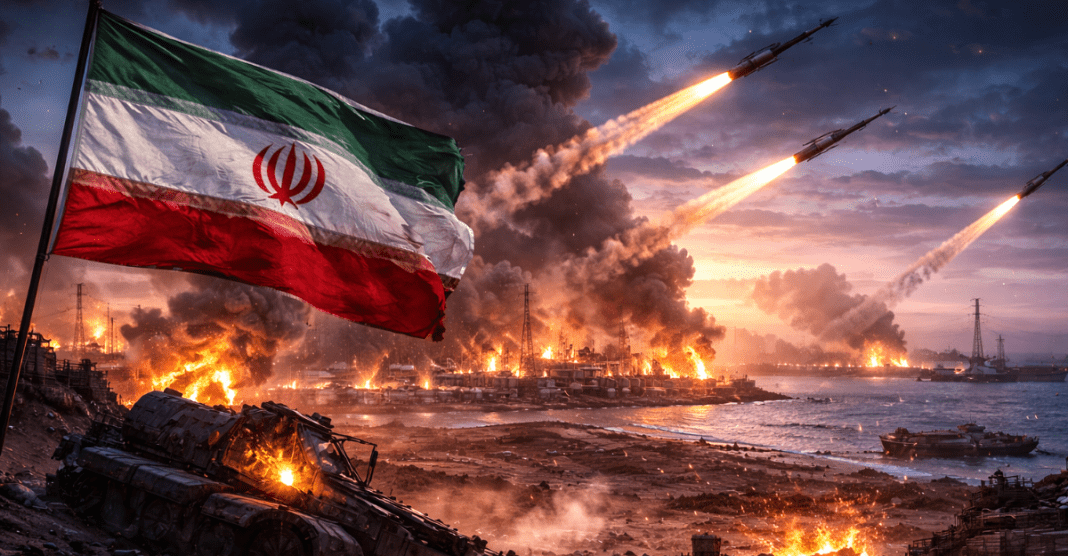

Battle of the Wallet: In the early hours of Saturday, March 28, 2026, the quiet of the Saudi Arabian desert was shattered by the buzzing sound of “flying lawnmowers.”
An Iranian swarm of suicide drones and ballistic missiles successfully breached the high-tech defenses of Prince Sultan Air Base (PSAB), marking one of the most significant strikes on U.S. logistical infrastructure since the conflict began exactly one month ago.
The attack wounded 12 U.S. service members and dealt a heavy blow to the operational spine of American air operations across the region. But beyond the smoke and wreckage lies a far more alarming reality for military planners: the math of this war no longer adds up.
While the U.S. and Israel are winning the “battle of statistics” destroying more targets, neutralizing more personnel, and maintaining clear air superiority Iran is winning the “battle of the wallet.”
By deploying mass-produced, low-cost weapons to force the U.S. into firing its most expensive interceptors, Tehran is executing a calculated campaign of economic attrition that the West may simply not be able to sustain.
Escalation at Prince Sultan Air Base
Battle of the Wallet: The strike on PSAB is the second major assault on the base this month.
According to Pentagon officials, the attack involved a “mixed salvo” a tactic in which dozens of cheap drones are launched first to drain air defense batteries, followed almost immediately by high-speed ballistic missiles designed to exploit the gaps left behind.
Twelve U.S. troops were wounded, two in serious condition, bringing the total American toll in “Operation Epic Fury” to 15 killed and over 300 wounded in 30 days.
Satellite imagery confirmed the destruction of one KC-135 Stratotanker and damage to three others.
Most critically, an E-3 Sentry the airborne warning aircraft that serves as the “eyes in the sky” for the entire theater sustained major damage to its radar dome, significantly degrading U.S. situational awareness over the region.
The financial loss from that single morning is staggering.
The E-3 Sentry carries a replacement value of approximately $270 million.
KC-46 Pegasus tankers cost roughly $165 million per unit.
Even the older KC-135s are valued at nearly $80 million each.
In under 20 minutes, Iran’s drone swarm disabled or destroyed hardware worth nearly half a billion dollars.
Asymmetric Warfare: The Economics of the Intercept
Battle of the Wallet: The defining characteristic of this conflict the figure that keeps senior Pentagon officials awake at night is the staggering cost disparity between attacker and defender.
Military analysts call this the “Cost-Exchange Ratio,” and right now, it tilts dramatically in Iran’s favor.
The “Ferrari vs. Bicycle” Problem
To protect a strategic installation like PSAB, the U.S. deploys the MIM-104 Patriot system. Each interceptor missile costs roughly $4 million.
When Iran launches a Shahed-136 suicide drone costing approximately $20,000 to produce the United States is spending 200 times more than the attacker simply to hold the line.
In a single 20-minute engagement, Iran can expend $2 million worth of drones to compel the U.S. to fire $400 million worth of interceptors.
The drones are destroyed but the financial damage to the American taxpayer vastly exceeds any physical damage done to an Iranian factory.
| Weapon System | Attacker Cost (Iran) | Defensive System | Interceptor Cost (U.S.) | Cost Ratio |
|---|---|---|---|---|
| Shahed Drone | $20,000 | Patriot PAC-3 | $3.7 – $4 Million | 185 : 1 |
| Fateh-110 Missile | $100,000 | THAAD Interceptor | $12.7 Million | 127 : 1 |
| Cruise Missile | $150,000 | SM-6 (Navy) | $4.3 Million | 28 : 1 |
The question military planners are beginning to ask out loud is not whether the shield can hold technically it can but whether it can hold financially.
Western Defense Costs Surpass $18 Billion in Thirty Days
In just 30 days of fighting, the financial toll on Western defense systems has surpassed $18 billion in unbudgeted expenditures a figure that does not include long-term replenishment costs or the strategic price of depleted stockpiles.
United States: High-Value Target Attrition
Battle of the Wallet: The most expensive single loss of the conflict is the $1.1 billion AN/FPS-132 Early Warning Radar in Qatar a system that took years to position and cannot be replaced overnight.
Four AN/TPY-2 radars integral to the THAAD architecture, each valued at roughly $500 million, have also been damaged or destroyed across the theater.
Aviation losses compound the picture. The U.S. has lost or sustained damage to more than 20 aircraft, including 12 MQ-9 Reaper drones at $56 million each.
Most symbolically significant was the first-ever confirmed combat damage to an F-35 stealth fighter, which made an emergency landing on March 19 a milestone adversaries around the world noted carefully.
Israel: The Munitions Burn Rate
Israel’s integrated air defense network is among the most sophisticated in the world, but it was never designed to absorb a month of sustained mass-salvo attacks at this tempo.
Within the first 96 hours, Israel had reportedly burned through nearly half of its entire Arrow interceptor stockpile, forcing an immediate request for emergency resupply from Washington further straining a U.S. defense industrial base already stretched thin.
The Army Is Gone, The Drones Remain
On paper, Iran’s losses are catastrophically worse. Nearly 90% of its Russian-supplied S-300 and S-400 air defense batteries have been destroyed.
Over 190 ballistic missile launchers and 140 naval vessels have been neutralized. Strikes on the Arak and Yazd nuclear facilities on March 27 have reportedly set Iran’s nuclear program back by the better part of a decade.
By every conventional metric, Iran is losing this war badly.
But here is the problem, while Iran has lost nearly all of its expensive, prestige military systems, its cheap arsenal has barely been disrupted.
The Shahed drone is not assembled in a single large factory that can be targeted and leveled.
It is built across dispersed, decentralized, underground facilities deliberately designed to survive a total air campaign. Raw materials remain available. Production lines keep running.
Iran’s asymmetric doctrine was not improvised under pressure.
It was built over two decades with one scenario in mind surviving and bleeding a technologically superior adversary in a prolonged war of attrition.
The strategy of flooding the battlespace with expendable weapons faster than the enemy can afford to shoot them down is not a fallback. It is the plan.
A War of Sustainability
Thirty days in, this conflict has arrived at a stalemate not on the battlefield, but in the accounting ledger.
The United States and Israel can destroy virtually any target inside Iran at will.
Iranian conventional forces have been shattered. Its nuclear ambitions set back significantly.
By every traditional measure, the Western coalition is winning.
And yet Iran is not broken. Its drone factories still hum. Its swarms still fly.
Every morning that a Patriot battery fires a $4 million interceptor at a $20,000 drone, Tehran registers it as a strategic victory regardless of what burns on the ground.
The central question of this war is no longer military. It is financial and political.
Can the U.S. and its allies sustain $18 billion in unbudgeted monthly costs, accelerating depletion of interceptor stockpiles, and mounting pressure to replenish allied munitions indefinitely?
Iran is betting the answer is no. It is wagering that Western tolerance for open-ended defense spending has a ceiling and that the path to strategic victory runs not through a single decisive battle, but through exhausting an adversary’s will one $4 million missile at a time.
The shield will not fail because the technology stops working. It will fail, if it fails, because the country that built it can no longer afford to keep it in the air.
Written by – Namita Deora
Also Read: The Silicon Siege: Why AI is the Deadliest National Security Frontier of 2026