


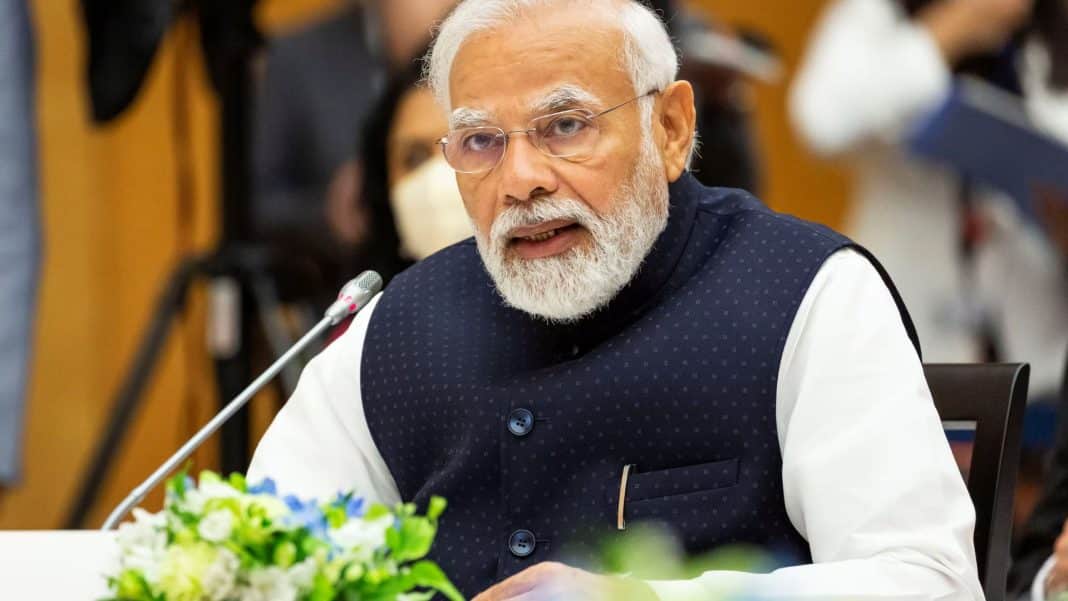

PM Modi UAE Visit 2026: On a Friday morning that saw Indian commuters reeling from a sharp ₹3 per litre hike at fuel pumps, Prime Minister Narendra Modi’s Air India One touched down in the UAE.
While the visit is the first leg of a five-nation diplomatic tour, the brief four-hour stopover in Abu Dhabi is no routine layover.
It is a high-stakes “energy sprint” designed to insulate 1.4 billion people from a global economic derailment.
The backdrop could not be more volatile. As the third-largest energy consumer on the planet, India is facing a “triple whammy”: soaring global oil prices, a record-low Rupee, and a full-blown maritime crisis in the Strait of Hormuz.
The ₹3 Reality Check: Why the Shield Broke
For nearly four years, Indian citizens lived in a bubble of price stability.
State-owned Oil Marketing Companies (OMCs) acted as a shock absorber, soaking up global volatility. But today, that shield cracked.
Reports indicate that OMCs like IOC, HPCL, and BPCL were hemorrhaging nearly ₹1,000 crore every single day to keep prices capped.
With Brent crude breaching the $113 mark and assembly elections in Tamil Nadu and West Bengal concluded, the “political shielding” has ended.
In Delhi, petrol now retails at ₹97.77, while diesel has climbed to ₹90.67.
The crisis is compounded by the Rupee hitting a historic low of 95.95 against the US dollar.
Since India imports 90% of its oil, a weaker currency creates a punishing feedback loop, making every barrel exponentially more expensive.
The UAE as a “Free Agent”: India’s New Windfall
PM Modi UAE Visit 2026: The timing of this visit is surgically precise. On May 1, the UAE officially exited the Saudi-led OPEC+ cartel. For years, Abu Dhabi was frustrated by production quotas that left 1.35 million barrels of its capacity idle.
By asserting “National Interests First,” the UAE is now a “free agent” in the energy market. For India, this is a game-changer. Without OPEC’s constraints, the UAE can offer New Delhi:
Preferential Pricing: Discounted rates away from the cartel’s rigid structures.
Volume Guarantees: Assured supply even as other nations struggle.
Crucially, the UAE’s Fujairah Port has become India’s energy lifeline. Situated on the Gulf of Oman, it sits outside the Strait of Hormuz, the narrow chokepoint currently deadlocked by the US-Israeli conflict with Iran.
By using Fujairah, Indian tankers can bypass the most dangerous waters in the world.
Three Pillars of the Abu Dhabi Agenda
PM Modi UAE Visit 2026: PM Modi and UAE President Sheikh Mohamed bin Zayed Al Nahyan are expected to seal three high-impact agreements:
The Mangalore Buffer: ADNOC (Abu Dhabi National Oil Co) is set to fill India’s Strategic Petroleum Reserve in Mangalore to maximum capacity. This effectively creates a “sovereign buffer” of oil physically sitting on Indian soil, immune to maritime blockades.
The 10-Year LPG Shield: With 40% of India’s LPG coming from the UAE, a new decade-long security agreement will lock in prices. This ensures that the “war shock” doesn’t make the average kitchen fire unaffordable.
Rupee-Dirham Trade: To fight “de-dollarization,” the two leaders are expanding the Local Currency Settlement (LCS) mechanism. Paying for oil in Dirhams saves India billions in exchange rate losses and protects dwindling foreign reserves.
A Rare Diplomatic Risk
In an era where direct strikes on GulfBeyond the oil, the safety of 4.5 million Indians living in the Emirates remains a primary concern.
During this regional instability, protecting the diaspora and the vital remittances they send home is as much a priority as the oil itself.
As the Prime Minister prepares to take off for the Netherlands later today, the success of this four-hour stopover will be measured not in diplomatic pleasantries, but in the stability of the price boards at thousands of petrol pumps back home.
nations have made high-level visits rare, Modi’s presence in Abu Dhabi sends a loud message.
The Indian government is battling a third consecutive year of a balance of payments deficit.
By securing these bilateral deals, the PM hopes to limit the inflation impact to just 15 basis points, preventing the national rate from hitting the dreaded 6% mark.
Also Read : Shashi Tharoor US Trade War: Shashi Tharoor Questions Indian Diaspora’s Quietness Amid Trump’s Trade War