


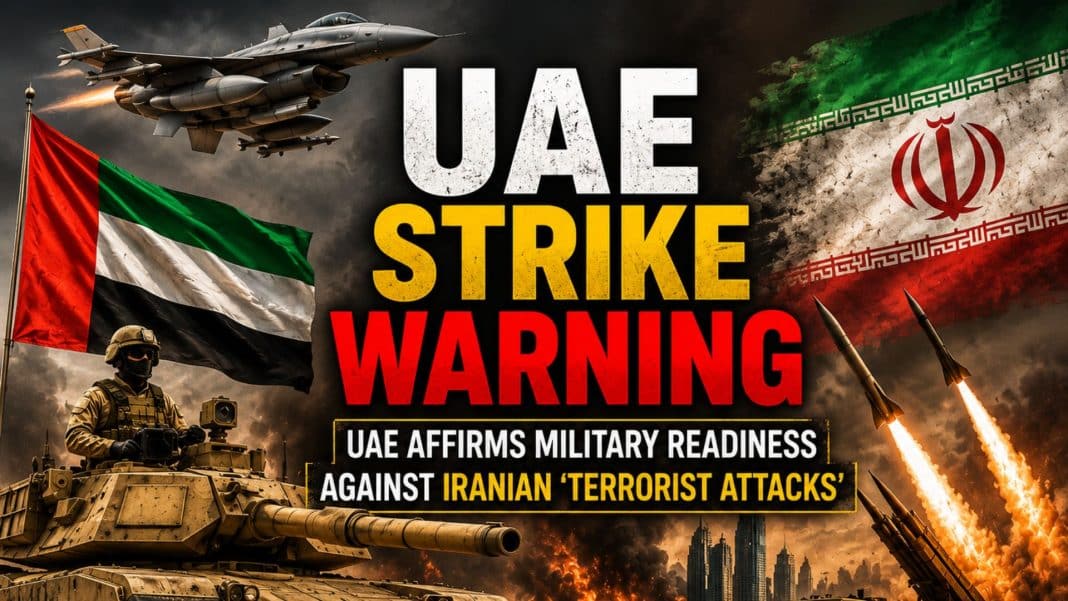

UAE Strike Warning: Tensions in the Persian Gulf have reached a boiling point. The United Arab Emirates (UAE) has issued an exceptionally fierce warning to Iran, asserting its absolute right to launch direct military strikes in response to continued aggression.
Rejecting what it termed Iranian “attempts to justify terrorist attacks,” Abu Dhabi declared that any ongoing threat to its sovereignty will face an immediate, forceful, and unyielding military response.
This diplomatic showdown follows explosive accusations from Tehran and a series of relentless drone and missile barrages that have tested the region’s stability to its absolute limits.
Key Takeaways of the Gulf Escalation
The Ultimatum: The UAE has stated it reserves all sovereign, legal, and military rights to counter imminent threats from Iran.
The Accusation: Tehran openly accused the UAE of being an “active partner” in regional military aggression, warning that Western allies cannot guarantee Abu Dhabi’s safety.
The Damage Toll: The UAE revealed it has been subjected to approximately 3,000 ballistic missiles, cruise missiles, and drone attacks linked to Iranian aggression.
The Fragile Truce: Despite a nominal ceasefire established in April, recent drone interceptions over Dubai and Kuwait have brought the Gulf to the brink of an all-out war.
The Trigger: A Heated Clash at the BRICS Summit
UAE Strike Warning: The latest diplomatic firestorm ignited during a high-profile BRICS meeting in New Delhi. Iranian Foreign Minister Abbas Araghchi took to social media to launch a direct verbal assault against the wealthy Gulf federation.
“The UAE is an active partner in this aggression, and there is no doubt about it. The Zionist regime (Israel) and the United States cannot guarantee their security.”
Abbas Araghchi, Iranian Foreign Minister Araghchi went further to issue a veiled threat, advising Abu Dhabi that it had already “seen the consequences” of hosting American military installations on its soil.
The UAE responded with swift fury. UAE Minister of State Khalifa bin Shaheen Al Marar issued a categorical rejection of Tehran’s statements.
The Emirati Foreign Ministry slammed Iran’s rhetoric as a desperate attempt to legitimize hostile operations against sovereign Arab nations.
3,000 Missiles and Drones: The True Scale of the Conflict
UAE Strike Warning: For months, the UAE has quietly borne the brunt of a massive aerial bombardment. Emirati defense officials disclosed that the nation has been targeted by roughly 3,000 hostile projectiles, including sophisticated ballistic missiles and explosive cruise drones.
UAE Air Defense Interceptions (THAAD & Patriot Systems):
Ballistic Missiles Intercepted: 500+
Hostile Drone Attacks Intercepted: 2,200+
Cruise Missiles Destroyed: 25+
While advanced US-supplied THAAD and Patriot missile defense networks successfully neutralized the vast majority of these threats, falling shrapnel and interception debris have repeatedly rained down on populated residential areas in Abu Dhabi and Dubai.
These strikes have caused fires, damaged vital civilian infrastructure near Zayed International Airport, and resulted in tragic civilian casualties.
Behind the Secret Strikes: The Battle for the Strait of Hormuz
The escalating rhetoric comes amid shifting geopolitical realities. While major Gulf nations initially hesitated to get dragged into the wider conflict involving Western powers, recent intelligence reports indicate that the UAE previously conducted targeted covert airstrikes on Iran’s Lavan Island refinery in the Persian Gulf.
Iran’s military strategy has moved away from trying to dismantle the UAE’s armed forces. Instead, Tehran is targeting the Emirates’ highly successful economic model, its status as a global logistics hub, tourism hotspot, and financial capital.
By launching drones near Dubai International Airport and disturbing maritime traffic in the critical Strait of Hormuz, Iran aims to signal that no country in the region can remain safely neutral.
Breaking the Ceasefire: What Happens Next?
A fragile, nominal ceasefire brokered in early April was supposed to bring calm to West Asia. However, the truce exists purely on paper.
Just days ago, UAE forces intercepted two hostile Iranian drones violating its airspace, while neighboring Kuwait reported similar incursions.
With Iran threatening a “crushing response” if any operations are launched from Emirati soil, and the UAE declaring its weapons are locked and loaded to defend its borders, the window for diplomacy is closing fast.
If deterrence fails, the Persian Gulf is just hours away from a catastrophic military escalation that could completely disrupt global energy markets and reshape the Middle East forever.
Also Read : A Price Tag on a President: Iran Weighs Formal $54M Bounty on Donald Trump