


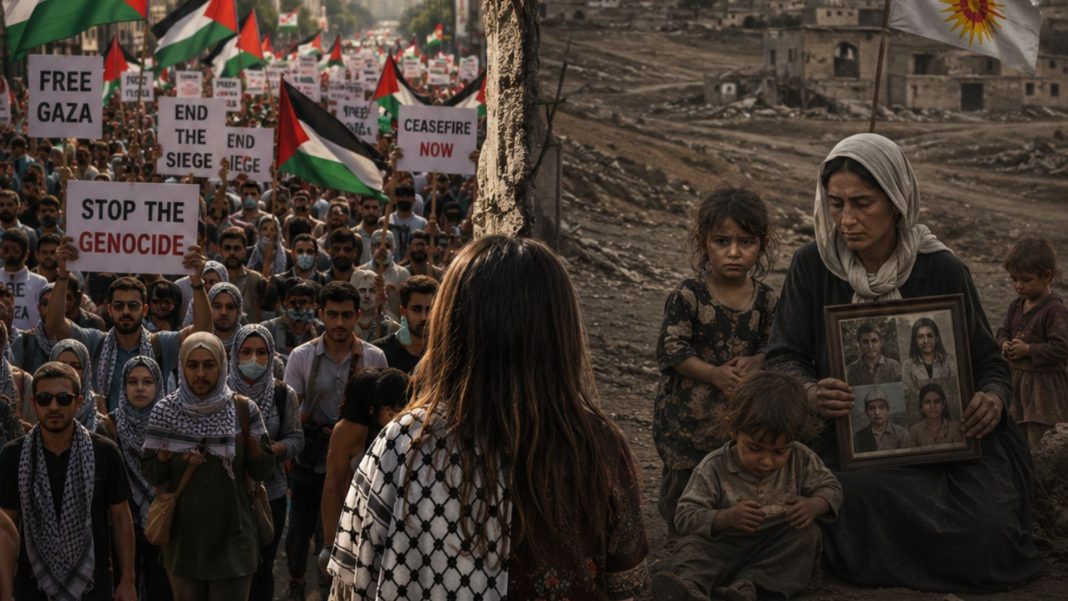

THE SILENT GENOCIDE: In August 2014, the world witnessed one of the most brutal acts of modern savagery when the Islamic State (ISIS) launched a systematic campaign to erase the Yazidi people, an ancient religious minority in northern Iraq.
Labeling them as “devil worshippers,” the militant group unleashed a wave of violence that shocked human rights investigators.
Reports thoroughly documented by the United Nations and various international rights watchdogs revealed a level of cruelty that defied comprehension. Men and elderly women deemed “unusable” were executed en masse and pushed into shallow trenches, some reportedly buried while still breathing.
For the young women and children, a highly organized, bureaucratic system of sexual slavery was established. Thousands were sold in open markets, kept in iron cages, and subjected to horrific torture. Survivors later shared harrowing accounts of psychological warfare, including forced cannibalism and public executions of those who resisted.
The UN officially declared the atrocities a textbook case of genocide. Yet, outside of official government statements, the global public response was vastly different from what the world sees today regarding other Middle Eastern conflicts.
A Tale of Two Crises: Mass Protests vs. Global Silence
THE SILENT GENOCIDE: A stark contrast has emerged in how the international public mobilizes for humanitarian crises. In recent years, cities across the globe from London and New York to Paris and Tokyo, have seen hundreds of thousands of protestors flood the streets, demanding ceasefires and justice for Palestinians in Gaza.
However, during the peak of the Yazidi genocide between 2014 and 2017, these same streets remained largely empty. There were no massive student encampments, no global boycott movements, and no sustained, multi-city street marches for the Yazidis.
This dramatic difference in public outrage has sparked intense debate among political analysts, historians, and human rights advocates. Why does one humanitarian catastrophe capture the global conscience while another, arguably more brutal in its localized intent, receives silence from the masses?
Understanding the Divide: Why the Public Marched for One and Not the Other
THE SILENT GENOCIDE: Political scientists point to several distinct factors that dictate why certain conflicts trigger mass public mobilization while others do not.
Targeting Western Foreign Policy: Public protests in Western nations are most effective when they target the actions or foreign policies of their own democratically elected governments. In the Gaza conflict, protestors take to the streets because their governments provide diplomatic, financial, or military aid to Israel.
They have a clear political demand: change domestic policy. In the case of the Yazidis, Western governments were already actively fighting ISIS. Because there was no domestic political disagreement on the evil of ISIS, there was no policy for citizens to protest against.
The Power of Pre-Existing Activism Networks: The Israeli-Palestinian conflict has lasted for over seven decades. Over generations, it has built a massive, deeply entrenched global network of student organizations, activist groups, and diaspora communities capable of mobilizing millions at a moment’s notice.
The Yazidi crisis, by contrast, happened suddenly at the hands of a non-state terrorist group, affecting a small, isolated minority that lacked an established global lobbying or activist infrastructure.
The Nature of the Actor: Public activism is traditionally geared toward holding recognized nation-states accountable to international law and treaties. Activists utilize tools like economic boycotts, sanctions, and diplomatic pressure. Because ISIS was an unrecognized, universally condemned terrorist organization, traditional methods of political activism and public pressure were completely useless against them.
The Legacy of Advocacy Beyond the Streets
THE SILENT GENOCIDE: While mass street protests were absent, the Yazidi community found other ways to demand justice. Survivors like Nadia Murad took their stories directly to the highest halls of power, testifying before the United Nations Security Council.
Murad’s relentless pursuit of justice eventually earned her the Nobel Peace Prize in 2018, ensuring that while the streets may have been silent, the history books would not forget.
The disparity in global public reaction highlights a complex truth about international activism: public outrage is rarely driven solely by the scale of human suffering; instead, it is deeply shaped by geopolitics, historical networks, and the political identity of the oppressor.
Also Read : Afghanistan Crisis: “If I don’t sell my daughter, my other children will die…” — The Real Reason