


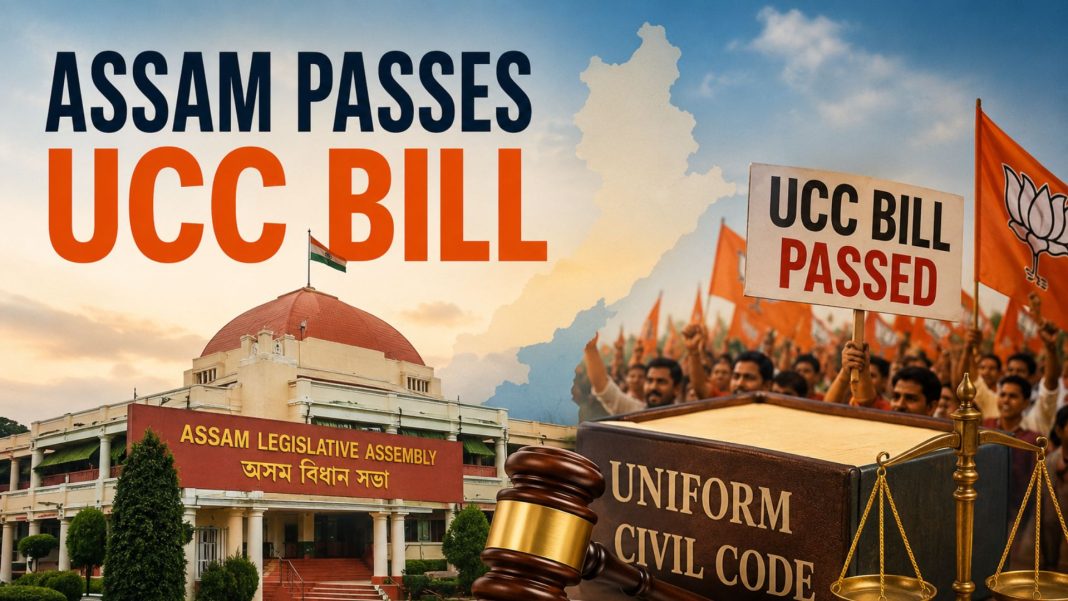

Assam Assembly Passes UCC Bill: The BJP-led Assam government cleared ‘The Uniform Civil Code, Assam, 2026 Bill’ amid heavy opposition uproar, making it the first northeastern state to implement a common civil framework.
The Assam Legislative Assembly achieved a massive legislative milestone on Wednesday, May 27, 2026, by passing The Uniform Civil Code, Assam, 2026 Bill.
With the passage of this landmark legislation, Assam has officially become the third state in post-independence India to adopt a Uniform Civil Code (UCC), following in the footsteps of Uttarakhand and Gujarat.
Introduced by Parliamentary Affairs Minister Atul Bora, the Bill aims to establish a single, common legal framework governing crucial personal matters such as marriage, divorce, succession, and live-in relationships for all residents of the state, cutting across religious boundaries.
Chief Minister Himanta Biswa Sarma hailed the day as a “watershed moment” in the history of Assam, noting that it fulfills a core constitutional obligation under Article 44, as well as a major electoral promise made by the ruling Bharatiya Janata Party (BJP).
Assembly Drama: Opposition Demands Select Committee Review
Assam Assembly Passes UCC Bill: The passage of the UCC Bill was far from peaceful. It was cleared following an intense, five-hour-long discussion on the final day of the ongoing five-day Assembly session.
Opposition parties, led by the Indian National Congress, the All India United Democratic Front (AIUDF), and the All India Trinamool Congress (AITC), strongly objected to the immediate passage of the legislation.
They demanded that the proposed Bill be referred to a Select Committee for wider public consultation, calling the move a “political agenda” of the BJP and a diversionary tactic from state issues like unemployment and floods.
When Speaker Ranjeet Kumar Dass rejected the opposition’s demand to delay the Bill, opposition MLAs trooped into the Well of the House, shouting slogans in protest.
Amidst the chaos and counter-slogans of ‘Bharat Mata Ki Jai’ and ‘Jai Shree Ram’ from the treasury benches, the Speaker put the Bill to a voice vote and declared it passed.
Key Provisions: Marriage, Divorce, and a Strict Ban on Polygamy
Assam Assembly Passes UCC Bill: The fundamental objective of the Assam UCC is to move away from unrecorded or purely customary personal laws to a structured system rooted in documentary family law governance.
Age Standardisation: The law strictly mandates the legal age of marriage as 21 years for grooms and 18 years for brides across all communities.
Complete Ban on Polygamy: The legislation completely outlaws bigamy and polygamy. Once the Act is fully implemented, practicing polygamy will attract severe penalties, including up to 7 years of imprisonment under Section 82 of the Bharatiya Nyaya Sanhita (BNS), 2023.
Compulsory Registration: All marriages and divorces must be compulsorily registered within 60 days of the occurrence. A deliberate failure to register within this period will result in a penalty of ₹10,000.
Abolition of Instant Talaq: The Bill effectively bans practices like instant triple talaq, dictating that a legal divorce can only take place through a valid court decree. It also introduces extra grounds for women to seek a divorce under specific circumstances.
First-of-its-Kind Rules for Live-in Relationships
In a progressive yet heavily monitored move, the Assam UCC introduces a legally binding framework for live-in relationships:
Mandatory Registration: Couples residing in a live-in relationship must register their partnership with the Sub-Registrar within 30 days of moving in together.
Punitive Actions for Non-compliance: If a couple fails to register their live-in status within one month, they face up to 3 months of imprisonment, a fine of ₹10,000, or both. Furnishing false information or concealing material facts during registration will invite up to 3 months in jail and a fine of ₹25,000.
Rights of Women and Children: To protect women and offspring, the Bill declares that any child born out of a registered live-in relationship will automatically be recognized as legally legitimate. Furthermore, if a man deserts his live-in partner, she holds the statutory right to claim financial maintenance through a court of law.
Important Exemptions: Protection for Scheduled Tribes
A critical feature of the Assam UCC Bill is the explicit exclusion of the Scheduled Tribes (ST) residing in Assam.
The law will not apply to tribal communities, ensuring that their constitutional protections, distinct cultural identities, and age-old customary laws remain entirely untouched.
Chief Minister Sarma justified this exclusion by stating that tribal communities have successfully practiced self-regulation for generations, heavily discouraging polygamy and granting equal rights to women on their own accord.
Additionally, the Bill explicitly preserves the cultural diversity of non-tribals by allowing marriages to be performed via any existing religious or customary ritual, including Vedic Vivah, Nikah, Ahom Chaklong, Saptapadi, and Holy Union.
Succession and Property Rights Reformed
The newly passed Bill brings a uniform, gender-equal order of preference for intestate inheritance (when a person dies without leaving a will) among Class-1 heirs.
This ensures that a deceased person’s spouse, children, and parents receive a fair and equal distribution of property, significantly strengthening women’s inheritance rights.
For testamentary succession, any adult of sound mind can execute a written, witnessed will without religious limitations.
With the Assam Assembly passes UCC Bill update, India’s legal landscape continues to transition toward state-driven civil uniformity.
While Goa has maintained a common civil code since its Portuguese colonial era, the state-by-state implementation by Uttarakhand, Gujarat, and now Assam indicates a growing momentum toward a shared national civil framework.
Also Read: Himanta Biswa Sarma Biography: Assam’s Visionary Leader and Chief Minister