


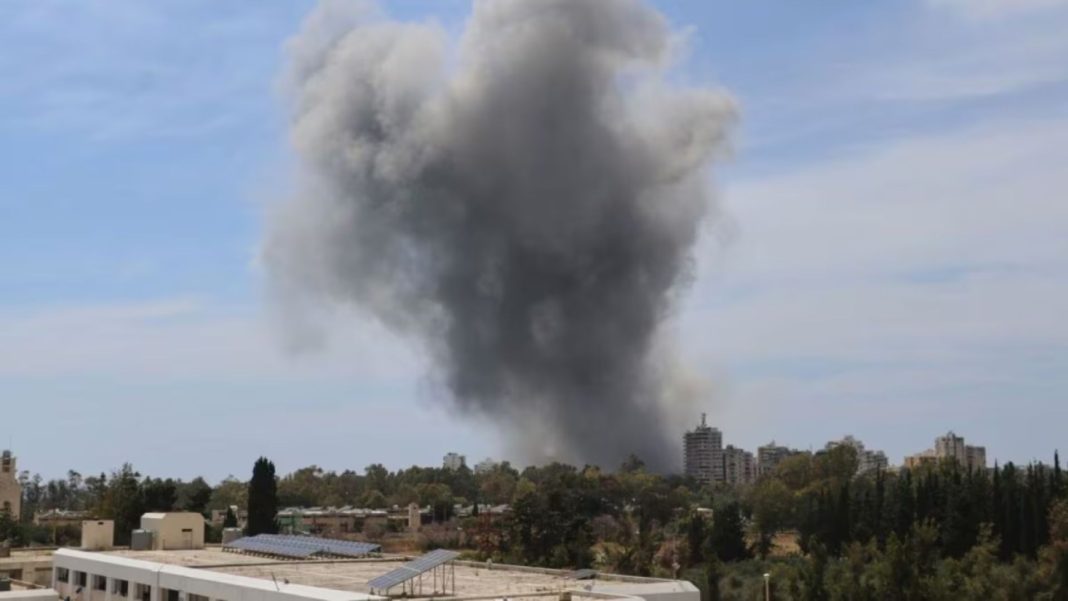

Iran Missile Attack: The Middle East has plunged into a dangerous new cycle of military confrontation. In a rapid series of escalations, the United States military launched targeted airstrikes against key Iranian radar installations.
The strikes were triggered after US forces intercepted multiple Iranian attack drones over the strategic Strait of Hormuz.
Iran’s Islamic Revolutionary Guard Corps (IRGC) retaliated almost immediately, launching a volley of ballistic missiles toward US-linked targets in Kuwait and Bahrain, threatening to drag neighboring Gulf nations into a wider regional war.
The Trigger: Drone Shootdowns and Precision US Airstrikes
Iran Missile Attack: According to U.S. Central Command (CENTCOM), the flare-up began when American forces detected and shot down four Iranian attack drones operating in the airspace over the Strait of Hormuz, a vital global choke point for oil transit.
Viewing the drone activity as an imminent threat, the US military launched immediate counter-strikes to neutralize Iran’s tracking capabilities.
Target Locations: The US strikes targeted sophisticated Iranian radar sites located on Goruk and Qeshm Island.
The Pentagon’s Stance: CENTCOM stated that destroying these radar stations was a necessary, defensive measure designed to disrupt Iran’s ability to track international shipping and launch further aerial assaults.
Iran Retaliates: 7 Ballistic Missiles Fired at Gulf Neighbors
Iran Missile Attack: Tehran’s response was swift and aggressive. The IRGC confirmed it had targeted “enemy bases” near the Strait of Hormuz. However, US military tracking revealed that the retaliation went far beyond the immediate waters of the Gulf.
Iran fired seven ballistic missiles aimed toward Kuwait and Bahrain, both of which host major US military personnel and installations.
CENTCOM’s Damage Assessment:
6 Missiles Intercepted: US and allied air defense systems successfully shot down six of the incoming ballistic missiles mid-air.
1 Missile Failed: The seventh Iranian missile suffered a malfunction and failed to reach its intended target.
Casualties: No immediate casualties or major damages were reported by coalition forces following the attack.
“Only 22% Left”: Trump Claims Iran’s Missile Arsenal is Crippled
Following the military engagements, US President Donald Trump took a highly confident stance, claiming that American operations have severely degraded Iran’s military infrastructure.
Speaking from Washington, President Trump asserted that the US-led strikes have broken the backbone of Tehran’s offensive capabilities.
“Iran’s missile strength has been heavily depleted after our latest strikes. Our data shows they are now down to just 21% to 22% of their total missile capacity,” Trump stated, emphasizing that the Islamic Republic’s ability to wage a prolonged missile war has been compromised.
The Intelligence Clash: NYT Reports Iran is Flashing 70% Strength
Despite President Trump’s optimistic briefing, a starkly contrasting picture has emerged from within the American intelligence community.
A report published by The New York Times suggests that the White House may be underestimating Tehran’s resilience. According to classified assessments by US intelligence agencies, Iran’s military infrastructure has bounced back with surprising speed.
Key Findings from US Intelligence:
Resilient Infrastructure: Iran has successfully reactivated 30 out of its 33 major missile launch and storage sites that were previously damaged or targeted.
Massive Reserves: Contrary to the 22% estimate, intelligence analysts believe Iran still retains roughly 70% of its total missile stockpile intact.
Underground Network: Experts note that Iran’s deeply buried underground “missile cities” have shielded a vast portion of its arsenal from conventional air raids.
What Lies Ahead: A Fragile Region on Edge
The direct exchange of fire between US forces and Iran, coupled with missiles flying toward Kuwait and Bahrain, marks a volatile chapter in Gulf security.
While air defenses prevented a catastrophe this time, the presence of a 70% intact Iranian arsenal means the threat of a larger, multi-national conflict remains dangerously high.
As international diplomats call for immediate de-escalation, both Washington and Tehran remain on high alert, with the Strait of Hormuz converted into a heavily armed powder keg.
Also Read : Israeli Airstrikes Across Gaza: Big Israeli Action in Gaza, At Least 11 Killed in Fierce Air Attacks!