


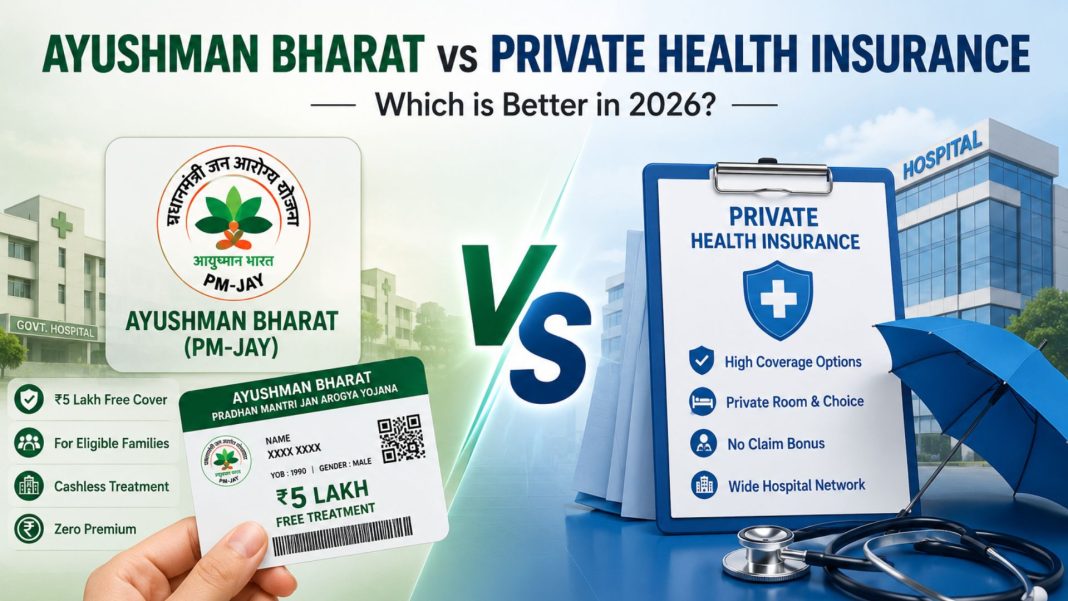

Ayushman Bharat vs Private Health Insurance: With medical expenses skyrocketing today, stepping into a hospital without a financial backup can drain your life savings in the blink of an eye.
A single major illness can completely wipe out a family’s hard-earned money. That is exactly why having health insurance is no longer a luxury in India it is an absolute necessity.
When it comes to choosing the best health cover, we generally look at two major paths: the government’s mega-scheme Ayushman Bharat (PM-JAY) and Private Health Insurance policies offered by various companies.
With changing healthcare dynamics and updated rules in 2026, this debate has become more relevant than ever.
What is Ayushman Bharat Scheme (AB-PMJAY)?
Ayushman Bharat vs Private Health Insurance: Ayushman Bharat, also known as the Pradhan Mantri Jan Arogya Yojana (PM-JAY), is the world’s largest government-funded health assurance scheme.
Launched by the Government of India, its primary goal is to protect poor, economically vulnerable, and rural families from catastrophic medical expenses.
Following recent updates, the scheme is now fully active across all 36 states and Union Territories in India (including West Bengal and Delhi).
Key Features of Ayushman Bharat (2026 Update):
₹5 Lakh Free Cover: It provides a cashless cover of up to ₹5 lakh per family, per year, for secondary and tertiary care hospitalization.
Zero Premium: Unlike regular insurance, you don’t have to pay any annual premium or fee. The entire cost is funded by the government.
Special Cover for Seniors (70+): Under the latest guidelines, all senior citizens aged 70 and above are eligible for a distinct card called the “Ayushman Vay Vandana Card“. This provides an exclusive, separate ₹5 lakh annual cover, regardless of their family’s economic status.
No Waiting Period: Pre-existing diseases are covered from day one. There is no waiting time to get treatment for illnesses you already have.
What is Private Health Insurance?
Ayushman Bharat vs Private Health Insurance: Private Health Insurance refers to health covers that you purchase directly from private insurance companies (such as Star Health, HDFC Ergo, Care Health, etc.) based on your specific requirements. In exchange for this cover, you pay a fixed annual fee called a premium.
This is the go-to option for individuals who do not fall under the government’s free eligibility criteria and want access to premium amenities at corporate hospitals.
Key Features of Private Health Insurance:
Flexible Coverage Options: You can choose a sum insured ranging from ₹5 lakh to ₹1 crore or even more, depending on your healthcare needs.
Premium Payments: The annual premium depends heavily on your age, medical history, and the amount of coverage you choose.
Choice of Rooms and Doctors: Depending on your plan, you can choose a private AC room, a shared room, or a deluxe suite during your hospital stay.
No Claim Bonus (NCB): If you enjoy a claim-free year, insurance companies reward you by increasing your total coverage amount for the next year at no extra cost.
| Features | Ayushman Bharat (PM-JAY) | Private Health Insurance |
|---|---|---|
| Eligibility | Low-income families identified by SECC data and all senior citizens aged 70+ | Anyone who can afford to pay the annual premium |
| Premium Cost | Completely free (₹0 premium). Government covers the cost | Ranges from ₹5,000 to ₹50,000+ per year depending on age and plan |
| Coverage Limit | Fixed at ₹5 lakh per family per year | Flexible, from ₹3 lakh to ₹1 crore+ based on the plan purchased |
| Pre-existing Diseases | Covered from Day 1 (No waiting period) | Usually requires a waiting period of 2–4 years |
| Hospital Room Type | General ward only | Single private AC room, shared room, or deluxe room (as per policy terms) |
| Hospital Network | Government and government-empanelled private hospitals only | Nationwide network of premium private and corporate hospitals |
| OPD Expenses | Not covered (requires minimum 24-hour hospitalization) | Covered in certain premium or high-end plans |
Pros and Cons of Ayushman Bharat
Pros:
Zero Financial Burden: It is a massive relief for low-income families, offering a solid ₹5 lakh safety net without charging a single rupee.
No Family Size Cap: Whether you have 3 members or 8 in your family, everyone is covered under the same plan. There are no restrictions on family size or age.
Pan-India Portability: A card made in one state can be used to get treated at any empanelled hospital across the country.
Cons:
Limited Hospital Network: You cannot walk into just any elite corporate hospital. You must choose from the list of hospitals registered under the scheme.
Basic Accommodations: It only covers general ward stays, meaning you won’t get the privacy or comfort of a private room.
Capped Coverage for Major Illnesses: For critical conditions like advanced cancer or major organ transplants, a ₹5 lakh limit can run out very quickly in private setups.
Pros and Cons of Private Health Insurance
Pros:
Premium Comfort and Privacy: Securing a private room ensures comfort, peace, and better hygiene for both the patient and the family during a stressful time.
High Medical Pool: In case of major emergencies, having a ₹20 lakh or ₹50 lakh policy keeps you entirely stress-free regarding hospital bills.
Advanced Medical Treatments: Private plans easily cover advanced medical procedures, modern robotic surgeries, and premium cancer care therapies.
Cons:
Expensive Premiums for Seniors: As you age, the cost of private insurance climbs significantly, making it harder to maintain on a retirement budget.
The Waiting Period Trap: If you have existing conditions like diabetes or high blood pressure, you will have to wait a few years before the policy covers those specific ailments.
Complex Terms and Conditions: Policies often come with complex hidden clauses like co-payments, sub-limits on room rents, or exclusions that require careful reading.
Which One is Better in 2026?
The choice boils down to your financial situation, family age brackets, and eligibility. Looking at the landscape in 2026, here is the best way to approach it:
If you meet the government eligibility criteria or have a tight budget: Ayushman Bharat is an absolute lifesaver. You should download your card immediately.
Additionally, if you have parents or grandparents aged 70+, make sure to register them for the Vay Vandana Card right away.
If you belong to the middle or upper-middle class: If you do not qualify for government schemes and can afford it, buying a Private Health Insurance policy is non-negotiable. Aim for a family floater plan of at least ₹10 Lakh to ₹25 Lakh to stay fully protected against medical inflation.
The Smart Hybrid Approach: If you are a senior citizen eligible for Ayushman Bharat but can also afford private insurance, use both! You can utilize the Ayushman card for standard treatments and preserve your private insurance policy as a high-value backup for major surgeries or specific corporate hospitals.
Also Read: Health Insurance Claim Process in India: Step-by-Step Guide and Mistakes to Avoid