


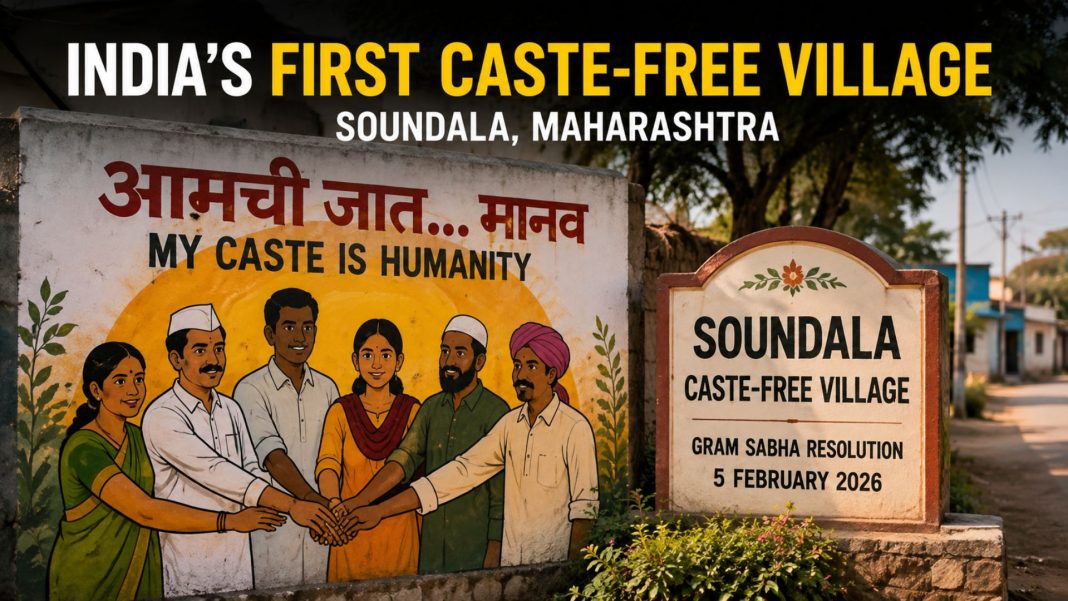

India’s First Caste-Free Village: In a historic move toward social reform and communal harmony, Soundala a modest village situated in the Nevasa taluka of Maharashtra’s Ahilyanagar district (formerly Ahmednagar) has officially declared itself India’s first “caste-free” village.
The landmark decision was formalized through a special Gram Sabha resolution passed unanimously on February 5, 2026.
According to media reports, the villagers collectively adopted the unifying Marathi slogan “Aamchi jaat… manav” which translates to “My caste is humanity” signaling a total rejection of traditional caste-based hierarchies, social exclusion, and discriminatory practices.
A Historic Resolution Grounded in Constitutional Principles
Which village declared caste free in Maharashtra? As reported by local news outlets, the Gram Sabha resolution was drafted with explicit references to the Preamble of the Indian Constitution, invoking its core tenets of Liberty, Equality, and Fraternity.
Under the new community declaration, the residents of Soundala comprising diverse social backgrounds, including Savarna, Bahujan, and minority groups agreed to renounce all forms of caste distinctions in their everyday lives.
Caste-free village in Maharashtra: According to official sources, the resolution legally and socially guarantees that all public spaces, infrastructure, and services within the village boundaries are universally accessible to every resident without bias. Key areas covered under the open-access mandate include:
Educational Institutions & Government Facilities: Local primary schools and village administrative centers.
Religious & Community Hubs: Public temples, community halls, and event spaces.
Essential Resources: Shared drinking water wells, hand pumps, and cremation grounds.
Village administrators stated that the decision was taken as a preventive initiative to safeguard future generations against social polarization and hate speech.
The Gram Sabha has also pledged to monitor local grievances and curtail derogatory social media content that could disrupt communal cohesion.
Blood Donation Drive Symbolizes Shared Identity
India’s First Caste-Free Village: According to media coverage, prior to convening the historic Gram Sabha, Sarpanch Sharadrao Argade organized a voluntary community blood donation drive. Over 200 villagers participated in the camp, creating a powerful symbolic prelude to the formal vote.
Addressing the assembly, Sarpanch Argade emphasized the biological unity of all human beings:
“Our blood is not green or blue. It is simply red. Once it mixes, no one can ever separate it again.”
This collective gesture served as a practical demonstration of the village’s philosophical shift, reinforcing the idea that physical and social divisions are man-made constructs that can be overcome through consensus.
A Track Record of Progressive Social Governance
India’s First Caste-Free Village: Media reports highlight that Soundala’s caste-free declaration is not an isolated event, but rather the continuation of a long-standing culture of grassroots social engineering.
Over the past few years, the Gram Sabha has repeatedly made headlines across the state for passing progressive local legislation.
Support for Widow Remarriage: In 2024, the village passed a resolution condemning outdated social stigmas against widows and actively encouraging widow remarriage within the community.
Ban on Degrading Language: The local council previously instituted strict community norms against abusive or derogatory language directed toward women, aiming to foster respect and gender dignity at the household level.
Civil society observers note that Soundala’s location within the Ahilyanagar district a region that has historically witnessed caste-related frictionmakes this grassroots transformation particularly significant. By actively dismantling social barriers from within, the village offers a practical blueprint for rural self-governance and social integration.
National Impact and Grassroots Model
Sociologists and policy analysts cited in news reports have praised Soundala’s initiative as a rare example of constitutional ideals being translated into village-level praxis.
While caste discrimination remains prohibited under Article 15 of the Indian Constitution, social enforcement at the rural level often poses administrative challenges.
Soundala’s self-enforced model demonstrates that sustainable social reform achieves its strongest footing when driven directly by local consensus rather than top-down mandates.
Following the positive nationwide reception of the Gram Sabha’s resolution, several social organizations and regional leaders have advocated for recognizing February 5 as “Caste-Free Day” to encourage other Panchayats across Maharashtra and India to replicate Soundala’s visionary model.
Also Read: ‘Ghajini’ Actor Pradeep Rawat Passes Away at 74: The Real Reason Behind His Cancer Relapse