


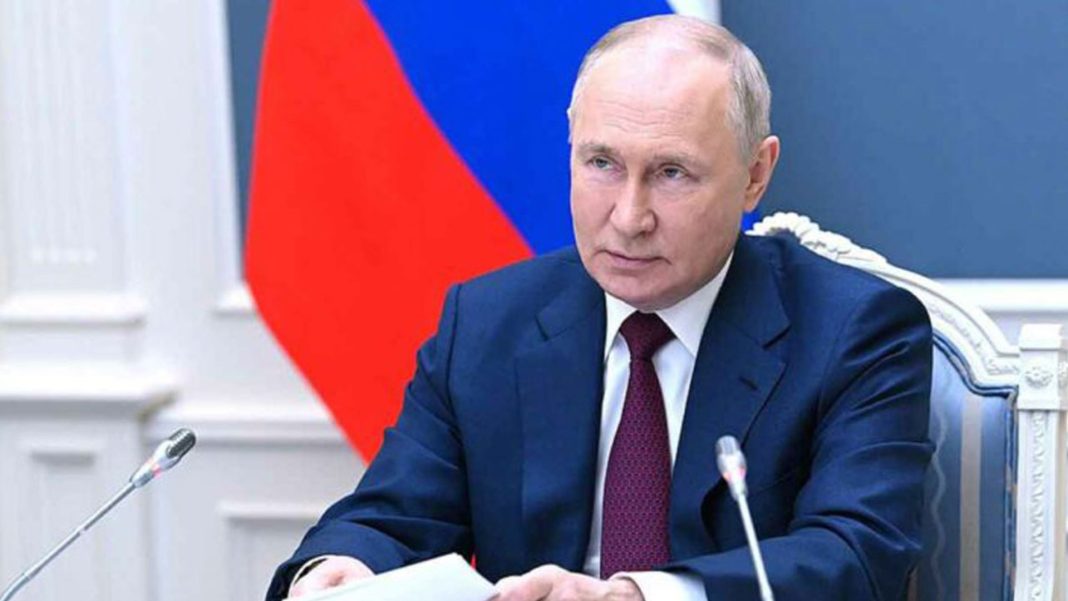

Putin’s Mega Defense Pitch: In a major geopolitical move aimed at reshaping global defense alliances, Russian President Vladimir Putin has extended an unprecedented military partnership to New Delhi.
Moscow is ready to provide unrestricted technology transfer and grant joint production rights to India for its flagship Sukhoi Su-57 fifth-generation stealth fighter jet.
Speaking to the international press on the sidelines of the St. Petersburg International Economic Forum (SPIEF), Putin confirmed that Russia is fully prepared to co-develop the advanced aircraft and share its most sensitive air defense technologies with its long-standing ally.
“No Restrictions Whatsoever”: Putin’s Open Invitation to New Delhi
Putin’s Mega Defense Pitch: Reflecting on the history of the Fifth Generation Fighter Aircraft (FGFA) program, Putin recalled that New Delhi had previously adopted a cautious, “wait-and-see” approach.
At the time, India suggested that Russia develop the stealth platform independently before Indian forces considered joining the initiative.
“This aircraft could have been our joint project. We developed it independently, but we are ready to work with India in this field, to supply this aircraft and to keep developing it.
We don’t have any issues or limitations. The same goes for air defense systems.”
, Russian President Vladimir Putin
The revamped Russian proposal is highly lucrative, reportedly covering the domestic manufacturing of critical components, the co-development of a specialized two-seat variant, and the seamless integration of Indian-made weapons systems.
Inside the Su-57: Why Moscow Calls it the World’s Best Fighter
Putin’s Mega Defense Pitch: Putin fiercely defended the capabilities of the Sukhoi Su-57, describing it as the pinnacle of modern aviation technology. As a true fifth-generation powerhouse, the Su-57 is built to dominate heavily contested airspace using an elite suite of tactical features:
Radically Low Radar Cross-Section (Stealth): Designed to penetrate highly sophisticated enemy air defense networks undetected.
Super-Maneuverability & Hypersonic Cruise: Exceptional dogfighting agility paired with advanced aerodynamic supersonic capabilities.
Next-Gen Integrated Avionics: All-direction radar coverage and electronic warfare systems that can double the aircraft’s utility as an airborne battle command center.
All-Domain Strike Dominance: Highly effective at neutralizing complex targets across air, ground, and maritime theaters.
Currently, the global fifth-generation landscape is exceptionally tight, featuring only Russia’s Su-57, the American F-35 Lightning II, and China’s J-20 and upcoming J-35 platforms.
The IAF Gap: From Rafale’s 4.5 Gen to the Ambition of AMCA
The Indian Air Force (IAF) currently operates the French-origin Rafale as its most advanced combat platform. While highly lethal, the Rafale is classified as a 4.5-generation aircraft.
This leaves India without an active fifth-generation stealth fighter in its fleet, a pressing concern given China’s rapidly expanding stealth inventory.
THE FIFTH-GENERATION STEALTH LANDSCAPE

 COUNTRY                                 FIGHTER PLATFORM                        OPERATIONAL STATUS

 Russia                                     Sukhoi Su-57                                 Active (Offered to India)
 United States                          F-35 Lightning II                             Active (Proposed to India)
China                                        J-20 / J-35                                   Active / Under Trial
 India                                      AMCA Project                                In Development (Post-2035)
Overcoming the Shadows of 2018
India had originally walked away from the joint Russian fighter program around 2018. The IAF had raised critical technical questions regarding the jet’s exact stealth engine parameters and expressed deep dissatisfaction over the transparency of technology sharing.
However, with India’s indigenous Advanced Medium Combat Aircraft (AMCA) project not expected to enter active service until at least 2035, defense analysts suggest that New Delhi is seriously reviewing options to bridge the interim capability gap, potentially evaluating the acquisition of at least two Su-57 squadrons.
“Futile and Detrimental”: Putin Blasts US Pressure on PM Modi
Addressing India’s complex geopolitical tightrope between Moscow and Washington, Putin dismissed Western attempts to dictate India’s trade and defense choices. He noted that the US continues to exert immense pressure on New Delhi regarding its energy and military ties with Russia, but praised Prime Minister Narendra Modi’s unwavering commitment to strategic autonomy.
“Everyone has understood that putting pressure on PM Narendra Modi is detrimental to international relations. India is a great nation and a major democracy that consistently acts in pursuit of its own national interests.”
Russian President Vladimir Putin
Putin emphasized that Russia-India defense ties remain completely insulated from external political environments and shifting Western sanctions.
Hands-Off Approach: Russia Refuses to Interfere in India-China Ties
When questioned about the fragile and highly sensitive border relations between New Delhi and Beijing, Putin maintained a strict policy of non-interference.
He expressed absolute confidence that PM Modi and Chinese President Xi Jinping possess the diplomatic maturity to resolve bilateral disputes through direct dialogue.
Independent Bilateral Tracks: Putin stressed that Russia’s historic ties with India and its close partnership with China are entirely independent. Moscow’s friendship with New Delhi does not come at Beijing’s expense, and vice versa.
The Power of Multilateralism: He highlighted the Russia-India-China (RIC) trilateral framework as a historic forum that successfully bridged gaps in the past and ultimately laid the powerful foundation for the modern, expanded BRICS bloc.
Putin’s sweeping offer leaves the ball squarely in India’s court. As New Delhi continues to modernize its military to counter regional security challenges, a localized, restriction-free production line of Su-57 stealth fighters could drastically accelerate India’s defense indigenization goals while maintaining its vital strategic edge in the Indo-Pacific.
Also Read : Iran Missile Attack: US Army claims Iran fired 7 ballistic missiles at Kuwait and Bahrain