
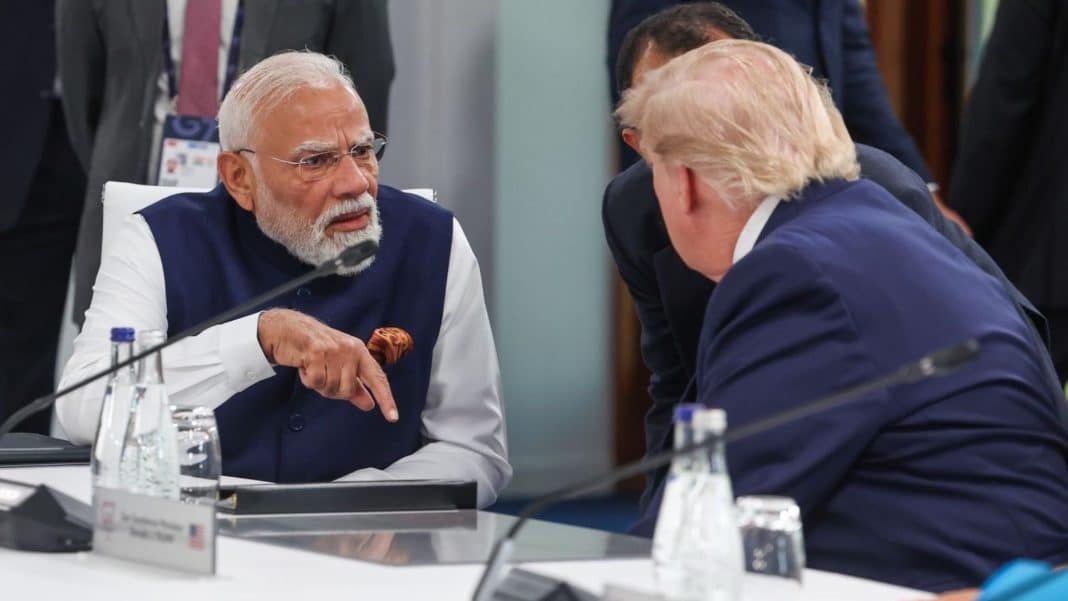

G7 Summit 2026: In a powerful diplomatic move at the 52nd G7 Summit in France, Prime Minister Narendra Modi delivered a sharp message to the world’s most developed nations.
Seated right next to US President Donald Trump during the high-profile outreach session, PM Modi raised the sensitive issue of the tragic deaths of three Indian seafarers in West Asian waters, while issuing a strong warning against the weaponization of global trade routes and critical technologies.
Addressing the session titled “Forging New Partnerships and Rebuilding International Solidarity,” PM Modi emphasized that global alliances can only be meaningful if nations collectively address shared vulnerabilities.
The Human Cost of Conflict: Modi Raises Indian Sailors’ Safety
G7 Summit 2026: The core of India’s intervention centered around maritime security and the immediate safety of civilian mariners. Weeks after a fatal strike near the critical Strait of Hormuz claimed the lives of three Indian sailors, PM Modi used the global stage to send a clear directive to international powers.
The Strait of Hormuz Crisis: The Prime Minister noted that disruptions in the Strait of Hormuz, the world’s most vital oil transit chokepoint, have dealt severe blows to the global economy and directly resulted in the loss of innocent Indian lives.
A Collective Mandate: “Protecting seafarers, who seamlessly connect the world through maritime trade, is our collective responsibility,” PM Modi stated firmly. He insisted that the global community must ensure sea lanes remain entirely safe and that mariners can operate globally without fear.
While welcoming recent progress toward West Asian peace efforts, Modi pointed out that unilateral escalations and naval blockades have extracted an immense economic and human price from neutral, friendly nations.
Rebuilding Global Trust: Strategic Assets Beyond Minerals and Markets
G7 Summit 2026: In a deeply analytical segment of his speech, PM Modi diagnosed the root cause of contemporary international friction. Moving beyond traditional definitions of geopolitical power, he stated that the ultimate global currency is no longer physical resources.
“Today, the world does not suffer from a shortage of resources; it suffers from a shortage of trust. The most critical strategic asset today is not a mineral, technology, or market, it is mutual trust.” , PM Narendra Modi at G7
We, in India, view the world as one family.
— Narendra Modi (@narendramodi) June 16, 2026
Our experience shows that development is most effective when it is connected to the aspirations of people.
This principle also forms the basis of our international partnerships like the International Solar Alliance, Coalition for…
The Interconnected Threat Matrix
Modi explained that in modern geopolitics, no nation’s vital interests are confined purely within its own borders. He highlighted a deeply webbed ecosystem where:
Energy Security & Food Security
Healthcare & Cybersecurity
Capital Flows, Data, and Technology
…are entirely intertwined. Because these elements bind humanity together, partnerships have become a necessity rather than a choice. However, these alliances are bound to fail if they lack a foundation of absolute trust at their core.
Invoking Reagan’s Legacy: ‘Trust, but Verify’ in the New Era
Striking a resonant chord with Western leaders, particularly President Trump, PM Modi invoked the famous diplomatic slogan of former US President Ronald Reagan: “Trust, but Verify.”
Modi asserted that this Cold War-era philosophy remains incredibly relevant today as global frameworks fracture. He noted that the COVID-19 pandemic had exposed the “hollowness” of global solidarity, proving how quickly trust can erode during a crisis. He challenged the G7 to build a reliable, rules-based international order that can genuinely handle the demands and challenges of this new era.
‘Supply Chains as Weapons’: India Draws a Hard Line
India’s address featured an explicit critique of how developed nations manipulate global trade nodes during geopolitical disputes. PM Modi demanded a global commitment ensuring that:
Technology and Supply Chains must exclusively serve the “global good” and never be transformed into geopolitical weapons of economic coercion.
Developmental Opportunities must not remain confined to a handful of privileged Western nations but must be distributed equitably.
Rooting India’s approach in the civilizational philosophy of ‘Sarvajan Hitaya, Sarvajan Sukhaya’ (welfare and happiness for all) and ‘Vasudhaiva Kutumbakam’ (the world is one family), Modi highlighted India-led global public goods like the International Solar Alliance and the Global Biofuels Alliance as true templates for open cooperation.
From Charity to Parity: A Voice for the Global South
Closing with a strong pitch for developing nations, PM Modi urged the G7 to completely abandon old, outdated diplomatic habits.
He stated that the Global South is no longer looking for aid, charity, or patronizing handouts. “They do not wish to remain mere beneficiaries of global development; they want to become active participants in it,” Modi noted.
By calling for a shift away from the traditional “donor-recipient” mindset toward relationships built strictly on equal footing, dignity, and shared responsibility, India has once again successfully positioned itself as the definitive, unyielding voice of the developing world on the G7 stage.