


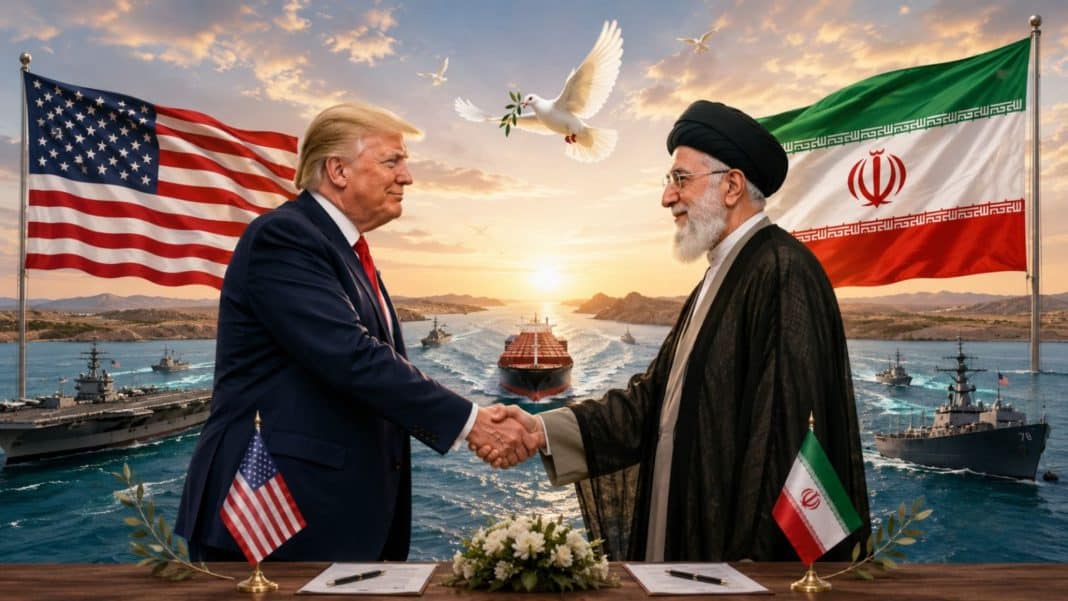

US-Iran War Ends: In a stunning diplomatic breakthrough, the United States and Iran have signed a major interim agreement to immediately halt military conflict.
Breaking from standard diplomatic schedules, US President Donald Trump signed the Memorandum of Understanding (MoU) during a high-profile dinner at the Palace of Versailles in France on Wednesday night. French President Emmanuel Macron stood as the primary witness to the historic moment.
Shortly after, Iranian President Masoud Pezeshkian executed his side of the agreement via a secure digital signature from Tehran. The deal officially became public at 5:30 AM Indian Standard Time (IST) on Thursday and took effect immediately, bypassing a formal signing ceremony that was originally scheduled for June 19 in Lucerne, Switzerland.
De-escalation on All Fronts: The Immediate Terms
US-Iran War Ends: The interim deal features a 14-point framework aimed at systematically unwinding months of active warfare in West Asia. It targets three immediate flashpoints:
Cessation of Hostilities: Active military operations by the US and its regional allies against Iranian targets and in Lebanon have been completely frozen.
Lifting the Naval Blockade: The United States has agreed to immediately begin dismantling its naval blockade of Iranian ports. The total removal of maritime restrictions is slated for completion within 30 days.
Reopening Global Trade: In exchange, Iran has committed to restoring the safe, unhindered passage of commercial vessels through the critical Strait of Hormuz.
Behind the Sudden Versailles Breakthrough
US-Iran War Ends: The decision to sign the MoU 24 hours ahead of schedule in France caught international observers by surprise. Trump, who was attending the G7 summit in France, capitalized on a dinner meeting hosted by Macron to finalize the text.
“It’s signed. Signed it in Versailles, I just signed it,” Trump told reporters upon leaving the historic palace.
By executing the document early, both administrations effectively avoided potential domestic political interference or last-minute diplomatic hurdles that could have stalled the formal Swiss assembly.
The Strategic Focus: Why the Strait of Hormuz Matters
The core component driving this quick resolution is the immediate stabilization of global energy corridors. The Strait of Hormuz is the world’s most vital choke point for oil supply.
Under the new terms, global oil traffic, which typically accounts for about 20% to 21% of the world’s petroleum consumption, is expected to return to its pre-war volume within the next 30 days. To make this happen, all technical and commercial obstacles, including active naval mining, must be cleared within that same 30-day window.
Furthermore, Iran has guaranteed that transit through the strait will remain completely free of charge for a strict 60-day window to allow global markets to stabilize.
However, the text explicitly notes that toll-free passage is not permanently guaranteed. Analysts indicate this opens the door for Tehran to seek sovereign transit fees in a finalized treaty later on.
Nuclear Concessions and a $300 Billion Rebuilding Plan
Beyond an immediate ceasefire, the MoU sets up a high-stakes 60-day negotiating clock to hammer out a permanent treaty. To secure immediate sanctions relief and the unfreezing of restricted financial assets, Iran has agreed to critical compromises:
Uranium Downblending: Iran must freeze its current nuclear expansion and begin downblending its existing stockpiles of highly enriched uranium on-site.
IAEA Oversight: The International Atomic Energy Agency (IAEA) will step in to monitor and verify the dilution process to prevent weapons-grade material accumulation.
Economic Reconstruction: In return, the US has pledged to coordinate with regional partners to establish a massive $300 billion reconstruction and economic development plan for Iran.
Challenges to a Permanent Peace
Though global oil markets responded positively, with crude prices dipping over 1% immediately following the announcement—experts warn that the true test lies in the upcoming 60 days of negotiations.
The deal faces immediate domestic friction in Washington, alongside explicit resistance from Israeli Prime Minister Benjamin Netanyahu, whose government has rejected claims regarding immediate withdrawals from regional operations.
Trump himself maintained a cautious posture, noting that if compliance falters, the US retains the option to resume military action. For now, however, the guns are silent, the blockades are lifting, and a critical global trade route is open once again.