


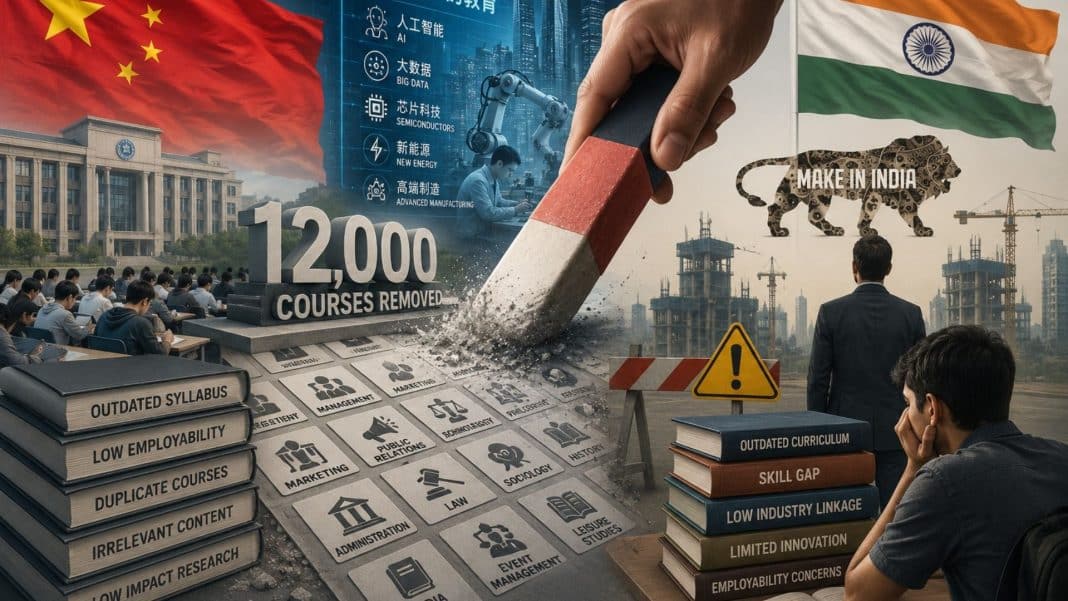

China education reform: The traditional university degree is officially on life support in China. For decades, a diploma in fields like product design, foreign languages, or business management was a guaranteed ticket to middle-class stability.
Today, it is increasingly viewed as an expensive, four-year piece of paper that Generative AI can render obsolete in seconds.
In a massive, top-down transformation of its higher education system, Beijing is systematically erasing thousands of academic programs. The message to its millions of students is brutal and clear
if your degree doesn’t help the country win the global tech war or survive the AI revolution, it no longer has a place in the classroom.
The 30% Shockwave: Inside China’s Great Academic Overhaul
China education reform: According to startling data from China’s Ministry of Education, Chinese higher education institutions scrapped 12,200 undergraduate degrees between 2021 and 2025 after finding them completely obsolete. In their place, universities rushed to introduce 10,200 new courses engineered specifically for a hyper-automated job market.
This unprecedented restructuring has directly impacted more than 30 percent of all degree programs offered across the nation.
The Catalyst: 17% Youth Unemployment and the ‘Gaokao’ Death Spiral
China education reform: This educational shock therapy is driven by a compounding crisis of economic slowdown, record graduate numbers, and rapid automation. The unemployment rate among China’s youth (aged 16 to 24, excluding students) recently climbed to a staggering 16.9 percent. This crisis is bound to worsen, with 12.7 million fresh university graduates flooding the job market this year alone.
The anxiety surrounding useless degrees is fundamentally changing student behavior. For generations, the Gaokao, China’s notoriously grueling national university entrance exam, the single most important milestone for a teenager.
That reality has cracked. In 2026, the number of students appearing for the Gaokao dropped by 450,000, bringing total registrations down to 12.9 million. This marks the second consecutive year of decline, down from a peak in 2024.
Young people are looking at millions of unemployed graduates and deciding that the intense stress of the Gaokao simply isn’t worth the shrinking reward.
Instead of studying outdated theory, a growing wave of Chinese students is opting for practical, vocational courses. In May, hundreds of applicants turned up at a vocational school in Beijing, fiercely competing for just 30 available spots in advanced manufacturing.
The India Connection: A Direct Threat to ‘Make in India’
China’s radical pivot from white-collar theory to blue-collar tech mastery isn’t just a domestic experiment; it sends a direct warning flare to India’s geopolitical and economic ambitions, particularly New Delhi’s flagship “Make in India” and “Semicon India” initiatives.
- The Semiconductor and Robotics Race
India is currently spending billions in subsidies (PLI schemes) to attract global chipmakers and build a domestic semiconductor ecosystem. However, China is countering India’s financial incentives by weaponizing its human capital.
By training hundreds of thousands of students directly in semiconductor engineering and embedded intelligence, China aims to maintain an insurmountable lead in tech-manufacturing talent, potentially choking India’s ability to pull global tech supply chains away from Beijing.
- The Danger of India’s “Degree Factory” Model
While China is aggressively shutting down obsolete courses, India’s higher education system remains heavily reliant on traditional, theory-based degrees. India produces millions of engineers and management graduates every year, but industry reports consistently highlight that over 80% of Indian graduates are unemployable in core technical roles.
If India continues to churn out degrees that Generative AI can replace, it risks facing a youth unemployment crisis even more severe than China’s.
- The Re-Skilling Pivot
China’s shift toward high-end vocational training poses a direct challenge to India’s cost-advantage in manufacturing. If Chinese factory floors are manned by highly specialized, AI-literate technical diploma holders rather than general graduates, their productivity will skyrocket.
For India to compete and truly become the “Office and Factory of the World,” it must pivot its own National Education Policy (NEP) to rapidly phase out redundant courses and mandate AI and advanced robotics across all disciplines.
A High-Stakes Technocratic Gamble
China is attempting an experiment never before seen on this scale: forcefully rewiring the minds of an entire generation to fit the immediate, cold calculations of a tech-centric economy.
By eliminating the humanities and doubling down on hardware, Beijing aims to build an economy powered by automation. However, if these new AI-driven degrees cannot absorb the 12.7 million graduates entering the market, China’s youth crisis could transform from an economic headache into a deep societal fracture.
For India, the lesson is clear: the era of the generic degree is over. If New Delhi does not aggressively align its university curricula with the realities of the AI revolution, its demographic dividend could quickly turn into a demographic disaster.
Also Read : Telegram Banned in India Until June 22: Government Restricts App to Prevent NEET UG 2026 Re-Exam Fraud