

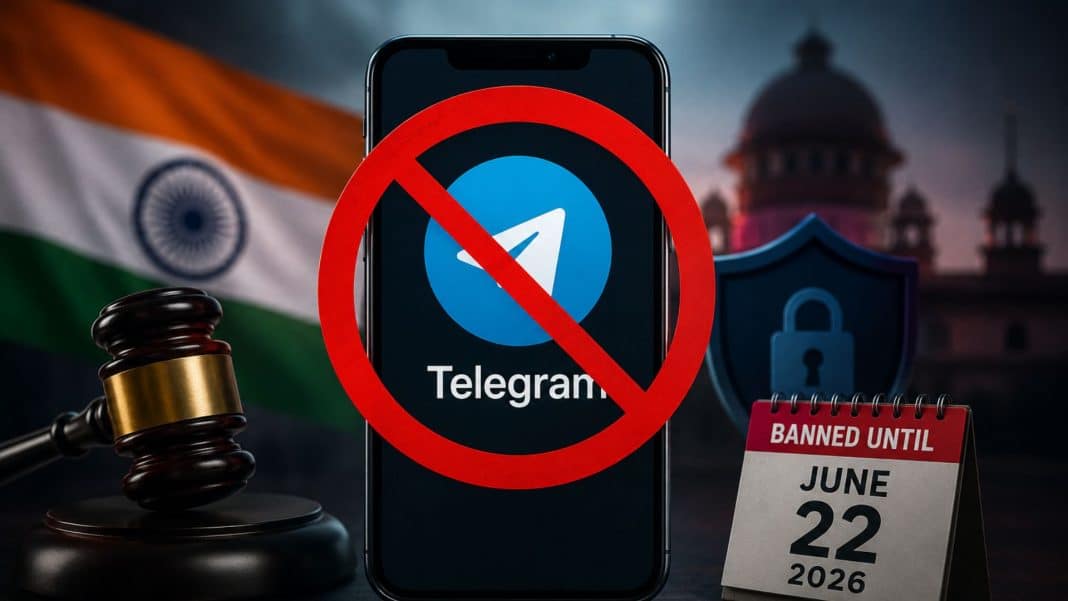

Telegram Banned in India Until June 22: The Central Government has implemented a temporary nationwide restriction on the instant messaging platform Telegram.
This strategic intervention follows recommendations from the National Testing Agency (NTA) to protect the absolute integrity of the upcoming National Eligibility cum Entrance Test (NEET-UG) 2026 re-examination, which is scheduled for June 21, 2026.
According to official press statements, the regulatory measures are strictly time-bound and aim to prevent the distribution of misleading information, coordinate public safety, and neutralize operations led by illegal cheating syndicates.
Details of the Government Directives
Telegram Banned in India Until June 22: According to a public notification issued by the National Testing Agency, the Ministry of Electronics and Information Technology (MeitY) exercised its statutory powers to execute two separate directives aimed at regulating the application’s functionality during this critical academic window.
1.Temporary Platform Restriction
The central government invoked Section 69A of the Information Technology Act, 2000, to restrict access to the Telegram platform across India.
This suspension is effective immediately and will remain in place for a defined period ending June 22, 2026.
This duration deliberately covers the day of the highly sensitive medical entrance re-test and its immediate aftermath to ensure public order.
2.Suspension of the Message-Editing Feature
In a separate but related enforcement action, MeitY directed Telegram to completely disable its message-editing capability for all already-posted messages within the country. This targeted technical restriction will remain active until June 30, 2026.
Reasons Behind Disabling the Edit Feature
Telegram Banned in India Until June 22: According to the NTA, the decision to curtail the message-editing tool was required to address a specific structural vulnerability on the platform that had been heavily exploited by fraud networks during recent nationwide competitive examinations.
Fabrication of Digital Evidence: The testing agency revealed that administrative heads of malicious channels previously engaged in generating artificial “paper leak” claims. They would take an older, harmless message posted days prior to an exam, edit its text or attachments to insert the actual question paper after the exam concluded, and retain the original historical timestamp.
Misleading Public Perception: These edited messages were then photographed or screenshotted to falsely suggest to the public, parents, and candidates that the examination material had been leaked online hours or days before the test actually commenced. Authorities stated that freezing the edit tool prevents the post-facto creation of such manipulated digital evidence.
Crackdown on Cheating Syndicates
The NTA reported that organized underground networks had been actively operating on Telegram under highly deceptive handles such as “PAPER LEAKED NEET”, “Re-NEET 2026”, and “Private Mafia”.
According to senior law enforcement officials, these channels openly advertised fraudulent examination-related services, demanding financial payments ranging from a few thousand rupees to several lakh rupees from vulnerable candidates and families in exchange for fake papers.
Inter-Agency Operations
The Indian Cyber Crime Coordination Centre (I4C), operating under the aegis of the Ministry of Home Affairs, has taken charge as the nodal monitoring mechanism.
Working alongside state police forces, the I4C has successfully facilitated the systematic removal of multiple malicious groups, automated chat-bots, and deceptive channels.
Regional Enforcement Actions
State law-enforcement agencies have initiated independent crackdowns against the operators behind these digital scams:
Gujarat: The Ahmedabad City Cyber Crime Branch successfully busted a major inter-state cyber fraud network managing eight distinct Telegram channels, tracking monetary transactions totaling nearly ₹1.5 crore routed through fraudulent accounts.
Bihar: The Economic Offences Unit (EOU) of the Bihar Police issued a detailed public advisory warning students against engaging with untrusted entities on social platforms.
Impact on Regular Users and NTA Guidance
The NTA explicitly clarified that no question paper exists outside its highly secured, closed-circuit examination chain, reiterating that all online advertisements promising advanced access to papers are entirely fraudulent.
Acknowledging that Telegram serves as a primary mode of routine communication for millions of citizens for genuine educational, corporate, and personal requirements, the testing agency expressed sincere regret for the temporary inconvenience caused to legitimate users.
However, officials emphasized that the move was an absolute last resort implemented after channel-specific takedowns proved structurally insufficient to contain the scale of organized disinformation.
The NTA reassured candidates that the NEET-UG 2026 re-examination process remains safe, secure, and fully intact.
Aspirants have been advised to disregard unverified online materials, maintain focus on their studies, and rely exclusively on official NTA portals for notifications.
Citizens encountering suspicious offers are urged to file immediate reports via the National Cyber Crime Helpline at 1930 or the official National Cyber Crime Reporting Portal.