


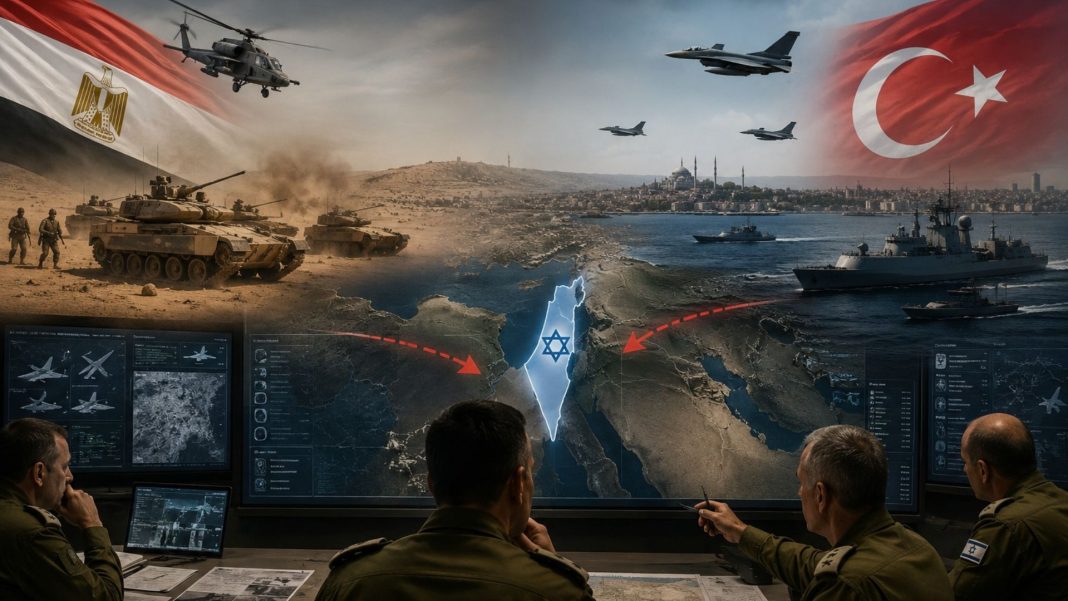

Israel two-front conflict: Global intelligence networks are closely monitoring an evolving strategic shift in the Middle East as reports surface regarding Israel’s active preparedness and monitoring for potential, long-term military friction with regional heavyweights Egypt and Turkey.
While diplomatic channels remain open, defense analysts warn that the underlying strategic calculations are being rapidly redrawn.
The historic 1979 Camp David peace accord between Israel and Egypt, which has served as the bedrock of regional stability for decades, is facing unprecedented psychological and structural strains.
At the same time, escalating political rhetoric from Ankara has prompted security planners to review long-term defense postures along the Eastern Mediterranean.
The Sinai Equation: Monitoring the “Cold Peace”
Israel two-front conflict: At the heart of the immediate concern is the gradual but steady militarization of the Sinai Peninsula. Under Annex I of the 1979 treaty, the border zone adjacent to Israel was strictly designated for lightly armed civil police.
However, recent security assessments highlight that over 40,000 Egyptian troops, alongside advanced armor and air-defense assets, have maintained a persistent presence in these previously restricted zones.
While initially permitted as temporary measures to counter localized insurgencies, these forward deployments are now viewed by Israeli planners as semi-permanent fixtures.
Erosion of the Buffer Zone: The buildup effectively shortens early-warning times for border defense.
Israel two-front conflict: The Horn of Africa Dynamic: Tensions have been further complicated by Egypt’s shifting focus toward the Horn of Africa, raising fears that a secondary proxy conflict could inadvertently spill over into vital maritime corridors.
The Official Stance: High-level defense briefings indicate that while economic interdependencies, such as multi-billion-dollar natural gas deals, remain intact, the military is actively monitoring Egypt’s excessive buildup to prevent an imbalance in border deterrence.
The Northern Friction: Assessing the Turkish Challenge
Simultaneously, the geopolitical landscape in the Eastern Mediterranean is growing increasingly complex. Following intense regional conflicts that reshaped the Levant, Turkey has openly expressed concern regarding Israel’s expanding security footprint and buffer zones in Syria and Lebanon.
Recent Turkish national security assessments have explicitly called for an overhaul of their own defense postures, citing Israeli military behavior as a long-term strategic challenge.
Turkish rhetoric has labeled the expanding defense cooperation between Israel, Greece, and Cyprus as a direct threat to Ankara’s maritime ambitions.
In response, intelligence reports confirm that Israeli defense networks are factoring a potential northern maritime or proxy dispute into their broader, long-term operational readiness models.
Global Implications: The Threat of a Multi-Front Escalation
For Western allies, including the United States, United Kingdom, Canada, and Australia, these preparatory maneuvers carry massive geopolitical stakes. A breakdown in deterrence could have immediate, compounding global effects:
Energy Shockwaves: Any escalation threatening the Eastern Mediterranean or the Red Sea could immediately destabilize global oil and gas supplies, triggering severe economic ripple effects.
Humanitarian Crises: A confrontation involving large-scale state militaries would inevitably spark displacement challenges that dwarf recent localized conflicts.
Western Entanglement: The US and its allies could find themselves drawn into a deep diplomatic and military firestorm to preserve freedom of navigation and protect sovereign allies.
Current Status: Preparedness Over Conflict
Diplomatic sources emphasize that active preparations, strategic modeling, and heightened vigilance remain the current scope of operations. None of the involved nations have indicated a desire for immediate kinetic conflict.
Turkey’s intelligence frameworks continue to advocate for preserving communication channels with Jerusalem to maintain a “controlled competition,” while Egypt continues to view its peace treaty as a foremost strategic priority despite its domestic military exercises.
Nevertheless, global intelligence networks remain on high alert. The transition from a “cold peace” to active strategic preparedness signals that the margin for error in the Middle East has shrunk to its narrowest point in decades.
Also Read : Gunmen Attack Niamey Airport in Niger: 11 Soldiers, 2 Civilians Killed in Shootout