


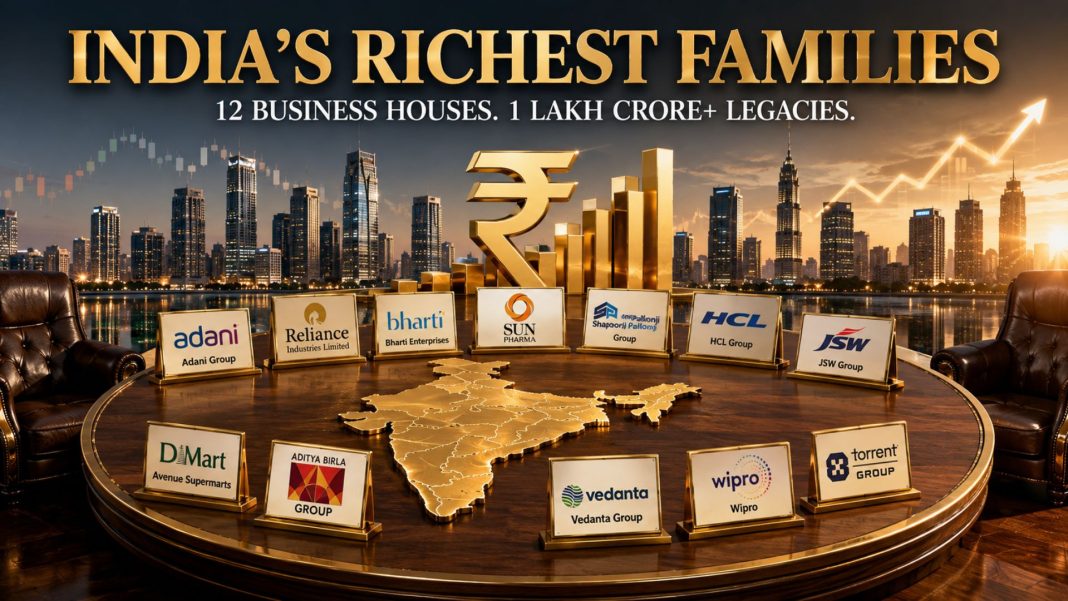

India’s Richest Families: India’s corporate landscape is witnessing an unprecedented surge in private wealth creation.
According to the latest 360 ONE Wealth Creators List 2026 released in collaboration with CRISIL Intelligence, India is now home to 12 mega business families whose individual family wealth exceeds the remarkable threshold of ₹1 lakh crore ($12+ billion).
As reported by financial media, this benchmark reflects the rapid expansion of India’s corporate sector, rising equity market valuations, and decades of strategic capital allocation across key industrial sectors.
Most of this estimated wealth remains tied to equity ownership in listed and unlisted corporate holdings, reflecting overall business valuation rather than direct liquid cash holdings.
The 12 ₹1 Lakh Crore Business Empires Shaping India’s Future
Top 10 india’s richest families: According to the report, industrial conglomerates and family-led business groups continue to hold immense sway over the nation’s economic ecosystem.
The 12 business families that have crossed the ₹1 lakh crore valuation mark include:
Adani Family (Adani Group – Ports, Power, Renewables, Logistics)
Ambani Family (Reliance Industries – Energy, Retail, Digital Services)
Mittal Family (Bharti Enterprises – Telecommunications & Infrastructure)
Dilip Shanghvi Family (Sun Pharmaceutical Industries – Healthcare & Generics)
Mistry Family (Shapoorji Pallonji Group – Construction & Engineering)
Shiv Nadar Family (HCL Group – Technology & IT Services)
Jindal Family (JSW Group – Steel, Energy, Infrastructure)
Damani Family (Avenue Supermarts / DMart – Retail & Commerce)
Birla Family (Aditya Birla Group – Metals, Cement, Financial Services)
Agarwal Family (Vedanta Group – Mining, Metals, Natural Resources)
Premji Family (Wipro – IT Services & Technology Investment)
Mehta Family (Torrent Group – Pharmaceuticals & Power Utilities)
India’s Richest Families: Media reports highlight that the top family positions are led by Gautam Adani & family (evaluating wealth around ₹9,08,178 crore) followed closely by Mukesh Ambani & family (₹8,93,622 crore) and Sunil Bharti Mittal & family (₹4,96,687 crore). Together, the top 100 business families in India control roughly ₹76.5 lakh crore in total wealth.
Macroeconomic Drivers Behind Wealth Accumulation
Who are the top 10 richest families in India? The rapid expansion of corporate wealth in India is deeply tied to broader macroeconomic tailwinds. According to financial publications and research reports, several core structural factors have propelled these market valuations:
Equity Market Expansion: A decade of steady bull runs and surging retail and institutional domestic capital inflows into Indian stock exchanges has amplified the promoter equity value of large listed conglomerates.
Diversified Sector Growth: Traditional heavy industries such as pharmaceuticals, infrastructure, metals, and telecommunications account for the bulk of wealth accumulation, providing stable, long-term compounding benefits.
Shift to Real-Return Assets: Market analysis in the 360 ONE–CRISIL report indicates that India’s ultra-wealthy promoter families have steadily shifted their capital allocation strategy over time moving away from conservative cash-preservation assets toward growth-driven real-return equity investments.
Economic Significance: Job Creation and Strategic Capital
Who is richer, Mittal or Ambani? While net worth metrics focus on business equity rather than liquid wealth, these large family-led business groups serve as fundamental engines for the national economy.
As noted in recent media reviews, these conglomerates drive widespread economic growth by:
Infrastructure Development: Investing tens of billions of dollars annually into national transport corridors, renewable energy grids, logistics hubs, and manufacturing facilities.
Employment Expansion: Generating direct and indirect jobs across primary, secondary, and service sectors on a massive scale.
Attracting Foreign Capital: Offering global investors structured, well-governed corporate partners through joint ventures, private equity investments, and public capital raises.
Looking Ahead: A Changing Wealth Landscape
India’s Richest Families: As India’s GDP continues its upward trend, the nature of enterprise and wealth in the country is also undergoing a generational transition.
Reports point out that while traditional industrial conglomerates still command the majority share of total private wealth, new-economy sectors such as fintech, renewable energy, and quick-commerce startups are rapidly creating first-generation wealth creators.
Nevertheless, the legacy business families highlighted in the CRISIL–360 ONE report remain the foundational bedrock of Indian private capital.
Their ability to navigate market cycles, execute multi-generational business plans, and scale up operations underscores the overall strength and long-term trajectory of the Indian corporate ecosystem.
Also Read: India’s Development Milestones: Strategic Breakthroughs Driving Economic Growth and Modernization