


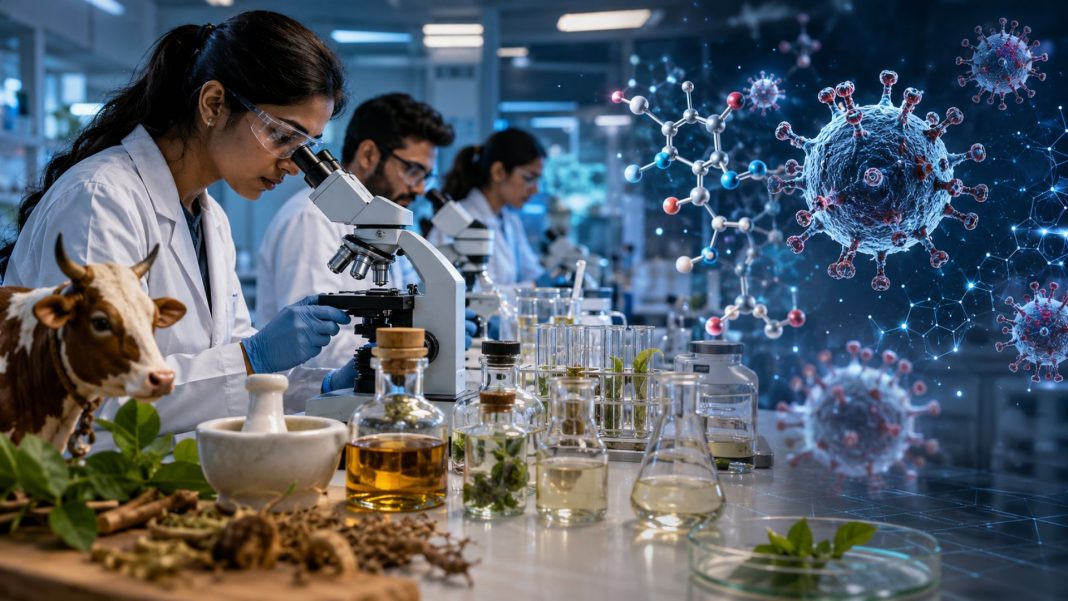

IIT Roorkee Study: Every year, monsoon seasons across India bring a sharp escalation in mosquito-borne illnesses, with Chikungunya presenting a major public health challenge.
In a bid to find affordable and accessible therapeutic solutions, researchers at the Indian Institute of Technology Roorkee (IIT Roorkee) have turned their attention to traditional knowledge, backing it with rigorous modern biotechnology.
A newly published study in the peer-reviewed journal ACS Agricultural Science & Technology reveals that specific bioactive compounds extracted from cow urine distillate (CUD) show substantial antiviral activity against the Chikungunya virus under controlled laboratory conditions.
Led by Prof. Shailly Tomar from the Department of Biosciences and Bioengineering at IIT Roorkee, the research was conducted in collaboration with prominent Ayurveda and biomedical institutions across India.
While the phrase “cow urine” frequently sparks debate, this study moves past folklore to identify the exact molecular science at play.
Here is an objective, fact-checked breakdown of the study’s findings, the science behind them, and what this means for the public.
The Laboratory Findings: In Vitro Success
IIT Roorkee Study: The study utilized an advanced combination of virology, metabolomics, molecular docking, and biochemical analyses to test how cow urine distillate interacts with virus-infected cells in laboratory dishes (in vitro).
The experimental results demonstrated a dose-dependent reduction in the viral load:
2% Concentration: Reduced the Chikungunya virus levels by approximately 90%.
4% Concentration: Reduced the viral load by over 99%.
The Power of Synergy
The research took a step further by combining the distillate with two well-known plant-derived bioactive compounds:
Thymoquinone: An active compound found in black seed (Nigella sativa).
Piperine: The alkaloid responsible for the pungency of black pepper (Piper nigrum).
When the researchers tested an optimized, three-part mixture of the cow urine distillate, thymoquinone, and piperine, they observed a synergistic effect.
This formulation worked significantly better than any individual component alone, eliminating 99.85% of the virus in the laboratory models.
Decoding the Science: How It Works
IIT Roorkee Study: To ensure the study met strict scientific benchmarks, the team used computer simulations and molecular docking to understand exactly how these substances inhibit the virus.
Chemical profiling identified three specific organic acids as the primary drivers of the antiviral activity: benzoic acid, hippuric acid, and oleic acid.
The molecular simulations revealed that these compounds successfully latch onto and block a critical enzyme that the Chikungunya virus requires to replicate its genetic material.
By jamming this replication machinery, the compounds effectively prevent the virus from multiplying and spreading to neighboring cells.
“Our research not only identifies specific bioactive molecules in Ayurvedic Gau mutra ark responsible for antiviral activity but also demonstrates the power of synergistic natural formulations,” explained Prof. Shailly Tomar in a press statement, noting that these findings lay a foundation for next-generation antiviral strategies.
Crucial Context: Is It Safe for Direct Consumption Now?
No. The public should not consume raw cow urine or over-the-counter distillates as a treatment or preventive measure for Chikungunya based on this study.
While the laboratory data is highly encouraging, there is a vast scientific gulf between destroying a virus in a plastic petri dish and treating an active infection inside the human body.
Why Laboratory Success Does Not Equal an Immediate Cure:
Bioavailability: When a compound is poured directly onto cells in a dish, it interacts with the virus immediately. When a human consumes a substance, the digestive system, liver, and metabolic pathways alter those compounds, which may change how or if they reach the target virus.
Toxicity and Dosages: Safe concentrations for cells in a lab do not automatically translate to safe or effective dosages for human consumption.
Lack of Clinical Trials: This study is strictly in the pre-clinical stage. It has not been tested on animal models (in vivo) or evaluated in human clinical trials to establish safety, efficacy, or standardized dosing protocols.
The Path Forward for Next-Generation Antivirals
Prof. Kamal Kishore Pant, Director of IIT Roorkee, emphasized that the study exemplifies how modern biotechnology can bridge traditional knowledge systems with evidence-based science to address global health threats.
The ultimate goal of this research is not to promote home remedies, but to identify viable molecular blueprints.
By isolating the exact chemical structures (like benzoic and hippuric acids) that inhibit the virus, pharmaceutical scientists can use these findings to design, synthesize, and standardize safe, purified antiviral medications in the future.
Until extensive clinical trials are completed and regulatory bodies give formal approval, standard medical protocols for Chikungunya which focus on hydration, rest, and symptom management under a doctor’s supervision remain the only validated course of action.