


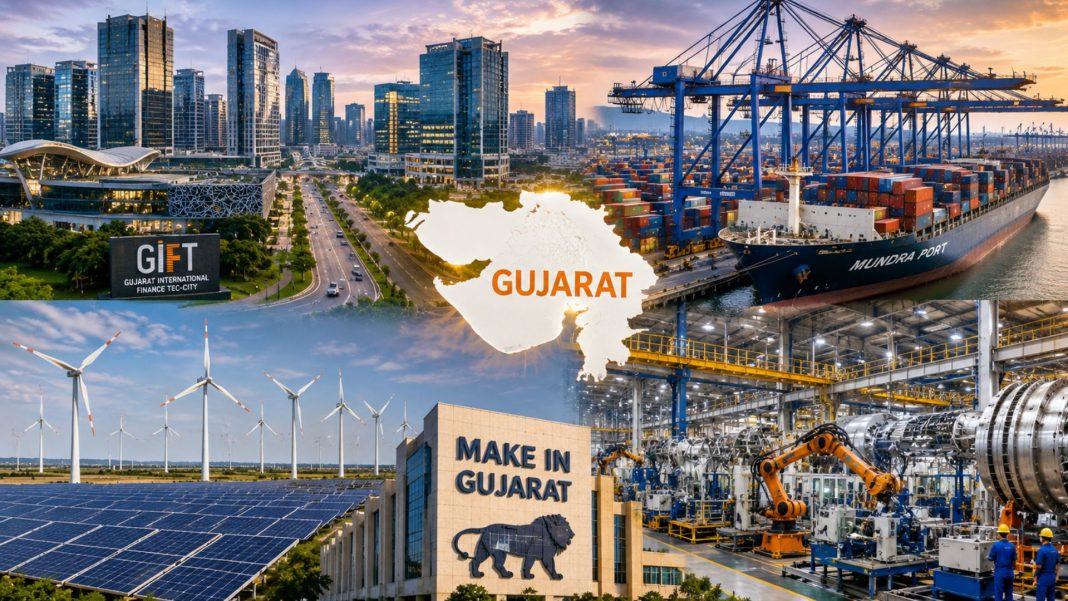

Gujarat Corporate Growth: Gujarat has transitioned from being just a major contributor to India’s economy to positioning itself as a dominant force on the global industrial stage.
According to a comprehensive analysis of the state’s corporate landscape, Gujarat is rapidly emerging as a global powerhouse, driven by massive investments, a booming MSME sector, and a rapidly evolving workforce.
With a clear roadmap to turn its economy into a $500 billion entity, the state’s economic trajectory is rewriting the rules of industrial development in India. Here is a detailed, fact-checked breakdown of how Gujarat’s corporate and industrial sectors are shaping up.
The Scale of Domination: Gujarat’s Economy in Numbers
Gujarat Corporate Growth: The sheer scale of Gujarat’s industrial footprint is reflected in its core macroeconomic indicators. The state is no longer just competing with other Indian states; it is benchmarking itself against global manufacturing hubs.
The $500 Billion Target: Gujarat is aggressively moving towards becoming a $500 billion economy, supported by heavy industrialization and global investments.
MSME Contribution: The state accounts for a massive 50% share in India’s composite MSME growth, showcasing a robust ecosystem for small and medium enterprises that act as the backbone for larger corporate entities.
The Entrepreneurial Force: More than 14 crore Gujarati entrepreneurs and workers are actively driving this economic engine, making it one of the most self-reliant industrial ecosystems in the world.
Consistent Growth Rate: Even during global economic slowdowns or pandemic-induced disruptions, Gujarat has managed to maintain a 10%+ growth rate, showcasing immense resilience.
Sector-Wise Breakdown: Where the Investments are Flowing
Gujarat Corporate Growth: Gujarat’s corporate world is no longer reliant solely on traditional sectors like textiles or diamonds. There is a massive shift towards high-tech manufacturing, green energy, and infrastructure.
An analysis of corporate trends reveals that over 1,000 companies in Gujarat have a turnover exceeding ₹100 crore, distributed across various high-performing segments:
| Sector | Turn-over Range (₹ Crore) | Growth Profile / Market Share |
|---|---|---|
| Renewable Energy & Infrastructure | 1,500–5,000+ | Fast-growing sector driven by heavy public-private investments |
| Chemicals & Petrochemicals | 1,000–1,500 | Accounts for nearly 6–7% of the total market share |
| Pharma & Healthcare | 750–1,000 | Holds 11–12% market share; major global export hub |
| Textiles & Diamonds | 500–750 | Traditional stronghold; contributes around 22% market share |
| Digital, IT & FinTech | 250–500 | Emerging sector with rapid growth of 23–25% |
| FMCG & Agro-industries | 100–250 | High-volume sector; localized consumption driving nearly 40% growth |
Financial Resilience and Fiscal Contributions
Gujarat’s business model is backed by high financial discipline and massive contributions to the national treasury.
National GST and Export Share
The state plays a pivotal role in India’s fiscal health. Gujarat alone accounts for 8% to 9% of the total national GST collection.
Furthermore, due to its strategic coastal location and world-class port infrastructure like Mundra and Kandla, the state remains a leader in trade and exports, facilitating smooth cross-border commerce for top-tier Indian conglomerates.
Strong Banking and Low Non-Performing Assets (NPAs)
One of the most significant indicators of a healthy corporate ecosystem is bank asset quality. Gujarat boasts an exceptionally low corporate NPA level.
The state’s financial institutions have maintained a highly disciplined lending environment, ensuring that corporate expansion is funded safely without risking banking crises.
The Changing Workforce: Women Leading the Corporate Surge
A highly significant and progressive trend in Gujarat’s corporate sector is the rapid rise of the female workforce and women entrepreneurs.
The state currently ranks third in India in terms of the number of women working in the corporate sector.
Key Workforce Metrics:
Rapid Adoption in Modern Sectors: While traditional sectors like textile packaging and diamond polishing have always employed women, modern corporate offices including IT, Finance, Pharmaceuticals, and FMCG are seeing a major influx of female professionals.
Boardroom Representation: In top-tier companies listed or operating out of Gujarat, female representation on corporate boards (including roles like CEO, CFO, CA, and CS) stands at an impressive average of 10% to 15%.
The Micro-Entrepreneurship Revolution: In the MSME and startup sectors, women-led enterprises are growing exponentially. In rural and semi-urban Gujarat, nearly 80% of micro-enterprises run by women are highly sustainable and profitable, particularly in dairy, retail, and apparel manufacturing.
The Road to 2035
Gujarat’s corporate journey is transitionary. By moving towards advanced sectors like semiconductor manufacturing, green hydrogen, and financial services via GIFT City, the state is securing its future for the next few decades.
With low financial risks, a highly disciplined entrepreneurial culture, an expanding inclusive workforce, and dominant manufacturing numbers, Gujarat is well on its way to cementing its position as the ultimate industrial powerhouse of the modern world.
Also Read: IIT Roorkee Study: Cow Urine Distillate Shows Antiviral Potential Against Chikungunya