

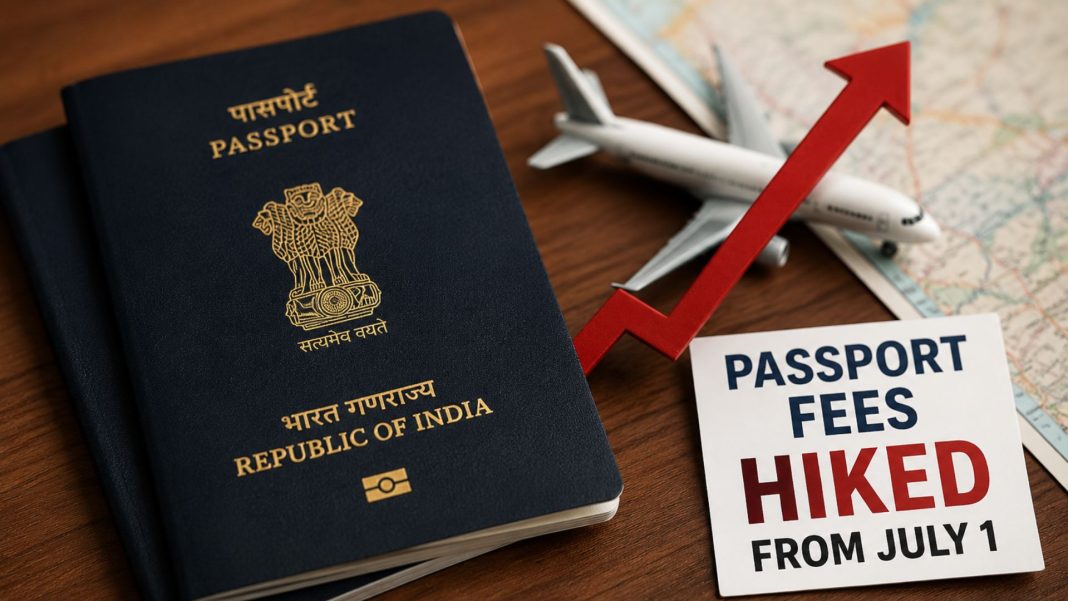

Passport Fees Hiked From July 1: Getting an Indian passport is set to become more expensive from July 1, 2026, as the Central Government has revised passport application fees across multiple categories.
The Ministry of External Affairs (MEA) has notified the new charges through the Passports (Amendment) Rules, 2026, bringing changes to fees for fresh passports, renewals, Tatkal applications, and replacement booklets issued in cases of loss or damage.
The revised fee structure will apply to all eligible applications submitted on or after the effective date.
This is the first revision in passport application fees since 2012.
The government says the updated charges are intended to reflect the current cost of delivering passport-related services while ensuring efficient processing through the Passport Seva system.
Anyone planning to apply for a new passport or renew an existing one after July 1 should be aware of the revised fee structure before scheduling an appointment.
Revised Charges for Regular Passport Applications
Passport Fees Hiked From July 1: The biggest change affects applicants opting for the standard passport application process. Under the revised schedule, adults applying for a fresh 36-page ordinary passport or seeking its reissue under the normal category will now have to pay ₹2,500, compared to the earlier fee of ₹1,500.
Similarly, the fee for a 60-page passport booklet, generally preferred by frequent international travellers, has been increased from ₹2,000 to ₹3,500 under the regular application category. The revised rates apply equally to fresh applications as well as reissue requests.
Tatkal Passport Fees Also Increased
Passport Fees Hiked From July 1: The fee revision also extends to the Tatkal scheme, which allows applicants to obtain passports through an expedited processing system.
Under the new structure, applicants seeking a 36-page passport through Tatkal will now pay ₹5,000, replacing the previous fee of ₹3,500.
Likewise, the charge for a 60-page passport under the Tatkal category has increased from ₹4,000 to ₹6,000.
The Tatkal facility remains available for applicants who require faster passport issuance, subject to the prescribed eligibility conditions and document verification process.
Higher Charges for Lost or Damaged Passports
The revised rules also introduce higher fees for replacement passports issued after the loss, theft, or severe damage of an existing passport.
Applicants replacing a 36-page passport under the normal category will now pay ₹5,000, while the Tatkal fee has been fixed at ₹7,500.
For replacement of a 60-page passport, the revised charges are ₹6,000 under the regular category and ₹8,500 under the Tatkal scheme.
These rates apply to adult applicants and eligible minors who choose to apply under the adult passport category in accordance with the applicable rules.
Legal Basis for the Revision
The revised fee structure has been introduced under the Passports (Amendment) Rules, 2026, framed by the Central Government using powers conferred under Section 24 of the Passports Act, 1967.
The amendment replaces the existing fee schedule contained in Schedule IV of the Passports Rules, 1980, and officially comes into force on July 1, 2026.
The updated rules continue to classify applicants into separate categories, including adults, minors below 18 years of age, and minors aged between 15 and 18 years who voluntarily opt for a full-validity passport under the adult category.
MEA Reiterates the Purpose of a Passport
The announcement of the revised fee structure coincided with observations made during Passport Seva Divas, where the Ministry of External Affairs highlighted the primary purpose of an Indian passport.
According to the ministry, a passport is fundamentally an international travel document that enables Indian citizens to travel abroad.
Although it is issued only after a detailed verification process, officials clarified that the passport should not be treated as conclusive proof of Indian citizenship.
Its principal role is to facilitate international travel while establishing the identity of the holder for cross-border movement.
Passport Application Process
The passport application process remains unchanged despite the revised fee structure.
Applicants can apply online through the Passport Seva Portal by filling out the application form, paying the applicable fee, and booking an appointment at the nearest Passport Seva Kendra (PSK) or Post Office Passport Seva Kendra (POPSK).
Applicants must carry the required original documents for verification during their appointment.
After document verification and the applicable police verification process, the passport is printed and delivered to the registered address through Speed Post.
Tatkal applicants will continue to receive priority processing, subject to eligibility and document requirements.
What Applicants Should Know
With the revised fee schedule taking effect from July 1, 2026, every eligible passport application submitted on or after that date will be processed under the new rates.
Applicants planning to apply for a fresh passport, renew an existing one, use the Tatkal service, or seek a replacement booklet should carefully review the updated fee structure before completing the application process.
As this is the first major passport fee revision in more than a decade, prospective applicants are advised to budget accordingly and verify the applicable charges based on the type of passport booklet and processing category they choose.
Also Read: Asian Relay Championships 2026: India’s Women’s 4x100m Team Wins Gold