


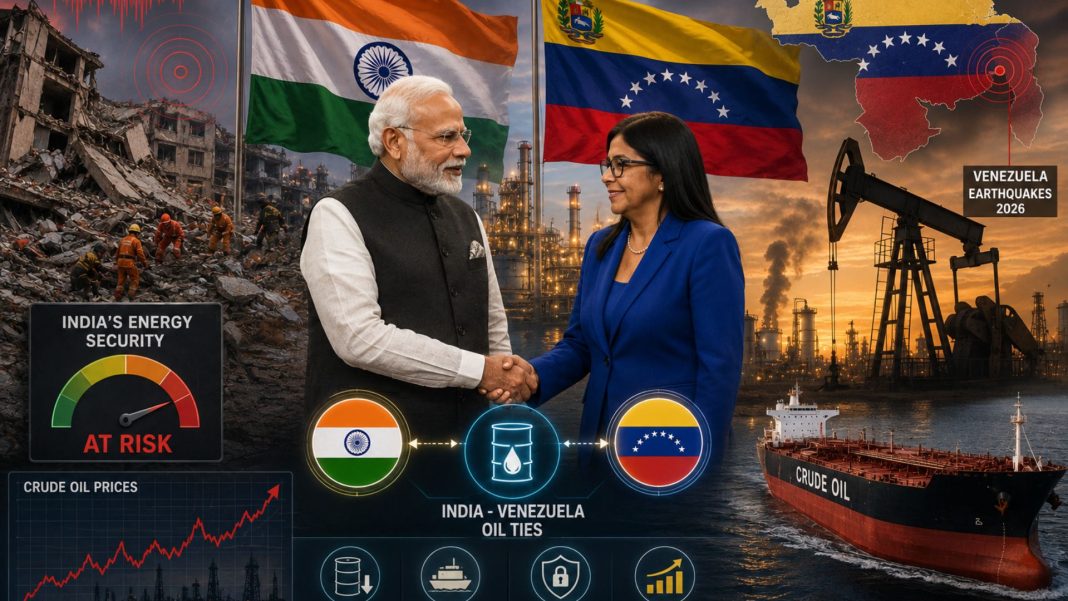

India Venezuela Oil Ties: Global energy markets and geopolitics are currently facing a defining moment. Just three weeks after a historic diplomatic meeting in New Delhi, a catastrophic double earthquake struck Venezuela on June 25, 2026. The timing could not have been more critical.
With the ongoing conflict in the Middle East severely blocking traditional shipping routes, India has heavily leaned on Venezuela to keep its economy running.
Now, as the South American nation grapples with its most powerful seismic disaster since 1900, Indian policymakers, market experts, and everyday consumers are left asking a crucial question: Will this sudden natural disaster derail India’s energy security and drive petrol and diesel prices through the roof?
This comprehensive, research-backed report explores the economic ties, geopolitical high stakes, and real-world impacts of this crisis on the Indian consumer.
The Backstory: The High-Stakes Modi-Rodriguez Summit
India Venezuela Oil Ties: To understand why a natural disaster thousands of miles away matters to India, we have to look back at the high-profile diplomatic visit that took place in early June 2026.
Following a dramatic political transition in Caracas, Venezuela’s Acting President, Delcy Rodríguez, arrived in New Delhi for a five-day official visit. On June 4, 2026, Prime Minister Narendra Modi hosted Rodriguez at Hyderabad House.
The discussions were intense, focused heavily on securing crude oil lines, expanding pharmaceutical trade, and establishing robust cross-border digital payment systems.
Key Focus Areas of the June 2026 Modi-Rodriguez Meeting:
Energy Diversification (Heavy Crude Oil Supply
Strategic Investments in the Orinoco Petroleum Belt
Bilateral Trade and Institutional Continuity
South-South Cooperation via the Global South Framework
For India, this meeting was not just routine diplomacy; it was a desperate race to safeguard its energy sovereignty during an unprecedented global oil crisis.
The Geopolitical Trigger: Why India Turned Westward
India Venezuela Oil Ties: The year 2026 has witnessed extreme volatility in the Middle East. The expansion of the US-Israel-Iran war led to the effective closure of the Strait of Hormuz, the vital maritime choke point that historically handled over 40% of India’s crude oil imports.
Faced with a sudden and massive supply shortfall from the Gulf, India’s Ministry of Petroleum and Natural Gas, led by Minister Hardeep Singh Puri, aggressively pivoted toward Latin America. Venezuela, which sits on the world’s largest proven oil reserves, became India’s primary safety net.
The Dramatic Surge in Oil Trade
India’s sophisticated refining sector is uniquely built to handle the heavy, complex crude oil grades that Venezuela produces. As a result, the import numbers escalated rapidly:
FY 2025-26 Average: India imported just 64 TMT (Thousand Metric Tons) per month from Venezuela.
April–May 2026 Average: This number skyrocketed to 1,047 TMT per month.
Rank Change: Within two months, Venezuela jumped to become India’s third-largest supplier of crude oil, providing roughly 427,000 barrels per day.
The Disaster: Inside Venezuela’s Twin Earthquakes
On June 25, 2026, Venezuela was rocked by two massive earthquakes striking within 39 seconds of each other.
The first, a magnitude 7.2 quake, hit near San Felipe in Yaracuy state.
The second, a devastating magnitude 7.5 quake, struck near Morón in Carabobo state, sending shockwaves as far as the capital city of Caracas.
The Venezuelan government immediately declared a nationwide state of emergency. While the human toll and urban destruction have been severe, the international energy market instantly turned its focus to Venezuela’s oil infrastructure.
MetricDetails of the June 25, 2026 CrisisImpact on Oil InfrastructurePrimary EpicentersYaracuy and Carabobo StatesClose to major northern coastal portsSeismic Magnitude7.5 M_w (Strongest recorded since 1900)Power grids knocked out nationwideHuman Impact32+ casualties, hundreds injuredPort staff and labor operations disruptedRefinery StatusIntact but running on emergency powerTemporary slowdown in oil loading
Ground Check: Is Venezuela’s Oil Infrastructure Damaged?
Historically, whenever a major OPEC or oil-producing nation faces a sudden crisis, panic buying drives global oil prices up. However, an in-depth look at Venezuela’s geography offers some reassurance for India.
The Core Oil Belt Is Safe: Venezuela’s primary oil production occurs in the Orinoco Petroleum Belt, located in the southern and eastern parts of the country. This region is situated hundreds of kilometers away from the northern fault lines where the earthquakes occurred.
Indian Investments Undamaged: Indian state-owned enterprises, including ONGC Videsh, have a $1 billion stake in projects like San Cristóbal and Petrocarabobo-1. Early field assessments indicate that these upstream production fields have suffered no physical damage.
The Shipping Bottleneck: The real vulnerability lies in the northern coastal terminals where oil is loaded onto tankers. While the pipelines are intact, widespread power blackouts mean that loading crude oil onto ships heading for India will experience minor operational delays.
The Million-Dollar Question: Will Petrol and Diesel Prices Spike in India?
The short answer is no. Despite the severity of the earthquake, Indian consumers are highly unlikely to face an increase in fuel prices at local gas stations in the coming weeks.
There are three major reasons why your daily fuel expenses will remain insulated from the Venezuelan earthquake:
A. Global Crude Prices Are Stable
Currently, global crude oil prices are hovering around $75 per barrel. India’s fiscal math and domestic fuel pricing structures are built to withstand shocks up to $84 per barrel. As long as global prices stay below this threshold, Indian Oil Marketing Companies (OMCs) like Indian Oil, HPCL, and BPCL will not feel the financial pressure to hike retail prices.
B. India’s Diversified “Oil Basket”
While Venezuela is an important partner, India does not put all its eggs in one basket. India continues to import massive volumes of discounted crude from Russia and various African nations. This diversified sourcing acts as a cushion; a delay in Venezuelan shipments can be easily compensated for by tapping into other suppliers.
C. Domestic Strategic Petroleum Reserves (SPR)
India maintains large underground strategic oil reserves in locations like Visakhapatnam, Mangaluru, and Padur. These stockpiles hold enough crude to power the nation for several days during a complete global cutoff. A temporary logistical delay at Venezuelan ports will not cause a shortage in India.
Expert Analysis: Turning Crisis into Strategy
Market analysts point out that while the immediate threat to petrol prices is low, this twin crisis (the Middle East war combined with the Venezuela earthquake) serves as a stark warning. To completely protect citizens from global volatility, experts suggest that India needs to move from physical oil storage to financial oil shielding.
The Concept of a “Strategic Pricing Reserve” (SPR)
Economic policy researchers advise the government to build a specialized financial buffer.
When global oil prices drop significantly, the government accumulates unexpected savings.
Instead of exhausting these savings, a portion should be redirected into a Strategic Pricing Reserve Fund.
When natural disasters or foreign wars threaten to push fuel prices up, the government can draw from this financial reserve to subsidize oil companies, ensuring that the price at the pump never changes for the common man.
The Verdict on the Modi-Rodriguez Test
The high-stakes energy partnership established during the Modi-Rodriguez meeting has encountered its first major trial. The natural disaster in Venezuela tested whether India’s new westward energy strategy could survive a sudden, catastrophic shock.
The data proves that India’s energy (diplomacy) has successfully matured. Because the physical oil fields in the Orinoco Belt escaped structural damage, and because India maintains a heavily diversified import portfolio, India’s energy security remains rock-solid.
While Venezuela begins the difficult process of rebuilding its infrastructure, Indian consumers can rest assured that their daily commutes, transport costs, and pockets will remain completely unaffected by the tremors in Caracas.
Also Read : Operation Amistad: India Dispatches IAF Jets, Field Hospital to Earthquake-Hit Venezuela