


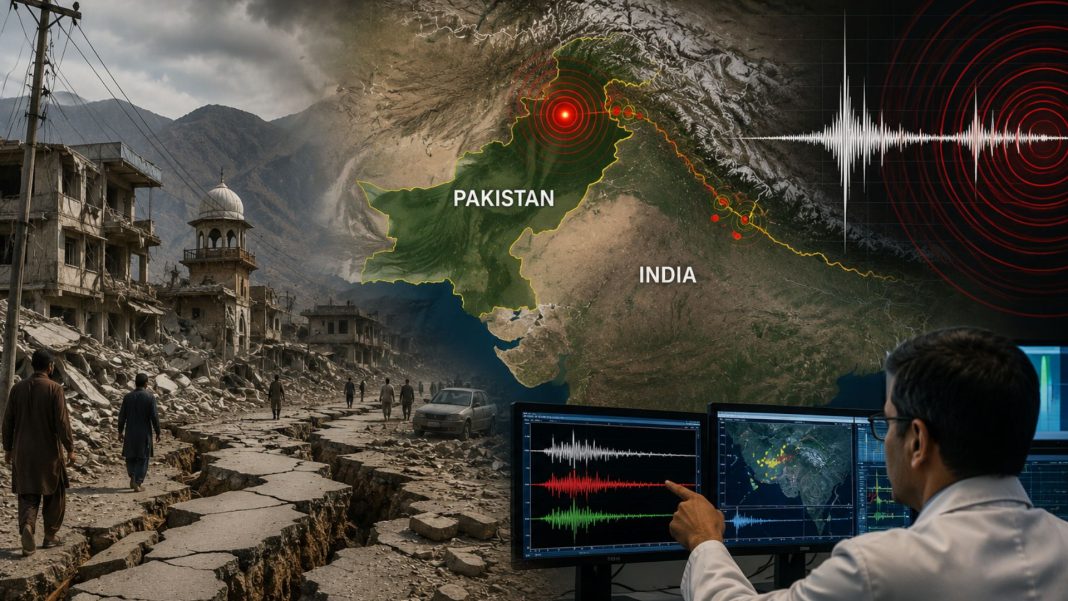

Pakistan Earthquake : In a deeply alarming geological event, neighboring Pakistan has been rocked by two powerful, consecutive earthquakes within a span of just 24 hours. Following a sharp magnitude 5.1 to 5.3 tremor on Friday evening, a second, massive magnitude 5.4 earthquake jolted the nation on Saturday morning, sending shockwaves primarily through the volatile Balochistan region.
These back-to-back quakes have not only triggered mass panic across Pakistan but have also sounded alarm bells among Indian seismologists and geologists.
Why did the earth shake twice in less than 24 hours? More importantly, could this intense tectonic activity cross the border and trigger a major earthquake across India? Let’s dive into a detailed, scientific, and news-driven analysis.
24 Hours, Two Major Quakes: The Latest Statistics
Pakistan Earthquake : According to the European-Mediterranean Seismological Centre (EMSC) and the National Center for Seismology (NCS), Pakistan’s ground has been in a state of constant unrest:
Saturday’s Earthquake: Registered at a magnitude of 5.4 with a depth of 35 kilometers. The epicenter was located near the Barkhan and Kohlu regions of Balochistan.
Friday’s Earthquake: Registered at a magnitude of 5.1 to 5.3 with a deeper focus at 75 kilometers.
The tremors were so strong that they were felt far beyond the epicenter, rattling major cities like Islamabad, Peshawar, Rawalpindi, and Lahore (which sits right on the Indian border).
While no immediate casualties have been reported from this weekend’s “double strike,” the memory of a similar quake last month in Jhelum, which destroyed houses and claimed a life, has left residents terrified.
The Science Behind the Shakes: Why is Pakistan Constantly Trembling?
Pakistan Earthquake : Geographically, Pakistan is located over one of the world’s most dangerous fault lines. Scientifically speaking, the country sits directly at the volatile intersection of three major tectonic plates:
The Indian Plate
The Eurasian Plate
The Arabian Plate
These massive underground rock slabs are constantly moving and grinding against each other. The Indian Plate is relentlessly pushing northward into the Eurasian Plate. As they collide, a massive amount of energy and pressure (stress) builds up in the crust.
When a fault line can no longer hold this stress, it snaps and releases energy in the form of successive earthquakes, which is exactly what is happening in Balochistan right now.
The Big Analysis: How Do These Quakes Impact India?
Pakistan Earthquake : Earthquakes do not stop at political borders. Tectonic pressure building up under Pakistan has direct, serious implications for India. Seismologists point out three main ways these tremors affect the Indian subcontinent:
- The Immediate Border Spillover (Trans-Border Waves)
When a large earthquake hits eastern Pakistan, the seismic waves travel through the ground into northern and western India within seconds. Because Lahore is right next to Punjab, any massive movement in these fault lines instantly shakes high-rise buildings and homes in Punjab, Jammu & Kashmir, Rajasthan, Haryana, and Delhi-NCR. If aftershocks continue to grow in magnitude, a vast portion of northern India will undoubtedly feel the physical vibrations.
- The Danger of “Stress Transfer” to Indian Fault Lines
In earthquake science, there is a proven theory called Coulomb Stress Transfer. When a fault line ruptures and releases its energy in one area (like Balochistan), it doesn’t just make the energy disappear. Instead, that pressure is pushed further down the line onto adjacent, unbroken faults.
The Real Concern: Because the Indian Plate connects both Pakistan and India, the ongoing instability under Pakistan could increase the tectonic stress on India’s highly sensitive Seismic Zone V and Zone IV, which includes the entire Himalayan belt (Jammu & Kashmir, Himachal Pradesh, Uttarakhand) and parts of Gujarat. This could accelerate the timeline for a future major quake within India.
- A Wake-Up Call for India’s Urban Infrastructure
This double earthquake is a severe warning for Indian urban planners and disaster management authorities. Many highly populated regions in northern and western India are built on loose alluvial soil or sit near active fault lines.
This type of soft soil can actually amplify (magnify) seismic waves rather than absorbing them. If a copycat earthquake of a higher magnitude is triggered along the shared plate boundaries, India’s densely populated cities and non-earthquake-resistant high-rises could face catastrophic structural damage.
Is it Time to Panic?
The back-to-back earthquakes in Pakistan are a clear sign that the tectonic plates beneath South Asia are highly active right now. While there is no need for immediate panic, this serves as a critical scientific warning. India cannot afford to treat this as just “neighboring news.” It is an urgent reminder for the Indian government and disaster management teams to strictly enforce earthquake-resistant building codes and prepare the country for any future seismic shifts.
Also Read : British Museum Stolen Treasures: 5 Stolen Treasures From Around the World That the UK Refuses to Return