


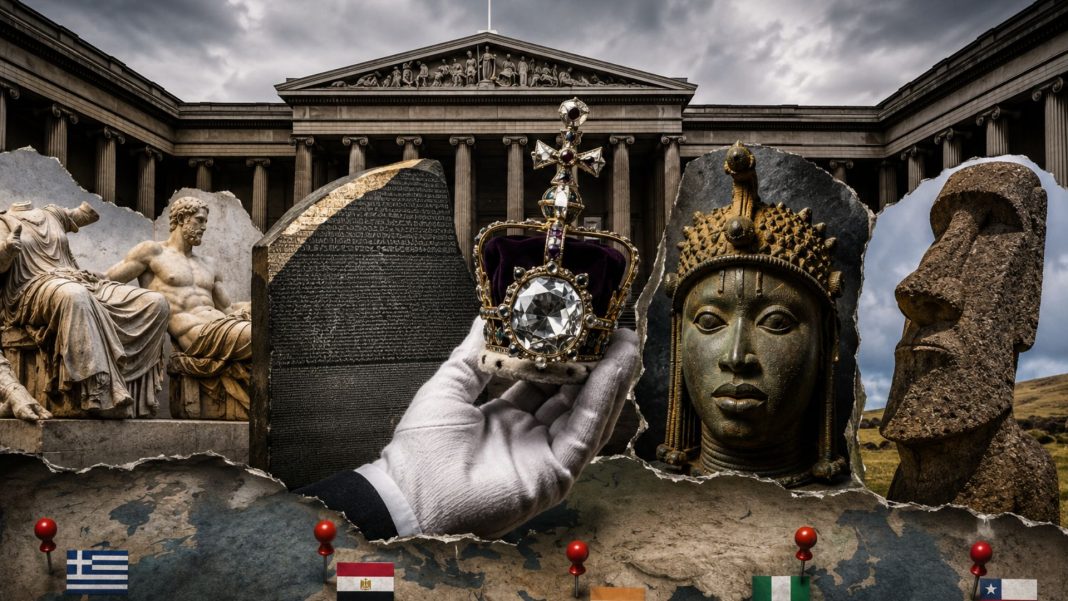

British Museum Stolen Treasures: Step inside the majestic halls of the British Museum today, and you are surrounded by some of the greatest cultural achievements in human history.
But behind the polished glass cases and pristine museum labels lies a dark, uncomfortable truth: many of these world-class treasures were never gifted, never bought, and never voluntarily handed over.
They were taken, often at gunpoint or through colonial coercion, from nations that have spent decades pleading for their return.
As global calls for historical justice grow louder, the fundamental debate surrounding the world’s most famous museum has radically shifted. The real question is no longer how these artifacts arrived in London.
The question is why, after centuries of pleading from their rightful owners, the British Museum still refuses to give them back.
The Catalogue of Loot: Five Treasures Held Hostage
British Museum Stolen Treasures: The sheer scale of contested heritage inside the institution spans continents, centuries, and empires. Among the thousands of disputed items, five iconic treasures stand at the center of this bitter international tug-of-war:
The Koh-i-Noor Diamond: Once the pride of India, this legendary gemstone was pried away from a heartbroken, ten-year-old Maharaja under colonial duress and forced into British hands.
The Parthenon Sculptures: Stripped directly from the ancient walls of Greece’s iconic temple by Lord Elgin in the early 1800s, these classical marbles remain a deep diplomatic wound between Athens and London.
The Benin Bronzes: Thousands of priceless, intricate brass plaques and sculptures that were violently looted during a bloody British military raid on Nigeria in 1897.
The Hoa Hakananai’a: A deeply sacred ancestral statue carried off from Easter Island (Rapa Nui), leaving a community spiritually fractured.
The Ashanti Royal Gold: Sacred regalia and gold weights seized by imperial troops from the historic Kingdom of Ghana.
The Great Wall of Denial: Why Won’t the UK Give Them Back?
British Museum Stolen Treasures: For decades, the British Museum and the UK government have deployed a series of legal and cultural excuses to justify keeping their colonial haul.
- The Legal Shield: The British Museum Act of 1963
The museum’s ultimate defense is a literal law. Under the British Museum Act of 1963, the institution is legally forbidden from “deaccessioning” (giving away) items in its collection unless they are duplicates or physically ruined. Whenever foreign governments demand their heritage back, the museum trustees simply point to the law and claim their hands are tied.
- The ‘Universal Museum’ Defense
Museum officials have long argued that by keeping these artifacts in London, they are preserving them for a global audience. They claim that the British Museum acts as a “universal museum” where anyone from around the world can see the collective history of humanity under one roof, free of charge.
“Only allowing a country to ‘borrow’ its own culture and history is outdated and shameful,” argues a recent UK parliamentary petition calling for a change to the law. “We should be working to put our own history in our museums rather than hoarding the history of others.”
News Analysis: The Changing Tides of Cultural Justice
The ground beneath the British Museum is rapidly shifting. Critics point out that the “universal museum” defense is collapsing under the weight of modern hypocrisy.
The owners of these treasures know exactly where their heritage sits. They can see it online, locked behind glass in a foreign country, while their own citizens face strict visa regimes just to travel to London to look at their own ancestors’ creations.
Furthermore, other western institutions are beginning to break the silence:
In a landmark move, universities and smaller museums across the UK and Europe have begun bypassed national restrictions to return ownership of Benin Bronzes to Nigeria.
Germany and France have recently returned hundreds of colonial-era artifacts to African nations.
Even the Vatican recently returned its fragments of the Parthenon back to Greece.
Yet, the British Museum remains one of the final holdouts of imperial hoarding. While it has recently engaged in soft diplomatic talks, such as proposing “temporary loans” or “cultural partnerships” with Greece, it steadfastly refuses to transfer official legal ownership.
A Challenging Future: Hope and the Road Ahead
The era of empires is long gone, but the physical remnants of its plunder remain proudly on display in the heart of London, polished and presented as if they always belonged there.
As international pressure mounts from Asia, Africa, and Europe, the British Museum’s current stance is becoming morally unsustainable.
True decolonization cannot happen through clever museum labeling or temporary loans. Until the UK government amends its outdated laws and returns these stolen treasures to the soils they were born in, the British Museum will continue to be viewed by the world not as a temple of culture, but as a monument to unresolved history.
Also Read : Venezuela Earthquake : Fresh 4.9-Magnitude Tremor Hits, Death Toll Reaches 920, Over 51,000 Missing